Guide
How to revise with ChatGPT (without losing marks)
ChatGPT can be a great revision tool, but only if you know how to ask and what to double-check. Here are the prompts that work and the traps that quietly cost marks.

Founder, Aicademy
10 min read
You ask ChatGPT to quiz you, and it gives you ten questions with the answers printed underneath. You ask it to mark your essay, and it tells you it is great, every time. You point out a mistake, it apologises, then gives you a different wrong answer. So you add more rules: stop giving me the answers, only use my notes, keep it short. Somehow it gets worse, and you end up closing the tab and starting a fresh chat.
I saw the same thing all through university. Someone would ask something vague, get a generic answer back, and decide ChatGPT was useless, when really it had nothing to go on: no exam board, no level, no idea what they already knew. That is what got me properly into prompting.
Now I build an AI study tool, Aicademy, so I spend a lot of time watching language models get things wrong. Most of the time the fix is not a better model. It is a better prompt, and knowing which answers to double-check. Here is what I would tell anyone revising with it.
The short answer
ChatGPT is only as good as what it knows about you and your course. When it does not know, it guesses. So before you ask for anything, give it three things:
- Your course. Exam board, subject, spec code and level, so it answers for the exam you are actually sitting.
- How you like to learn. Short and simple, detailed with examples, step by step, or questions to test yourself. Tell it which.
- The real material. Your specification, class slides, handouts, past-paper questions or your own notes. It is on much safer ground working from these than from memory.
Then check anything you are going to learn word for word, like quotations, named studies and formulae, against the source.
Four revision jobs ChatGPT genuinely does well
1. Explaining something you are stuck on
The trick is to tell it what you already understand, so it starts from the right place instead of from the beginning of the topic. Give it the board and the level too, or you will get an undergraduate answer to a GCSE question.
I'm revising AQA GCSE Chemistry 8462, Higher tier. Explain why increasing the temperature increases the rate of a reaction, using collision theory. I already understand that particles move faster when heated, but not why that changes the rate. Keep it under 150 words, then ask me one question to check I followed it.
The word limit matters more than it looks. Without one, you tend to get everything it knows about the topic, tangents included. With one, it has to stick to the part you asked about. The question at the end is a quick way to check it actually made sense to you.
2. Quizzing you, one question at a time
This is the single best use of it, and a lot of people do it wrong by asking for ten questions and getting ten questions with ten answers underneath. You need it to stop and wait.
Quiz me on AQA GCSE Chemistry 8462, rates of reaction, Higher tier. Ask one question at a time and wait for my answer before the next one. Don't give me the answer until I've replied. After each one, tell me what a strong answer would include and what I missed. Ten questions, mixed recall and application.
That is retrieval practice, one of the best-evidenced ways to actually remember things, and ChatGPT can give it to you on demand. If you want the theory behind why this works better than re-reading, we go through it in active recall and spaced repetition.
If you would rather not write the prompt, ChatGPT’s Study Mode does a version of this for you: it asks you questions and checks your understanding instead of handing over answers. It is free when you are logged in. Select the + next to the message box and choose Study.
3. Turning your study material into questions
When ChatGPT works from your own material instead of its memory, it has much less room to make things up, because it is reshaping what you gave it rather than recalling facts. Paste in your notes, upload your class slides or handouts, or take a photo of a page. Then tell it to use only what you gave it, and to say if something is missing rather than adding facts of its own.
Here are my class slides on Attachment for AQA A-level Psychology 7182. Turn them into 15 question-and-answer pairs I can use as flashcards. Use only what's in the slides. If something is unclear or missing, say so instead of filling the gap from your own knowledge.
4. Planning a week you will actually follow
ChatGPT is good at this because a revision plan is mostly fitting topics into the time you have, and you can keep asking it to change the plan until it works for you. Give it the hours you will really have, not the hours you wish you had.
I have 5 weeks until AQA A-level Psychology 7182 Paper 1. I'm confident on Social Influence, shaky on Attachment, weak on Psychopathology. I can do 45 minutes on weeknights and two hours on Saturday. Build a week-by-week plan that comes back to each topic at least twice, spends most time on the weak one, and leaves the last week for past papers.
If you would rather have a timetable you can print and stick on a wall, we made a free revision timetable builder for GCSE and A-level.
If you want more ideas for how to use it, OpenAI has a page of ways students use ChatGPT to study, like getting it to act as a classmate you explain a topic to, having it explain one idea at three different levels, or talking through your slides one at a time. Each one comes with an example prompt you can change to fit your own needs.
The traps that cost marks
Sometimes ChatGPT simply makes things up. This is called a hallucination, and it happens because the model is built to predict what text comes next, not to look something up and check it. The real problem is that a made-up answer sounds just as sure as a real one, so you cannot tell from the answer itself.
Researchers from Washington State University and three other universities asked ChatGPT whether 719 findings from published research held up, ten times each. They found:
- In more than a quarter of cases, at least one of the ten answers was wrong, so the same question could come back right once and wrong the next.
- When a finding was actually false, it still said it was true most of the time.
Treat everything below as places to look twice, not as reasons to avoid it.
It can make things up
A quotation that sounds right is the easiest thing for it to produce. Ask for a line from An Inspector Calls or Macbeth and you can get any of four things.
- The real line.
- A paraphrase presented as a quotation.
- A real line given to the wrong character.
- Two lines merged into one.
Named studies, like the ones in Psychology, are no safer: the researcher, year or finding can be wrong. Many subjects reward accurate detail, so check the quote in the text, or the study in your textbook, before you learn it.
Careful with references. Ask ChatGPT for sources for an essay or coursework and it can make up books and articles that do not exist. Look up every one before you cite it.
It will be kind about your essay
Ask if your essay is good and you will get encouragement. Models are trained to be agreeable, which is reasonable in an assistant and useless in a marker. But tell it to be brutally honest and it swings the other way, finding something wrong every time you ask, however good the essay gets.
So instead of asking how good it is, give it specific things to check:
- What is missing.
- What is asserted without evidence.
- Where the argument does not answer the question as set.
Those checks are sharper when it has something to measure against. If you are practising an exam question, paste in the real mark scheme from your board’s website along with your answer:
Here is a question from AQA GCSE English Literature 8702, the mark scheme for it, and my answer. Using only this mark scheme, tell me what is missing, what I've claimed without evidence, and where I haven't answered the question as set. [paste the question, the mark scheme and your answer]
And if all you want is a proofread, that is the safe job to hand it. It is very good at catching spelling, grammar and punctuation mistakes.
It can get maths wrong
The working can look perfect with one wrong step in the middle. In a question with several steps, one small slip carries through to the final answer, and that answer still sounds right. The same goes for calculations in science.
A 2025 study of nearly 1,000 high school students practising maths with GPT-4 found that:
- It got about half the problems wrong.
- Students who mostly asked it for answers did better in practice, but 17% worse in the exam once it was taken away.
- Students given a version that offered hints instead of answers did just as well in the exam as students who never used it.
Newer models like GPT-5 are much better at maths, but they can still slip, so do not just take the final answer:
- Ask it to show its working step by step, and check each step yourself.
- When you are stuck, ask for a hint towards the next step, not the answer.
How to check what it tells you
You do not need to verify everything. You need to verify the things that would be expensive to be wrong about, and there are three:
- Anything you will memorise. Quotations, dates, named studies, definitions and formulae. Check them against the text, your textbook or your board’s formula sheet before they go into your flashcards.
- Anything about the exam itself. Mark allocations, paper timings and whether a topic is on your spec. Your board publishes the specification, past papers and mark schemes on its website, though the most recent papers can take months to appear.
- Any answer to a calculation. Work it out yourself and compare, or check it against a worked example in your textbook.
A quick habit that makes this quicker: ask it to flag its own uncertainty. “Mark anything you are not confident about, and say which parts I should check against the spec” will not make it reliable, but it does surface the shakiest claims for you to look at first, which is a better use of your time than checking the things it got obviously right.
“Are you sure?” A 2026 University of Arizona study kept challenging seven chatbots like this over long conversations, and they flipped between agreeing and disagreeing with the same false statement from one reply to the next. Whatever it says back tells you nothing, so check against the source instead.
Where it is not the right tool at all
Two jobs where you should close the tab.
- Timed practice. The point is working on your own against the clock, the way you will in the exam, so use a real past paper and a timer.
- Examiner reports. These are where examiners explain what the best answers did and where students lost marks. Read the real ones rather than a version ChatGPT has pieced together.
One thing that catches people out: if you paste a revision site’s notes into ChatGPT to be quizzed on them, check that site’s terms first. Save My Exams, for one, does not allow its content to be put into any AI system. Notes you wrote yourself are fine.
Using it honestly
Revising with ChatGPT is not cheating. Asking it to explain photosynthesis is no different from asking a tutor, so there is no need to feel guilty about it.
Where it can become cheating is coursework, like NEA (non-exam assessment), which is work done during the course that counts towards your final grade. JCQ, which sets the exam rules the main boards follow, says in its guidance on AI use in assessments that:
- your work must be your own
- any AI-generated content must be acknowledged with the tool name and the date
- unacknowledged AI-generated sections cannot be awarded marks
Your school must have its own policy too, so read it before you start any coursework. And the self-interested reason to stick to these rules is simple: work you didn’t do teaches you nothing, and you still have to sit the exam.
What ChatGPT costs
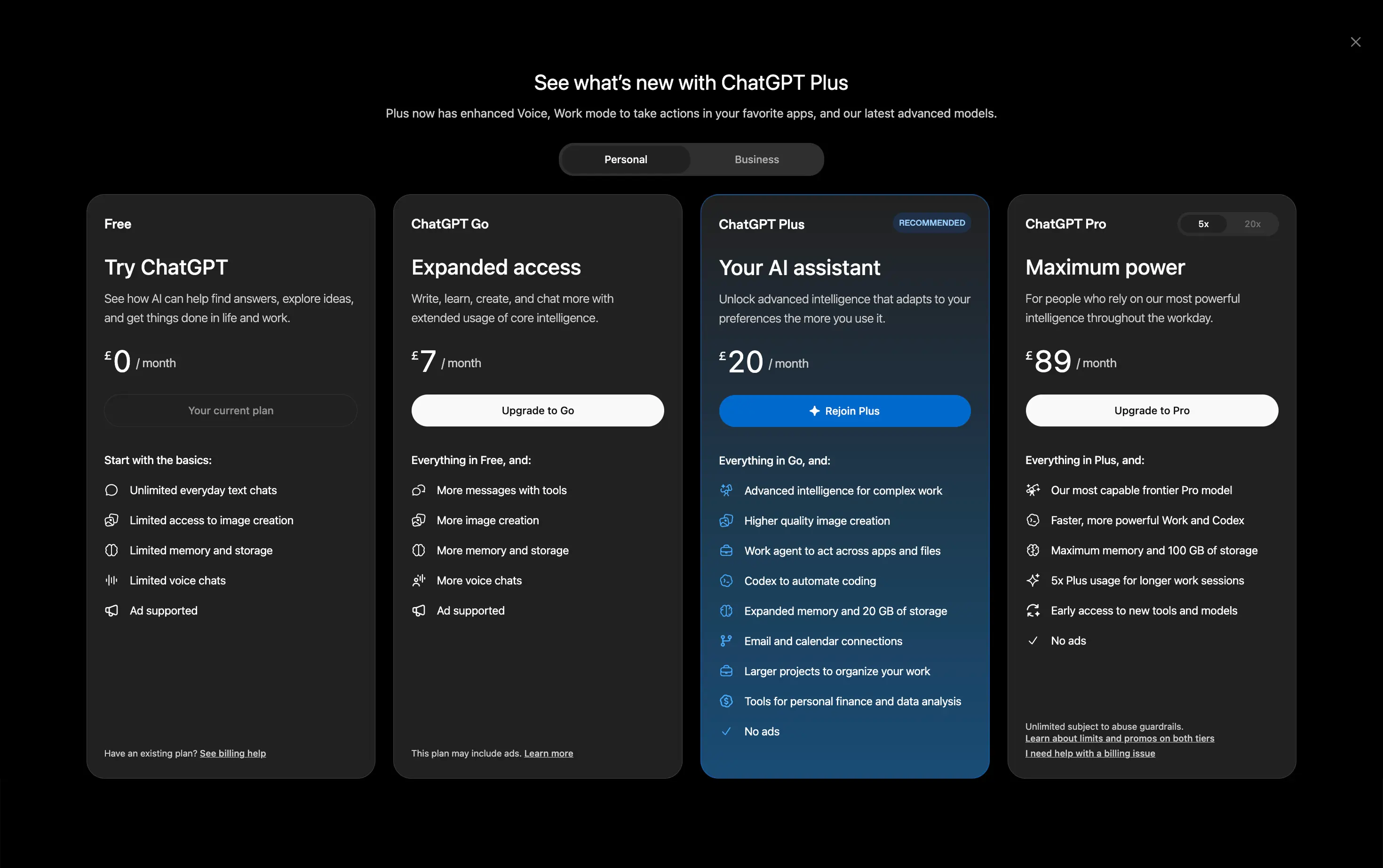
As of September 2026, OpenAI’s UK pricing has these personal tiers:
- Free, £0: limited file uploads, image creation, memory and voice chats, and has ads.
- ChatGPT Go, £7 a month: higher limits than Free, but still has ads.
- Plus, £20 a month: the first tier without ads.
There is also Pro at £89 a month, but that is built for all-day work rather than revision.
For how that compares with revision sites, see what UK revision sites cost.
If ChatGPT is not working for you
Everything above works, but it depends on writing a good prompt every time and keeping the useful parts somewhere you will come back to. The quiz you did last week ends up somewhere in your chat history, rather than back in front of you when you are due to review it.
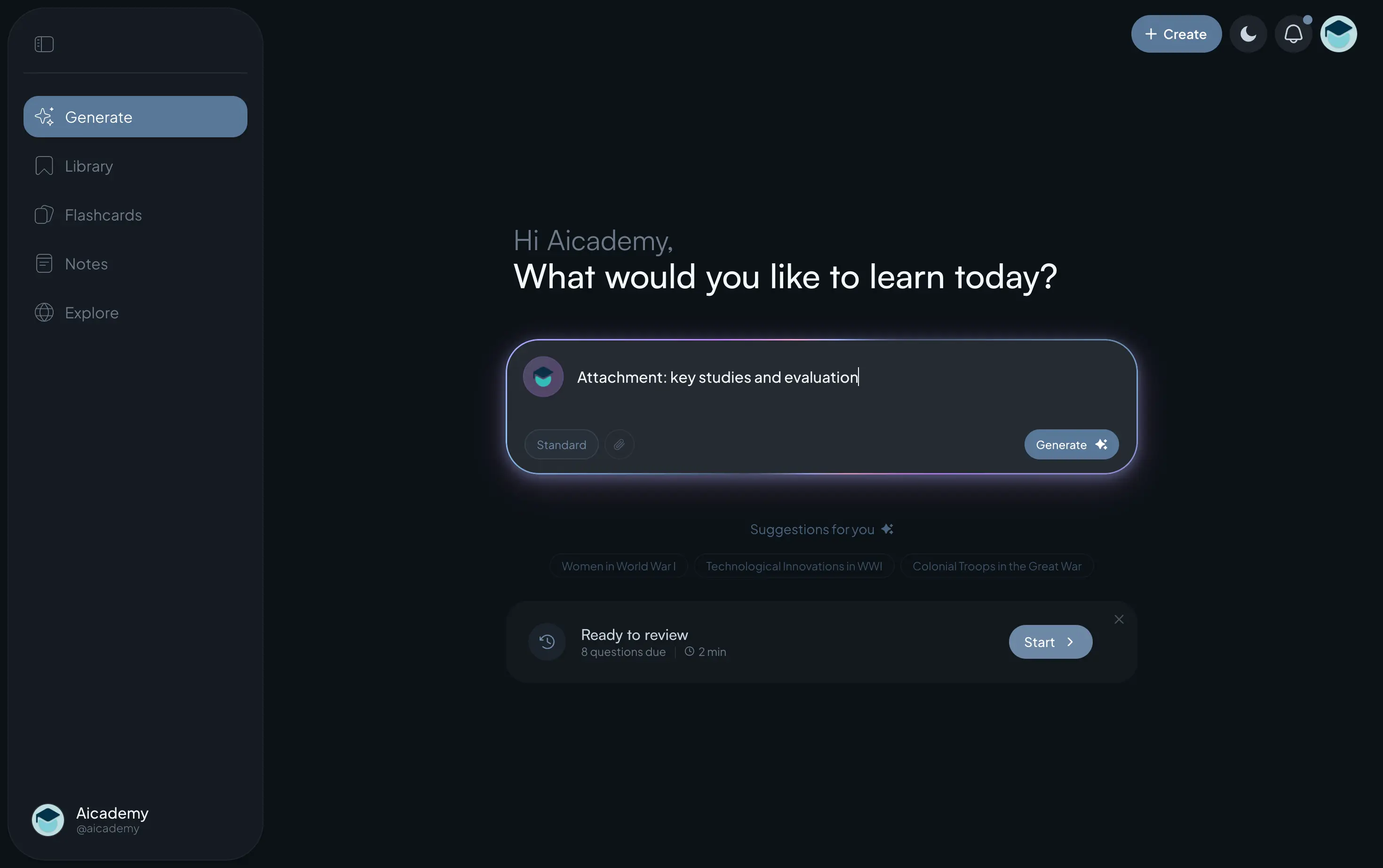
Aicademy runs on OpenAI models, GPT-5 and GPT-4o through Microsoft Azure, built into a study workspace instead of a chat box, so there is no prompt to write. Enter a topic or upload your class notes and it builds a learning path to work through, with lessons, quizzes and flashcards along the way, and a built-in tutor for follow-up questions. Everything it makes is saved, and your flashcards come back on a spaced-repetition schedule.
- Free: a lesson library covering GCSE and A-level subjects across AQA, Edexcel and OCR, readable without an account. A free account adds 10 creation credits a month and 10 tutor messages a day.
- Pro, £9.99 a month, or £5.00 a month billed annually: unlimited creation and tutor messages.
For a side-by-side, see Aicademy vs ChatGPT.
I built Aicademy because I kept seeing people run into exactly these problems, and I would love for you to check it out. But you do not need it to get good answers. ChatGPT runs on the same kind of models, and with the right prompts it works really well for revision, which is why I wrote this guide. Keeping each subject in its own project helps too, so your chats and files for it stay in one place. Everything here comes from how these models work, and every study is linked in the sources below so you can check it yourself.
Frequently asked questions
Start by giving it three things: your course (exam board, subject, spec code and level), how you like to learn, and your study material. Then use it to explain topics you are stuck on, quiz you one question at a time, turn your material into flashcards and plan your revision week. Check anything factual against your textbook or specification before you learn it.
It is reliable for explaining and for generating practice, but not as a source of truth. Wrong answers sound just as confident as right ones, so you cannot tell them apart. It can make up quotes, studies and references, and slip on multi-step maths, so check anything you plan to learn against your textbook or the original source.
For understanding things, yes, genuinely. It will explain the same idea five different ways until one lands, and answer the follow-up question you would not want to ask in class. Understanding is only the first half, though: to remember it in the exam, test yourself on it again over the following weeks, with flashcards or past-paper questions.
Not reliably. Ask whether an essay is good and it tends to be encouraging, but tell it to be brutally honest and it finds fault every time. Ask for specific checks instead: what is missing, what is claimed without evidence, and where you have not answered the question. For an exam answer, paste in the real mark scheme too. It is very good at proofreading spelling, grammar and punctuation.
The ones that tell it about your course, how you like to learn and what material to work from, and that set a limit. 'Quiz me on AQA GCSE Chemistry 8462 rates of reaction, Higher tier, one question at a time' gets you questions at the right level on the right content. 'Quiz me on chemistry' gets you a generic list you will read rather than answer.
Revising with ChatGPT is not cheating. Submitting its words as your own is. For coursework that counts towards a qualification, JCQ rules say AI-generated content must be acknowledged, and unacknowledged AI-generated sections cannot be awarded marks. Your school will have its own policy too.
Yes, but with limits on file uploads, image creation, memory and voice chats, and it has ads. Study Mode is included. ChatGPT Go at £7 a month raises those limits but still has ads, and Plus at £20 a month is the first tier without them. Prices are from OpenAI's UK pricing page, checked in September 2026.
Sources
- JCQ — AI Use in Assessments: your role in protecting the integrity of qualifications (jcq.org.uk)
- OpenAI — ChatGPT pricing (openai.com)
- OpenAI — Study mode in ChatGPT (chatgpt.com)
- AQA — subject specifications and past papers (aqa.org.uk)
- Cicek (Washington State University), Ulu, Uslay and Karniouchina — Unstable Intelligence: GenAI Struggles with Accuracy and Consistency, Rutgers Business Review (2026)
- Rodriguez et al. (University of Arizona) — Fallibility, persuadability, and correctability of large language models under sustained conversational misinformation pressure, Scientific Reports (2026)
- Bastani et al. — Generative AI without guardrails can harm learning: Evidence from high school mathematics, PNAS (2025)
- Save My Exams — Terms of Service (savemyexams.com)
Prices and features were checked as of the date shown and can change. Where a figure could not be confirmed from a primary source, we say so in the text.
Founder, Aicademy
Diba is the founder of Aicademy and a first-class Computer Science graduate from the University of Birmingham. She writes about AI in education and how students actually learn.
Disclosure: Aicademy is the study app made by the team that publishes this blog. We compare it fairly against other tools and cite our sources so you can check everything yourself.
Keep reading
Is ChatGPT good for studying?
Where ChatGPT genuinely helps you study, where the evidence says it can backfire, and how to use it without hurting your own recall.
The 6 best ChatGPT alternatives for students in 2026
The best ChatGPT alternatives for students in 2026: AI study tools that save lessons, schedule revision and align to your exams, compared on price.
Active recall and spaced repetition: the study methods that actually work
Why re-reading fails, and how active recall and spaced repetition — the two most evidence-backed study methods — turn revision into long-term memory.
Study with more than flashcards
Aicademy generates personalised lessons, quizzes and flashcards from any topic or your own notes, with spaced-repetition revision and an AI tutor.
Lessons on anything
Structured, level-matched lessons on any topic you study
Practice quizzes
Find out what you actually know before the exam does
Flashcard sets
Lock in key concepts with instant revision cards
Ask Aica
Stuck on something? Get a clear explanation, any time
Upgrade to Pro whenever you're ready