Guide
How to make a GCSE revision timetable that actually works
Most revision timetables are pretty, rigid and abandoned by week two. Here is how to build one you will actually stick to, plus a free maker that does it for you.

Study content creator, Aicademy contributor
9 min read
Almost everyone makes the same revision timetable: a beautiful, colour-coded grid with every hour blocked out, made on a Sunday afternoon and quietly ignored by Tuesday. It looks like progress, but the making of it is often the last time it gets used. A timetable that actually works is the opposite: plain, a little flexible, and built around when you will forget things, not just when you are free.
This guide covers how to build one you will genuinely stick to, and there is a free maker below that does the fiddly part for you. Either way, the principles are the same, and they are the ones with real evidence behind them, not just “work hard and take breaks”.
Make your timetable in a minute
Add your subjects, mark the ones you find hardest, and tell it how much time you have. It weights your weak subjects, mixes topics up so you are not doing one subject all day, and protects time for reviewing old work and catching up. Download the full-page PDF, no account needed.
Free tool
Build your revision timetable
Add your subjects, tap a subject to mark how strong you are, and set how much time you have. Your plan leans into weak subjects, mixes topics up, and keeps space for review and catching up. Download a full-page PDF, no account needed.
Your subjects (tap the pill to set Weak/OK/Strong)
Sessions per weekday
Sessions per weekend day
(Sessions are ~40 min with a short break after each)
Your weekly plan
Add the exact topic or task by hand after you download it.
| Session | Monday | Tuesday | Wednesday | Thursday | Friday | Saturday | Sunday |
|---|---|---|---|---|---|---|---|
| 1about 40 min | Maths Topic / task | Biology Topic / task | Chemistry Topic / task | History Topic / task | Biology Topic / task | Chemistry Topic / task | History Topic / task |
| 2about 40 min | English Language Topic / task | ReviewQuiz an older topic | Physics Topic / task | Maths Topic / task | English Language Topic / task | Physics Topic / task | Maths Topic / task |
| 3about 40 min | Rest | Rest | Rest | Rest | Rest | Catch-upUse this when plans change | ReviewQuiz an older topic |
Weak subjects get more slots. Subjects are mixed up so you are not doing one all day. Review brings back older topics, while Catch-up stops one busy day from breaking the week.
How to make a timetable that sticks
If you would rather build your own, or just want to understand what the maker is doing, here is the whole method in five steps.
- List every subject, and the topics in each. You cannot plan around a subject you have not broken down. A rough topic list per subject also stops you “revising biology” vaguely for three hours and instead points you at, say, the required practicals.
- Be honest about your weak spots. The fastest way to raise a grade is time on the topics you are worst at, not another pass over the ones you already know. Give weak subjects and topics more slots. It is less comfortable, which is exactly why it works.
- Block short sessions, not marathons. Work in 25 to 45 minute blocks with real breaks between them. Long unbroken sessions feel productive but your attention and recall fall off a cliff after about 45 minutes.
- Mix subjects up (interleave). Do not spend a whole day on one subject. Switching between a few subjects or topics in a session is harder in the moment but improves how well you can tell them apart in the exam. Two or three subjects a day is a good rule.
- Leave slack, and plan downtime. Protect a slot for catch-up, so one bad day does not wreck the whole grid, and put rest in on purpose. Time to see friends and switch off is part of the plan, not a failure of it.
A realistic weekly example
Here is what a sensible school-week evening looks like for a student revising around lessons, roughly two to three hours a day:
- Session 1 (35 min): your weakest subject, active recall, close the book and test yourself.
- Break (10 min): away from your desk, off your phone.
- Session 2 (35 min): a different subject, a past-paper question or a set of practice problems, marked against the mark scheme.
- Break (10 min).
- Session 3 (25 min): flashcards, mixing today’s topics with a few older ones that are due for review.
Weekends get an extra session, and one slot each week is protected for whatever you fell behind on. Notice there is no ten-hour day in there. Consistency across the week beats a heroic Sunday you cannot repeat.
Build in spaced repetition (the bit most timetables miss)
This is where nearly every revision timetable goes wrong. Most plans treat revision like a checklist: cover each topic once, tick it off, move on. But you forget most of what you revise within a few days unless you come back to it. A good timetable does not just schedule when you first revise a topic, it schedules when you return to it.
In practice that means a short review slot every few days that revisits older topics, not only new ones. Testing yourself on a topic again just as you are about to forget it is what moves it into long-term memory, and it is the single biggest upgrade you can make to a timetable. We go deeper on the science in active recall and spaced repetition, and on turning topics into review-ready cards in how to make flashcards that work.
Common mistakes to avoid
- Spending longer making it than using it. A plain grid you use beats a work of art you abandon. Ten minutes, not a whole afternoon.
- Filling every hour. A timetable with no slack is a timetable you will break on the first busy evening. Protect catch-up time.
- Revising what you already know. It feels good and achieves little. Weight the plan towards weak topics.
- Only re-reading. If your sessions are “read notes”, the timetable will not help much. Every slot should be active: test yourself, do questions, use flashcards.
- No breaks or no rest. Burnout in April helps nobody. Breaks and downtime are part of the method.
How far ahead, and how many hours?
Start a focused exam timetable around eight to ten weeks before your first paper, usually just after February half-term, so you have room to space topics out. Before that, a lighter weekly plan that just reviews finished topics works from the start of Year 11. On school days, two to three genuinely focused hours is plenty; a bit more at weekends. If you are testing yourself properly, you do not need marathon days, and they rarely help.
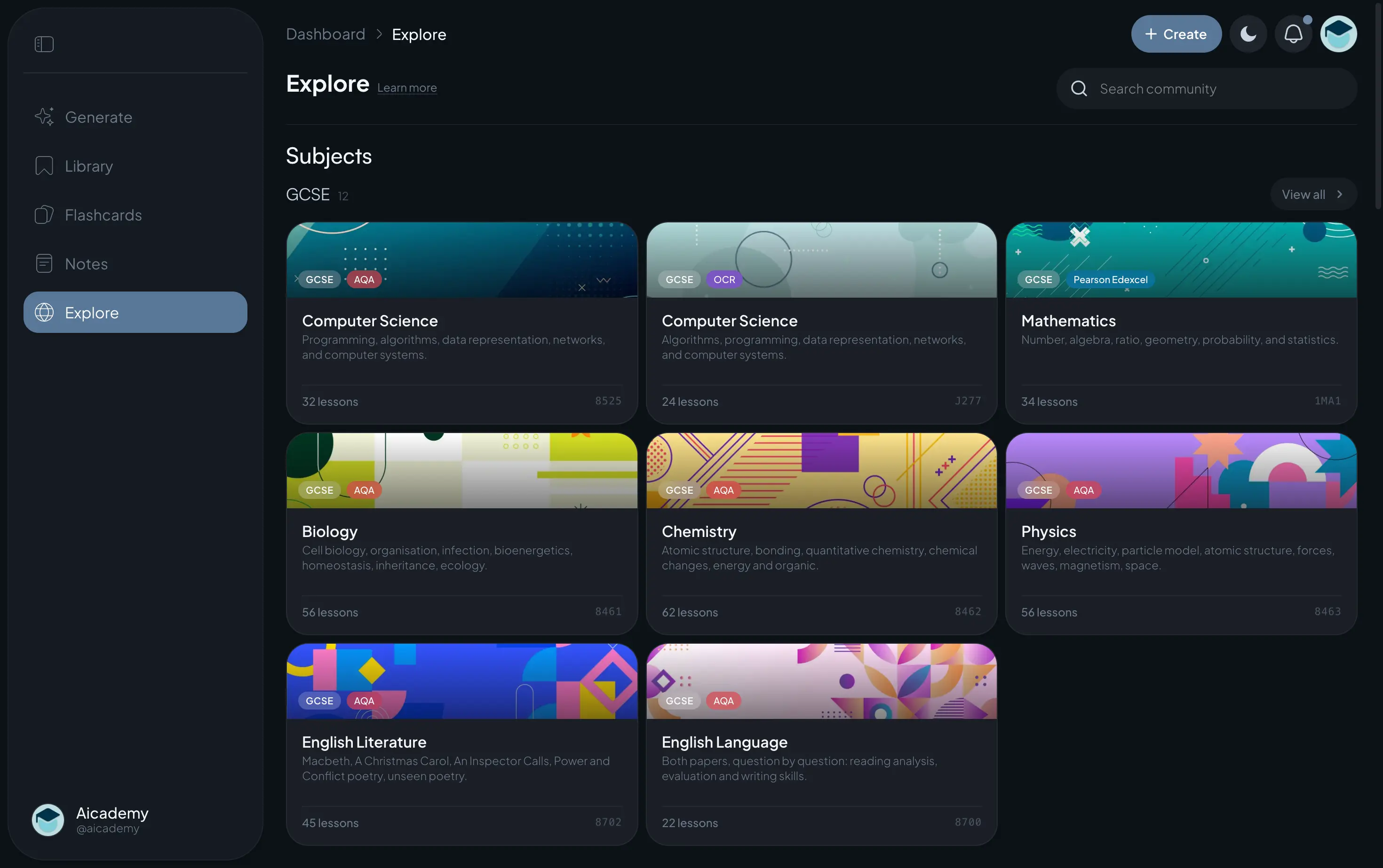
Once your plan points you at the right topics, the sessions themselves are what matter. Aicademy can turn any slot on your timetable into a lesson, a quiz or a set of spaced-repetition flashcards on that exact topic, so “revise osmosis” becomes something you actually do rather than stare at. It is free to start, and your material is saved so your review slots have something to review.
Frequently asked questions
List every subject and the topics in each, be honest about which you are weakest at, then block your available time into short sessions, giving the weak topics more slots. Mix subjects up rather than doing one all day, build in breaks, and protect a catch-up slot so a bad day does not break the whole plan. The free maker on this page does all of that for you in about a minute.
Quality matters far more than hours. In the exam term, two to three focused hours on a school day and a bit more at weekends is plenty for most students, as long as it is active revision (testing yourself) rather than re-reading. Work in short blocks of 25 to 45 minutes with real breaks; long unbroken sessions look productive but retain less.
For focused exam revision, most students do best starting around eight to ten weeks before the first paper, which usually means shortly after February half-term. Starting earlier lets you space topics out, which is what makes them stick. Before that, a lighter weekly timetable that just reviews finished topics works well from the start of Year 11.
Your subjects weighted by how weak you are at them, short sessions with breaks, a mix of subjects each day rather than one at a time, and, crucially, regular review slots so you come back to topics before you forget them. It should also include downtime: rest is part of the plan, not a failure of it.
Keep it realistic and flexible. The two things that break timetables are making them too ambitious (ten-hour days you cannot sustain) and too rigid (one missed session and the whole grid feels ruined). Protect catch-up time, plan downtime in, and review the plan weekly rather than treating it as fixed. A timetable is a tool, not a test.
Yes, if it is a simple, flexible plan you use, rather than a colourful grid you make once and abandon. Its real value is removing the daily 'what should I even revise?' decision and making sure weak subjects and older topics get time, instead of you drifting to whatever feels easiest. The plan is only worth the paper it is on if it points you at active revision.
Sources
- Dunlosky et al. (2013), Improving Students' Learning With Effective Learning Techniques (SAGE)
- The Learning Scientists — spaced practice and interleaving
- Education Endowment Foundation — revision and metacognition guidance
Prices and features were checked as of the date shown and can change. Where a figure could not be confirmed from a primary source, we say so in the text.
Study content creator, Aicademy contributor
Kieran, known online as @sturdythoughts, is a study and productivity creator with a large student following. He shares practical advice on study habits, focus and revision.
Disclosure: Aicademy is the study app made by the team that publishes this blog. We compare it fairly against other tools and cite our sources so you can check everything yourself.
Keep reading
How to revise for GCSEs: a method that actually works
Evidence-based GCSE revision: retrieval practice, spaced repetition and past papers, turned into a simple weekly plan that actually sticks.
Active recall and spaced repetition: the study methods that actually work
Why re-reading fails, and how active recall and spaced repetition — the two most evidence-backed study methods — turn revision into long-term memory.
How to make flashcards that actually work
Why most flashcards don't work, how to write ones that do, and how spaced repetition turns them into long-term memory.
Study with more than flashcards
Aicademy generates personalised lessons, quizzes and flashcards from any topic or your own notes, with spaced-repetition revision and an AI tutor.
Lessons on anything
Structured, level-matched lessons on any topic you study
Practice quizzes
Find out what you actually know before the exam does
Flashcard sets
Lock in key concepts with instant revision cards
Ask Aica
Stuck on something? Get a clear explanation, any time
Upgrade to Pro whenever you're ready