Guide
How to make an A-level revision timetable that works
Build a week around your subjects in about a minute, then work out what goes in each slot, how to use your free periods, and what to do when you fall behind.

Study content creator, Aicademy contributor
10 min read
Three subjects, a handful of free periods, and somehow less gets done than it did at GCSE. The slot says “revise Biology”, which is not really a task, so you read your notes for forty minutes and count it. Meanwhile the essay you meant to plan is still not planned and Friday’s free period went the way of every other one.
A timetable helps, but only if the slots say what to do rather than which subject to feel guilty about. This guide covers what to put in them, how to stop losing free periods, and what to do when you fall behind. There is also a timetable maker below that builds a week around your subjects in about a minute.
Build yours now
Add your subjects, tap each one to mark how strong you feel, and set how many sessions you can realistically do. It weights your weakest subject, mixes subjects across the week rather than blocking them, and keeps space for review and catching up. Download the full-page PDF, no account needed.
Free tool
Build your revision timetable
Add your subjects, tap a subject to mark how strong you are, and set how much time you have. Your plan leans into weak subjects, mixes topics up, and keeps space for review and catching up. Download a full-page PDF, no account needed.
Your subjects (tap the pill to set Weak/OK/Strong)
Sessions per weekday
Sessions per weekend day
(Sessions are ~40 min with a short break after each)
Your weekly plan
Add the exact topic or task by hand after you download it.
| Session | Monday | Tuesday | Wednesday | Thursday | Friday | Saturday | Sunday |
|---|---|---|---|---|---|---|---|
| 1about 40 min | Biology Topic / task | History Topic / task | Biology Topic / task | History Topic / task | Psychology Topic / task | History Topic / task | Psychology Topic / task |
| 2about 40 min | Psychology Topic / task | ReviewQuiz an older topic | Psychology Topic / task | Biology Topic / task | Biology Topic / task | Biology Topic / task | History Topic / task |
| 3about 40 min | Rest | Rest | Rest | Rest | Rest | Catch-upUse this when plans change | ReviewQuiz an older topic |
Weak subjects get more slots. Subjects are mixed up so you are not doing one all day. Review brings back older topics, while Catch-up stops one busy day from breaking the week.
What changes at A-level
Four things break a plan you carry over from GCSE.
- You need a topic list per subject. Without one you drift towards the topics you already like, and at three subjects that shows up in your grades fast. Take it from the specification, not from memory.
- Free periods. These are the largest block of usable study time you will ever be handed, and they are also the easiest to lose. A free period with a named task attached is worth more than two vague evening hours.
- Longer sessions. Short bursts are fine for memorising facts, but not for planning an essay, working through a full exam question, or marking your own answer properly. Most A-level work sits better in 45 to 60 minute blocks.
- Deadlines that are not exams. Coursework, an NEA (the non-exam assessment, the coursework project in subjects that have one), mocks, and in Year 13 your personal statement. These land whether or not your plan knows about them, so put them in first.
Free periods are worth a paragraph of their own, because they are the part most people waste. You arrive without having decided anything, end up wherever your friends are, and spend forty minutes on something that felt like work. What fixes it is deciding the task the night before and writing it into the slot, then going to the same place every time. It does not have to be the library and it does not have to be silent. It just has to be the same place, so that sitting down is the decision instead of the start of one.
More of the course is meant to happen outside lessons than it did at GCSE, which is why a timetable is worth more now than it was then. For the subject-by-subject method underneath it, see how to revise for A-levels.
How many hours, and from when
There is no right number of hours, so here is the arithmetic instead.
- Count what you actually have. Free periods on your real timetable, evenings minus travel, minus any job, minus the evening you are keeping. Write the number down.
- Plan for well under it. If you have twelve hours available, do not schedule twelve. A plan you complete is worth more than a plan you fail, because completing it is what makes you open it again tomorrow.
- Ask what you could repeat next week. That is the real test. Anything you can only manage once, in a burst, is not a timetable, it is a good Sunday.
The research is clearer about when you study than about how long. Spreading the same hours across more days beats bunching them, and testing yourself beats rereading. Two forty-five minute sessions on different days will do more for you than one ninety-minute session, and they cost you the same time.
On when to start, your exam board publishes the dates of the actual exams well in advance, so you can count back from your own first paper. The thing worth knowing is that A-level papers examine Year 12 content as well, so a short weekly slot on last year’s topics does more than any particular start date. If you have not started yet, that is fine. It does not change what the best move is today.
A realistic week
Here is a week for a Year 13 student doing Biology, Psychology and History, with a Saturday job and two evenings off. Nothing in it is heroic, which is the point.
| Day | In school | After school |
|---|---|---|
| Monday | Free period: Biology past-paper questions (45 min) | History: essay plan for one past question (50 min) |
| Tuesday | Free period: Psychology studies, written from memory (45 min) | Off |
| Wednesday | Two free periods: Biology weak topic, then 10 min of cards | Psychology: one 16-mark essay, timed (50 min) |
| Thursday | Free period: mark Wednesday's essay against the mark scheme | Biology: cards, plus one exam question (35 min) |
| Friday | Free period: catch-up on whatever slipped | Off |
| Saturday | Part-time job | Off |
| Sunday | — | Two 50-min blocks: History sources, then mixed Biology review |
Four things are deliberate in there. Free periods carry named tasks. Marking an essay has its own slot, on a different day from writing it, because straight afterwards you still have in your head what you meant to say, so you read that instead of what is actually on the page. A day later you see the same thing the examiner will. Friday is catch-up rather than new work. And two evenings are simply off, which is not slack in the plan, it is what makes the rest of it survive to next week.
What goes in a session
A timetable tells you when to work, not what to do when you sit down, and that is where most of them fall apart. You open the folder, see “revise Milgram”, and read your own notes for forty minutes. Give every slot a finish line: something you could show someone at the end.
- A timed past-paper question, then marked against the real mark scheme. Put it on the timetable by name, with the paper and question number written in. Papers and mark schemes are free from your exam board, and from Physics & Maths Tutor for the sciences and maths, with no account needed.
- An essay plan against a real past question. For essay subjects, five plans in an hour beats one full essay, because what you are practising is structure and selection of material.
- Problems worked with a pen. For Maths, Further Maths and the calculation half of the sciences, reading a worked solution is not practice. Doing it, then checking, is.
- Flashcards for the fact layer. Definitions, studies, dates, equations, key terms. Ten minutes daily rather than an hour weekly, and see how to make flashcards that work for writing them well.
- A review slot on older material. Not the topic you did this week. Something from last term, or from Year 12.
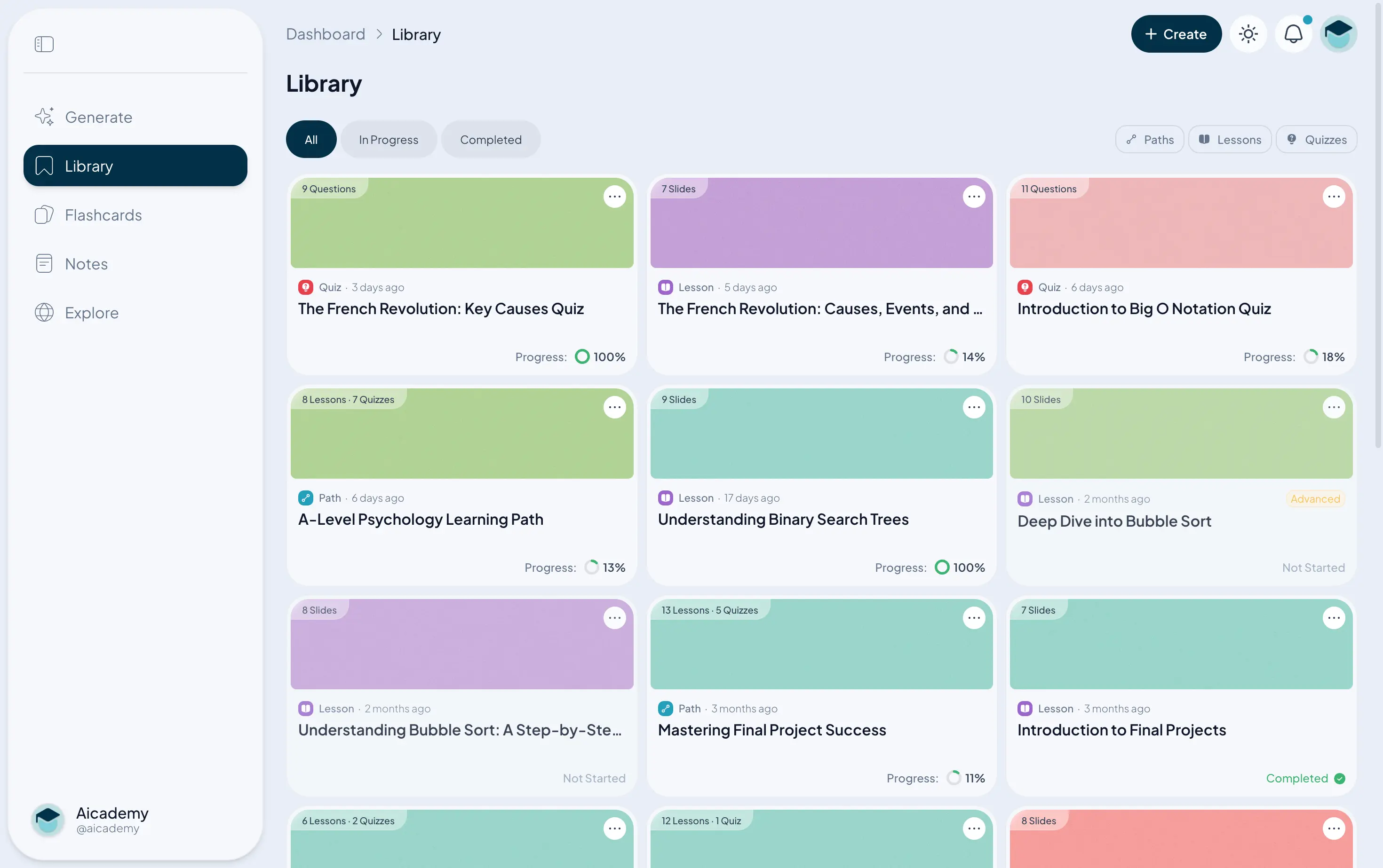
The slots that stay empty are usually the topics you do not know well enough yet to see what practising them would look like. That is where Aicademy, which we make, earns its place: name the topic and you get a lesson, a quiz and a spaced-repetition flashcard deck on it, plus a tutor to ask when something does not land, so the slot has a task in it by the time you sit down. It does the learning and the drilling, not past papers, which you should get from your exam board. The free tier is 10 creations a month, and Pro is £9.99 a month or £5.00 a month billed annually.
When you fall behind
You will. Nearly everyone does, usually around the second or third week, and not because you lack discipline. The first version of any plan is a guess made by an optimist.
The missed sessions are not really the problem. What happens next is. The plan turns into a list of things you did not do, so you stop opening it, and a week later there is no plan. Three things stop that.
- Delete, do not defer. Missed sessions do not roll forward into a debt. Cross them off and let them go. A revision timetable is a plan for the future, not an invoice for the past.
- Restart from today. Not from where you stopped. Open the plan, find today, and do the slot for today. You are not resuming a paused journey, you are just doing the next thing.
- Make the next session smaller. Deliberately smaller than the one you missed. Twenty minutes on one question. The purpose of that session is not the content, it is proving to yourself that the plan still works, and that is worth more this week than the content is.
If you have lost a fortnight rather than an evening, do not try to reclaim it. Pick the topic that carries the most marks in your subject and start there, then rebuild the week around what you have left. The alternative, trying to cover everything you missed before you allow yourself to move on, is how people spend March revising September.
Sometimes you fall behind for reasons that have nothing to do with effort. You were ill, something happened at home, the week took more out of you than you had. That needs a different response from a week you lost to your phone. Write it off on purpose instead of letting it write itself off, tell your teachers where you are, and start again smaller for a few days before going back to normal.
If you are falling behind every week, that is information, not a verdict. The plan is too big. Cut it by a third, keep the days off, and see if it holds. And rewriting the grid is not the fix. Redoing the colour scheme is procrastination wearing a hi-vis jacket.
Mocks, coursework and the NEA
Fixed dates go into the timetable before anything else, because they do not negotiate. Then work backwards from each one.
Coursework and NEA projects take considerably more time than the deadline suggests, and they are the classic cause of a three-week hole in a revision plan. The fix is boring and effective: give the project a small fixed weekly slot from the moment it is set, rather than a large one in the fortnight before it is due. It also keeps the rest of your subjects alive during that period, which is the part people lose.
Mocks are the most useful diagnostic you get for free, and most of their value is spent after them, not before. Book two slots in the week you get the papers back to go through every question you dropped marks on and work out which of the three reasons it was: you did not know it, you knew it and misread the question, or you ran out of time. Those need three different fixes, and your timetable for the following month should reflect whichever one keeps appearing.
In Year 13 the UCAS deadline and personal statement sit in the same category. Give them their own slots in the autumn so they are not competing with revision for the same evening.
For the wider toolkit, we compare the options in the best A-level revision apps. And if you are planning for someone in Year 10 or 11 instead, the GCSE version of this guide is built for nine subjects and shorter blocks.
Frequently asked questions
Start from the time you actually have rather than the time you wish you had: your free periods, your evenings after travel and any job, and your weekends minus one day off. Give your weakest subject the most slots, put past-paper and essay practice in as named tasks rather than as 'revision', and leave at least one empty catch-up slot a week so a bad day does not break the plan. The free maker on this page does the weighting and mixing for you.
There is no correct number, and any figure you are given is someone else's guess about your week. A more useful question is how much time you genuinely have once lessons, travel, a job and sleep are accounted for, and how much of that you can repeat next week without dreading it. What the research is clearer about is distribution: the same total time spread across more days beats the same time bunched together, so consistency matters more than the size of the number.
Your exam board publishes the dates of the actual exams well in advance, so you can work backwards from your own first paper rather than from a generic date. The more useful answer is that A-level exams cover Year 12 content as well, so a short weekly slot that revisits last year's topics is worth more than a big start date. If you have not started yet, today is a fine day to begin; there is no penalty for the weeks behind you.
Something with a finish line. 'Revise enzymes' has no end and tends to become reading; 'do the 2019 Paper 1 question on enzymes, then mark it' does. Good A-level slots look like: a timed exam question, an essay plan against a real past question, marking your own work against the mark scheme, a set of flashcards for definitions and studies, or working through problems with a pen rather than reading worked solutions.
Delete the missed sessions rather than rolling them forward, restart from today rather than from where you were, and make the next session smaller than the one you missed so you definitely finish it. Missed work does not accumulate into a debt you have to repay; the plan was an estimate, and estimates are meant to be revised. If you are falling behind every single week, the plan is too big, which is a planning problem and not a character one.
Yes, in four ways. You have three or four subjects instead of nine, so each one gets far more time and needs to be broken into topics to be plannable. You have free periods, which are the single biggest block of usable time you will get. Sessions need to be longer, because planning an essay or working through a full exam question takes closer to an hour than a quick burst. And past papers, essays and coursework deadlines are scheduled items rather than things you get to later.
The GCSE version of this guideSources
- Dunlosky et al. (2013), Improving Students' Learning With Effective Learning Techniques (SAGE)
- Roediger & Karpicke (2006), Test-Enhanced Learning (Psychological Science)
- The Learning Scientists — spaced practice and interleaving
- AQA — exam dates and timetables
- Education Endowment Foundation — metacognition and self-regulated learning
Prices and features were checked as of the date shown and can change. Where a figure could not be confirmed from a primary source, we say so in the text.
Study content creator, Aicademy contributor
Kieran, known online as @sturdythoughts, is a study and productivity creator with a large student following. He shares practical advice on study habits, focus and revision.
Disclosure: Aicademy is the study app made by the team that publishes this blog. We compare it fairly against other tools and cite our sources so you can check everything yourself.
Keep reading
How to make a GCSE revision timetable that actually works
How to make a GCSE revision timetable you will actually use: a simple evidence-based method, a free timetable maker, and how to fit spaced repetition around real life.
How to revise for A-levels: a smarter method
How to revise for A-levels: evidence-based techniques applied to essays, problem subjects and exam technique, with a realistic independent-study plan.
Active recall and spaced repetition: the study methods that actually work
Why re-reading fails, and how active recall and spaced repetition — the two most evidence-backed study methods — turn revision into long-term memory.
Study with more than flashcards
Aicademy generates personalised lessons, quizzes and flashcards from any topic or your own notes, with spaced-repetition revision and an AI tutor.
Lessons on anything
Structured, level-matched lessons on any topic you study
Practice quizzes
Find out what you actually know before the exam does
Flashcard sets
Lock in key concepts with instant revision cards
Ask Aica
Stuck on something? Get a clear explanation, any time
Upgrade to Pro whenever you're ready