Roundup
The 7 best A-level Psychology revision resources (AQA 7182)
Most Psychology students know the content and still drop marks on the 16-markers. Here are the resources worth using, organised by the part of the exam they actually help with.

GCSE & A-level tutor, Aicademy contributor
11 min read
A-level Psychology students almost never come to me because they do not know the content. They come because they know it, they revised properly, and they still got 9 out of 16 on an essay. That gap is not a knowledge problem. It is a mismatch between what the exam rewards and what almost every revision resource is built to do.
Here are AQA’s own numbers for 7182. AO1, knowledge and understanding, is worth 30 to 33% of the A-level. AO2, applying it, is another 30 to 33%. AO3, analysing and evaluating, is 36 to 38%, the biggest single block of marks. Almost everything the internet offers for A-level Psychology is notes, often excellent and detailed and free, and almost all of it serves AO1. Very little of it helps with AO3, which is where the largest share of the marks sits.
The seven below are sorted by which part of the exam they actually help with, so you can stop re-reading the approaches and start doing the thing that carries the marks. Everything was checked in September 2026 and is linked at the end.
How we picked these
Three rules. First, everything here has to be usable for AQA 7182 specifically, not generic psychology content, because the option topics and the 2025 specification changes make general material unreliable. Second, we sorted by job rather than by brand: a resource that is superb at AO1 and useless at AO3 is listed as exactly that. Third, prices are quoted with the tier and the billing period, checked on 8 September 2026, and where a site does not publish a price until checkout, we say so rather than guessing.
One thing we did not do is rank by which resource is “best overall”, because the honest answer is that the best resource for your Tuesday evening depends entirely on whether you are learning something new, drilling studies or writing an essay.
The seven resources worth your time
1. Simply Psychology — the best free notes, full stop
If you are learning or re-learning a topic, start here. Simply Psychology covers the AQA course topic by topic, in proper depth, written clearly, and it is free with no account. Its coverage runs across social influence, memory, attachment, clinical psychology, approaches, biopsychology, issues and debates and all nine Paper 3 options, which is more than most paid resources manage.
What it does not do is test you or coach your writing. It is an articles site, so it hands you the content and stops. That is not a criticism of it, it is a description of what it is for, and it is why students who read it for hours and never write an answer plateau at a B. The other thing to watch is that any large notes site takes time to catch up with a specification change, so cross-check anything that looks unfamiliar against the current spec (more on that below).
Best for: understanding a topic properly, for free, before you practise it · Free
2. The AQA website — the only place the standard is written down
The most underused free resource in this subject is the exam board. AQA publishes the specification, past papers and mark schemes, and most valuably examiner reports, which say in plain English what the cohort did badly on that essay and what the good answers did differently. For a subject where the marks are in a writing skill, a document written by the people who marked it is worth more than any revision guide.
There is no teaching here and no sorting: you get whole papers and a PDF. Use it as the calibration step rather than the learning step. Write an answer, mark it against the scheme, then read what the examiner said about that question. Two rounds of that teaches most students more about 16-markers than a term of reading.
Best for: past papers, mark schemes and examiner reports, which nobody else has · Free
3. Aicademy — evaluation practice and questions on your weak topic
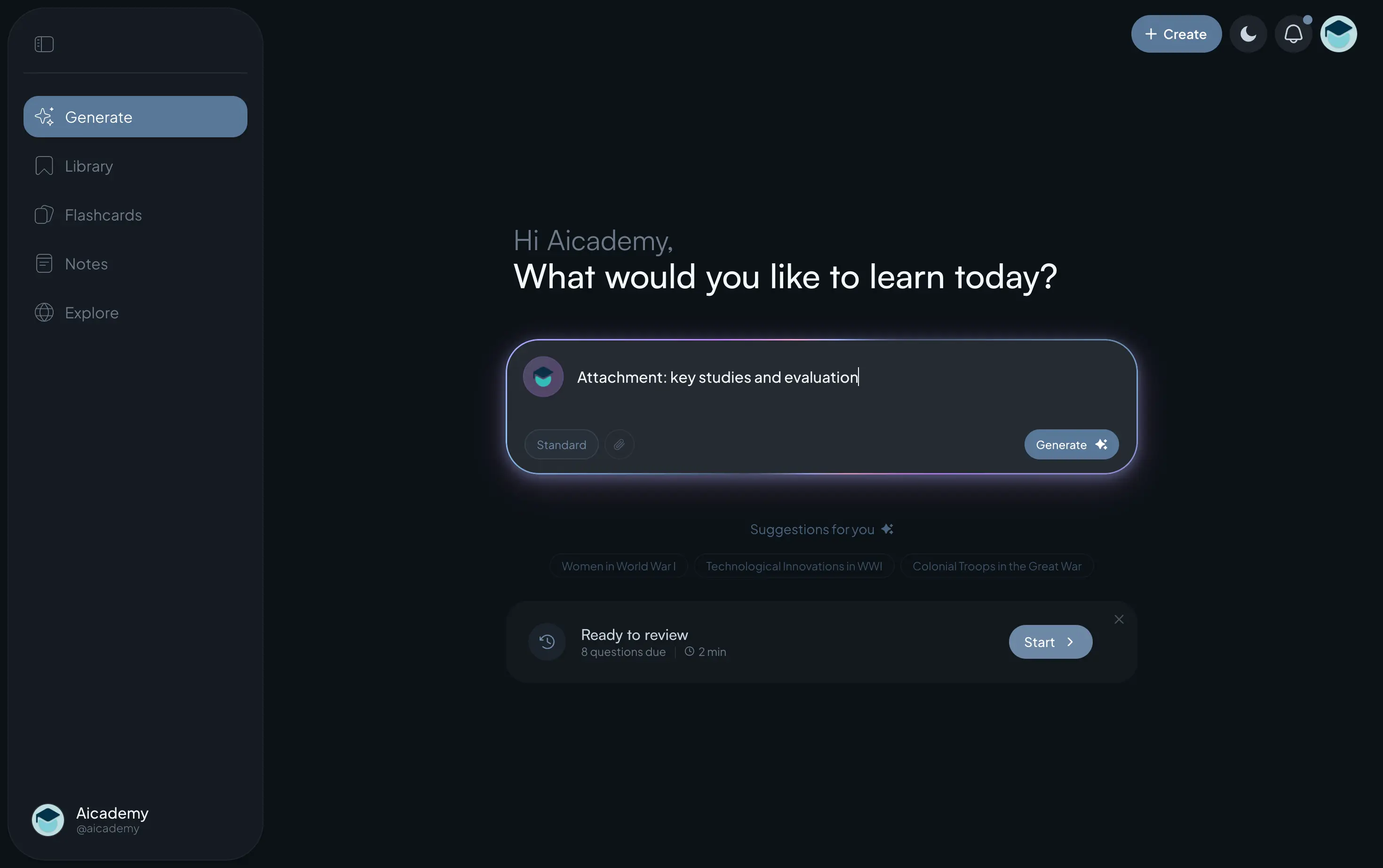
Aicademy is the only resource here that makes new material rather than handing you a fixed set of it, which is what you need once the reading and the marking are done. Its AQA 7182 lessons cover the eight compulsory topics and all nine Paper 3 options, so you can work through the spec rather than assemble it, and they are free to read with no account. On top of those it generates quizzes, spaced-repetition flashcards and practice questions on the topic you keep dropping marks on.
AO3 is where it does the most. Ask the tutor to take an evaluation point you have written and push on it, and you find out quickly whether you have made an argument or just named a study. It is also good for the thing nobody has time to do by hand: ten more application scenarios on conformity, or another set of research-methods questions on experimental design.
It generates practice rather than holding real papers, so for timed practice and for calibrating against the actual standard you want AQA above. A free account adds 10 creation credits a month and 10 tutor messages a day, and Pro makes both unlimited at £9.99 a month, or £5.00 a month billed annually (£59.99 a year).
Best for: AO3 evaluation practice and generating questions on a topic you keep losing marks on · Free tier · from £5.00/mo billed annually
4. Primrose Kitten — free video teaching on YouTube
Primrose Kitten is the strongest video option for AQA Psychology, and video suits some topics better than prose, particularly biopsychology and research methods where a walkthrough beats a paragraph. The Primrose Kitten Academy YouTube channel is free, covers Psychology alongside the sciences and sociology, and was still being added to when we checked on 8 September 2026.
It also ran a paid site, selling a Masterclass course with predicted papers, mark schemes and exam walkthroughs, and that side is closing. As of 8 September 2026 its own homepage says it is winding down: checkout is off, no further purchases can be made, and the site will close in due course, with current customers told to log in and download their materials while they still can. If you have ever bought anything from Primrose Kitten, download it today rather than at study leave.
Best for: free video teaching on the topics that are easier watched than read · Free on YouTube · the paid site is closing
5. Psychology with Rhi — small, exam-focused and well liked
This is a small independent resource selling AQA-specific revision notes covering the specification bullet by bullet, predicted papers with full mark schemes for all three papers including every Paper 3 option, and guidance on structuring 16-mark answers. Students rate it, and the Paper 3 coverage across all the options is unusual, because most resources cover the popular three and leave you to fend for yourself if your school teaches eating behaviour or addiction.
It is paid, sold as individual products rather than a subscription, and it is a one-person operation rather than a platform. Its A-level Psychology shop ran from £2.50 to £24.99 a product when we checked on 8 September 2026, and it is worth reading which exam year a predicted paper is written for before you buy it.
Best for: spec-by-spec notes and predicted papers, including the less common Paper 3 options · Paid, per product · £2.50 to £24.99
6. SimpleStudy — notes and topic questions in one place
SimpleStudy bundles premium notes, questions by topic, past papers, sample answers and exam simulation. If what you want is a single subscription that covers reading and question practice without you organising anything, it does that job. Its higher tier adds essay and exam grading, which is the feature students on essay subjects actually want.
Basic is £7.99 a month, or £4.17 a month billed annually. Advanced is £14.99 or £7.50, and Ultimate, the tier with the grading, is £24.99 or £12.50, all as of 8 September 2026. The per-page depth is thinner than a dedicated notes site, so it is a convenience purchase more than a depth purchase.
Best for: notes, topic questions and answer grading under one subscription · From £4.17/mo billed annually
7. Anki or Quizlet — for the studies, names and dates
Psychology has an unusually heavy recall load: study names, researcher names, dates, procedures, findings and a stock of evaluation points for each. That is precisely what spaced-repetition flashcards are for, and it is the one revision technique with a genuinely strong evidence base. Anki is free on desktop, web and Android, with a one-off £24.99 for the iOS app. Quizlet Plus is £7.99 a month or £2.99 a month billed annually (£35.99 a year), and Plus Unlimited is £9.99 or £3.75 annually (£44.99 a year), checked 8 September 2026.
The catch with both is that you either build the cards or trust someone else’s, and shared Psychology decks are often written for an older version of the specification. Building your own is slower and much better for you.
Best for: drilling studies, dates and evaluation points into long-term memory · Anki free · Quizlet from £2.99/mo annually
| Resource | AO1 content | AO3 evaluation | Past papers | Price |
|---|---|---|---|---|
| Simply Psychology | Yes | No | No | Free |
| AQA website | Partial | Yes | Yes | Free |
| Aicademy | Yes | Yes | No | Free tier · from £5.00/mo annually |
| Primrose Kitten | Yes | Partial | No | Free on YouTube |
| Psychology with Rhi | Yes | Partial | Partial | Paid, per product |
| SimpleStudy | Partial | Partial | Yes | From £4.17/mo annually |
| Anki / Quizlet | Partial | No | No | Free · from £2.99/mo annually |
Prices and features as of 8 September 2026, from each vendor’s own pages. “Past papers” means real AQA papers with mark schemes, or predicted papers written to that format. Confirm current details before subscribing.
What to use for each part of the exam
Match the resource to the assessment objective, not to the topic.
| The job | Share of marks | What to use |
|---|---|---|
| AO1 — learning and reviewing content | 30 to 33% | Simply Psychology, then flashcards to make it stick |
| AO2 — applying it to a scenario or to data | 30 to 33% | Past-paper application questions, then Aicademy for more scenarios once they run out |
| AO3 — evaluation and the extended writing | 36 to 38% | Written answers marked against mark schemes and examiner reports |
| Research methods (across the papers) | 25 to 30% | Paper 2 Section C past questions, the maths skills list, and Aicademy for extra question sets |
Weightings from AQA’s scheme of assessment for A-level Psychology 7182.
Two things fall out of that table that are worth saying plainly.
Research methods is the highest-value topic on the course. Between 25 and 30% of the whole A-level assesses it, at least 10% of the marks need Level 2 maths, and on Paper 2 it is Section C, worth 48 of the paper’s 96 marks. That is half a paper. Research methods is also, in my experience, the last thing most students revise, because it does not feel like psychology. If you are looking for the single highest-return hour tonight, it is a Paper 2 Section C past question.
The extended-writing questions are where AO3 lives. The essays students call the 16-markers reward evaluation that is elaborated and organised into an argument, not evaluation that is listed. The most common thing I mark is a paragraph that names a criticism, names a study that supports it, and stops, without ever saying what that means for the theory. Adding one sentence of “which suggests that...” to each evaluation paragraph is usually worth more than another week of content revision.
The spec-version trap: check you are revising version 1.4
AQA’s A-level Psychology specification was updated to version 1.4, dated 1 September 2025, with first A-level exams in June 2027. Older versions of the 7182 specification are still circulating as PDFs and still rank in search results, which means it is entirely possible to spend a fortnight revising content that is no longer assessable.
The clearest signal is the name: psychopathology is now Clinical Psychology and Mental Health, and it sits on Paper 1 with social influence, memory and attachment. If a resource still calls it psychopathology and puts it elsewhere, it has not been updated.
Other things that changed in the current version, so you can spot old material quickly.
- Social influence: Zimbardo and conformity to social roles, and social change, are gone.
- Memory: the types of long-term memory (episodic, semantic and procedural) are gone.
- Attachment: caregiver-infant interactions, Schaffer’s stages and the role of the father are gone.
- Approaches: Wundt and the origins of psychology are gone, and cognitive neuroscience has moved to the biological approach.
- Biopsychology: the whole biological rhythms sub-topic is gone.
- The options: evolutionary explanations of partner preferences, the psychodynamic explanation of gender, and the atavistic form and psychodynamic explanations of offending have all gone, and offender profiling is renamed the typology and data-driven approaches.
That list is taken from version 1.4 of the specification itself, checked topic by topic against the previous version. It is worth knowing rather than memorising, because the useful habit is the check rather than the list: open the specification on AQA’s site, confirm the version number on the front page, and search it for the topic you are unsure about. Two minutes, and it works for every future change as well as this one.
How to actually revise the approaches
The approaches are the topic students most often revise ineffectively, because they feel like six things to memorise when they are really one argument told six times. Behaviourist, social learning, cognitive, biological, psychodynamic and humanistic are each answering the same question, what causes behaviour, and each one is defined by what it rejects about the one before it.
Revised as a list, they blur, and in the exam students attribute the right idea to the wrong approach. Revised as a sequence of disagreements they stay separate, and you get evaluation for free, because every approach’s weakness is the next one’s reason for existing. Three specific confusions to watch: social learning theory is not the behaviourist approach with extra steps, it adds mediational processes; the cognitive approach is not neuroscience, and in the current specification cognitive neuroscience sits with the biological approach; and the psychodynamic approach is assessed on its explanatory claims, not on whether you find Freud convincing.
If it helps to work through them one at a time, Aicademy’s lessons on the behaviourist, cognitive, biological and psychodynamic approaches are written to the current spec, alongside the multi-store model and aims, hypotheses and variables for research methods. The full set sits under A-level Psychology.
For the method rather than the materials, see how to revise for A-level Psychology, and if Simply Psychology is your starting point, we have written separately about what to pair it with. For tools across all your subjects, see the best A-level revision apps.
A declaration of interest: Aicademy is ours, and it is the only resource here we have a stake in. Judge its entry on the same things as the other six, what it does and what it costs, rather than on who wrote the page. Every figure above is linked, and you can start free and turn a psychology topic into practice questions in a couple of minutes.
Frequently asked questions
There is no single one, because the exam asks for three different things. Simply Psychology is the best free source for learning and reviewing content (AO1). AQA's own past papers, mark schemes and examiner reports are the best source for exam technique, and they are free. For the evaluation writing that carries the most marks, you need something that makes you produce answers rather than read them, whether that is a teacher, a tutor, or a tool such as Aicademy.
It is enough to understand every topic, and it is genuinely the best free notes site for AQA Psychology. It is not enough on its own, because AO3 (analyse, interpret and evaluate) is worth 36 to 38% of the A-level, more than either AO1 or AO2, and you cannot build evaluation writing by reading. Pair it with past-paper practice and something that marks or coaches your answers.
Write them, timed, then compare against the mark scheme and the examiner report for that series. Most students lose marks not on the description at the start but on the evaluation: points are stated rather than elaborated, and there is no line of argument. A practical fix is to write evaluation paragraphs to a fixed shape (point, evidence, explanation of why that matters for the theory, counterpoint) until the shape is automatic, then stop thinking about the shape.
AO1 is knowledge and understanding, worth 30 to 33% of the A-level. AO2 is applying that knowledge in theoretical and practical contexts and when handling data, also 30 to 33%. AO3 is analysing, interpreting and evaluating, worth 36 to 38%, which makes it the largest single block of marks. Most revision resources are built around AO1, which is why students who have revised thoroughly still lose marks on the essays.
Between 25 and 30% of the whole A-level assesses research methods, and at least 10% of the marks require Level 2 mathematical skills. On Paper 2 it is Section C, worth 48 of the paper's 96 marks. It is the single highest-value topic on the course and it is regularly the last thing students revise.
Three papers, each 2 hours, 96 marks and worth 33.3%. Paper 1 covers social influence, memory, attachment and clinical psychology. Paper 2 covers approaches, biopsychology and research methods. Paper 3 covers issues and debates plus one option from each of three groups: relationships, gender or cognition and development; schizophrenia, eating behaviour or stress; aggression, forensic psychology or addiction.
An aim is a general statement of what a study is trying to find out, written as a purpose rather than a prediction: for example, to investigate whether sleep deprivation affects reaction time. A hypothesis is different. It is a precise, testable statement of the expected relationship between the variables, and it is either directional (one-tailed) or non-directional (two-tailed). Questions that give you a scenario and ask you to write a hypothesis want the operationalised variables in it.
If you are sitting A-level exams in June 2027 or later, you are on version 1.4 of the 7182 specification, dated 1 September 2025. It is not the same as the older version, and it renames psychopathology to clinical psychology, moves it to Paper 1, and removes several familiar topics. Older PDFs of the specification are still widely circulated, so check the version number on whatever you are revising from.
Sources
- AQA — A-level Psychology (7182) specification at a glance (papers, topics, options)
- AQA — A-level Psychology (7182) scheme of assessment (AO weightings, research methods and maths requirements)
- AQA — A-level Psychology (7182) assessment resources: past papers, mark schemes and examiner reports
- Simply Psychology — AQA A-level Psychology revision notes
- Primrose Kitten — wind-down notice on its homepage (checked 8 September 2026)
- Psychology with Rhi — A-level Psychology resources (checked 8 September 2026)
- SimpleStudy — pricing (checked 8 September 2026)
- Anki — downloads and platform support (apps.ankiweb.net)
- Quizlet — upgrade and pricing (checked 8 September 2026)
Prices and features were checked as of the date shown and can change. Where a figure could not be confirmed from a primary source, we say so in the text.
GCSE & A-level tutor, Aicademy contributor
Liba is a first-class Computer Science graduate from the University of Birmingham who tutors GCSE and A-level students. She writes about revision technique and exam prep.
Disclosure: Aicademy is the study app made by the team that publishes this blog. We compare it fairly against other tools and cite our sources so you can check everything yourself.
Keep reading
The 8 best Simply Psychology alternatives for A-level (2026)
The best Simply Psychology alternatives for A-level Psychology in 2026, from free interactive tools to exam-technique resources, and what each adds beyond reading notes.
How to revise for A-level Psychology (AQA)
A tutor's guide to revising AQA A-level Psychology: how it's marked, how to memorise studies, how to write 16-markers, and a realistic revision plan.
The 10 best A-level revision websites and apps
The best A-level revision websites and apps in 2026, free and paid, compared on exam-board fit, past papers, retention and price.
Study with more than flashcards
Aicademy generates personalised lessons, quizzes and flashcards from any topic or your own notes, with spaced-repetition revision and an AI tutor.
Lessons on anything
Structured, level-matched lessons on any topic you study
Practice quizzes
Find out what you actually know before the exam does
Flashcard sets
Lock in key concepts with instant revision cards
Ask Aica
Stuck on something? Get a clear explanation, any time
Upgrade to Pro whenever you're ready