Guide
How to revise for A-level Psychology (AQA)
A-level Psychology is won on evaluation and 16-mark essays, not just remembering studies. Here is how to revise for the marks that actually count.

GCSE & A-level tutor, Aicademy contributor
8 min read
Most students revise A-level Psychology by trying to memorise every study, and then wonder why their essay marks stay stuck. The subject is not really testing whether you can remember Baddeley or Bowlby. It is testing whether you can evaluate: weigh evidence, spot flaws in a theory, and build an argument. Description gets you a third of the marks on an essay; evaluation gets you the rest.
This guide is written around AQA’s 7182 specification, the most widely taught A-level Psychology course. It covers how the papers are marked, how to memorise studies so you can actually use them, how to write the 16-mark essays that decide grades, and a plan that puts your effort where the marks are.
How AQA Psychology is marked
Three exams, each 2 hours and worth a third of your grade:
- Paper 1 — Introductory topics: Social Influence, Memory, Attachment, Psychopathology.
- Paper 2 — Psychology in context: Approaches, Biopsychology, and Research Methods.
- Paper 3 — Issues and options: Issues and Debates (compulsory) plus your chosen options, such as Relationships, Schizophrenia and Aggression or Forensic Psychology.
Every question targets one or more assessment objectives, and knowing which one is being tested changes how you answer:
- AO1 — knowledge: describe theories and studies accurately.
- AO2 — application: apply psychology to a scenario in the question stem.
- AO3 — evaluation: analyse, criticise and weigh evidence. This is where the marks and the grades live.
Memorising studies, the useful way
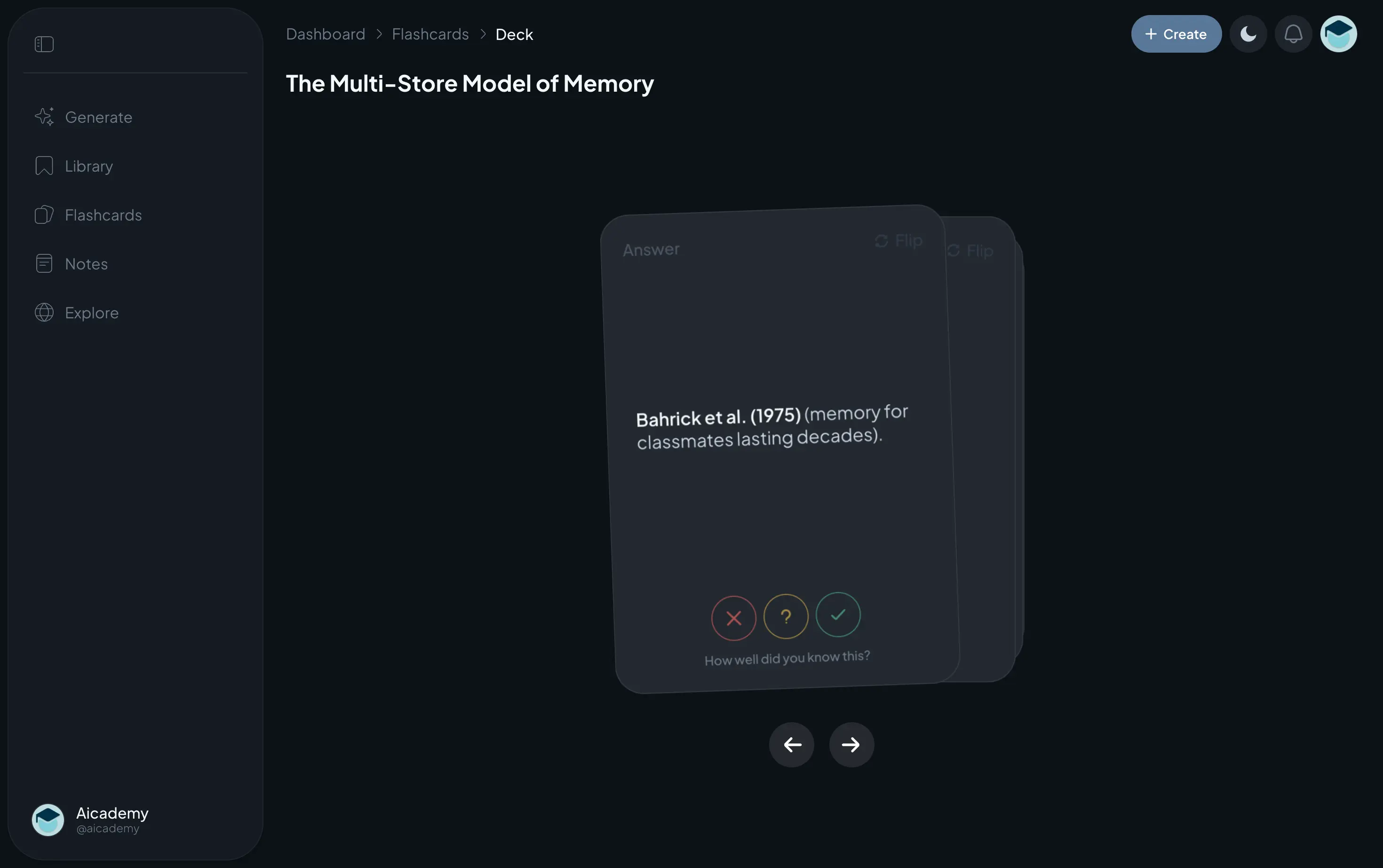
You do need the studies, but memorising them as isolated facts is half the job. For each study, make a compact card with five things:
- Who and when — the name and rough year.
- What they did — the method, in one line.
- What they found — the key result.
- What it shows — the conclusion.
- How you would use it — as support for a theory, or as a criticism. This fifth line is what turns a memorised study into an evaluation point you can drop into an essay.
Review these with spaced repetition so they are still there in June. Our guide to making flashcards that work covers how to write cards that test recall rather than recognition.
Writing the 16-mark essay
This is the skill that separates a B from an A. A reliable structure:
- Description (AO1): a concise, accurate outline of the theory or study. Do not over-write this, it is capped at around 6 marks. Be precise, then move on.
- Evaluation (AO3): three or four developed points. For each, use a simple chain: state the point, give the evidence or reasoning, explain why it matters, and add a counter-argument or implication. A point that says “this is a strength because research supports it” and stops is worth little; the marks are in the elaboration.
Depth beats breadth every time. Three evaluation points that each run for several sentences and genuinely argue will out-score six one-liner points. If the question has an application stem, weave the scenario in rather than tacking it on at the end.
Topic-by-topic priorities
Not everything deserves equal time. Where the marks and the pitfalls are:
- Paper 1 topics are your reliable marks. Social Influence, Memory, Attachment and Psychopathology are content-rich and predictable. Build strong essay plans for the big theories in each and you have banked a solid Paper 1.
- Research Methods is the sleeper that decides grades. It runs through Paper 2 and is worth a large share of marks, yet it is the most under-revised because it is maths-heavy. Drill experimental design, sampling, statistics and interpreting data. Do not leave it to the end.
- Issues and Debates (Paper 3) is a bank of ready-made evaluation, such as gender bias, cultural bias, free will versus determinism, and nature versus nurture. Learn these well and you can apply them across almost any essay.
- Your options reward tight, well-planned essays. Because you know roughly which essays can come up, pre-plan them.
The method that actually works
Re-reading your notes and highlighting them feels like revision but barely helps, and the same goes for re-reading a notes site like Simply Psychology, however good it is (here are the best Simply Psychology alternatives that actually test you). Three things do:
- Active recall for content: close the book and retrieve studies and definitions from memory, not by re-reading.
- Spaced repetition so the huge volume of content survives to the exam. Here is why it beats cramming.
- Essay planning and past papers for technique. Plan far more essays than you write in full, five-minute plans build the structure fast, then write some in full and mark them against the official mark scheme.
A weekly plan you can start now
- Daily (10–15 minutes): flashcards, mixing new studies with older ones that are due for review.
- Two or three times a week: a five-minute essay plan for a likely 16-marker, focusing on the evaluation points.
- Once a week: write one essay in full under time, then mark it against the mark scheme and note your two weakest evaluation points.
- Once a week: a Research Methods question set, because it is the bit everyone avoids and the bit that quietly lifts grades.
Resources
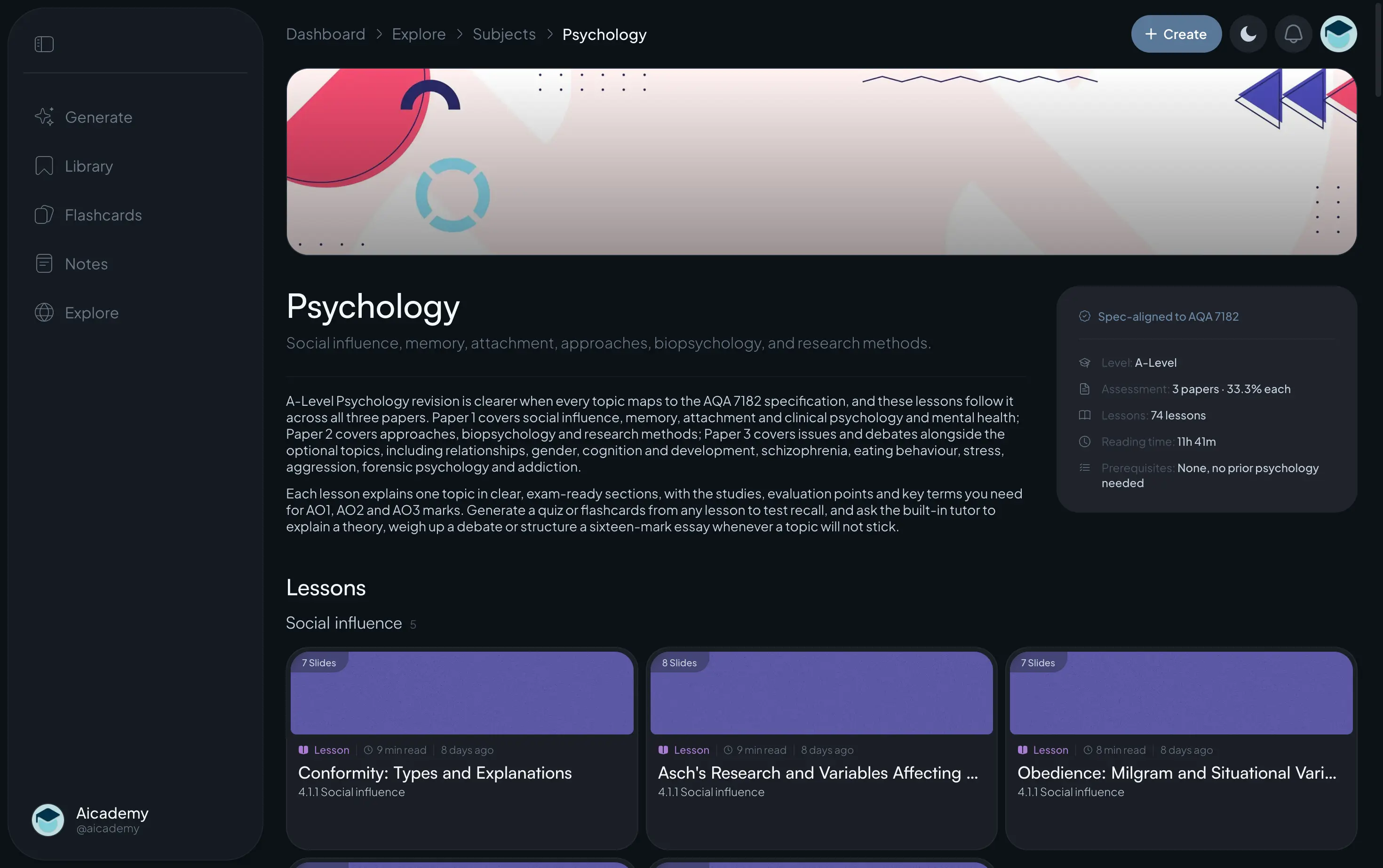
Revise from the official AQA 7182 specification and its past papers and mark schemes, so you are learning the right detail and the right way to phrase evaluation. Our own A-level Psychology lessons break each topic into short, testable chunks with built-in questions.
If you want to practise a specific topic, Aicademy can generate a lesson, a quiz and spaced-repetition flashcards on any part of the course, and its tutor can mark and stretch a practice essay plan. It is free to start, so you can drill the exact studies or essays that keep costing you marks.
Frequently asked questions
Revise in two layers. First, bank the content, studies, theories, definitions, using flashcards and spaced repetition. Second, and more importantly, practise turning that content into evaluation and essays, because A-level Psychology is won on AO3 analysis, not on description. Plan and write 16-mark essays regularly and mark them against the mark scheme so you learn what earns the higher bands.
Turn each study into a compact flashcard with four things: who, when, what they did, and what they found. Then, crucially, add a fifth, how you would use it as evaluation, for example as supporting evidence or a criticism of a theory. Reviewing these with spaced repetition means the studies are there when you need them, and tying each one to an evaluation point means you can actually use them in essays.
A 16-marker is typically around 6 marks for description (AO1) and 10 for evaluation (AO3), sometimes with application (AO2). Write a concise, accurate description, then spend most of your effort on a few well-developed evaluation points. Elaborate each one: state the point, give evidence or reasoning, explain why it matters, and consider a counter-argument. Three or four developed points beat six shallow ones.
Two things trip students up most: writing genuinely evaluative essays rather than descriptive ones, and Research Methods in Paper 2, which is maths-heavy and often under-revised. Both are very improvable with practice. Evaluation improves by planning essays repeatedly; Research Methods improves by doing exam questions on experimental design, statistics and interpreting data.
Three exams, each 2 hours and worth a third of the grade. Paper 1 covers Social Influence, Memory, Attachment and Psychopathology. Paper 2 covers Approaches, Biopsychology and Research Methods. Paper 3 covers Issues and Debates plus your chosen options, such as Relationships, Schizophrenia and Aggression or Forensic Psychology.
Begin light retrieval and essay practice at least two months before the exams, and keep flashcards ticking over all year so studies do not fade. Because so much depends on essay technique, which only improves by writing, starting early gives you time to write, get feedback and improve, rather than cramming content you cannot yet apply.
Sources
- AQA — A-level Psychology 7182 specification (aqa.org.uk)
- AQA — 7182 past papers and mark schemes (aqa.org.uk)
- Education Endowment Foundation — evidence on retrieval practice and spaced learning (educationendowmentfoundation.org.uk)
Prices and features were checked as of the date shown and can change. Where a figure could not be confirmed from a primary source, we say so in the text.
GCSE & A-level tutor, Aicademy contributor
Liba is a first-class Computer Science graduate from the University of Birmingham who tutors GCSE and A-level students. She writes about revision technique and exam prep.
Disclosure: Aicademy is the study app made by the team that publishes this blog. We compare it fairly against other tools and cite our sources so you can check everything yourself.
Keep reading
How to revise for A-levels: a smarter method
How to revise for A-levels: evidence-based techniques applied to essays, problem subjects and exam technique, with a realistic independent-study plan.
Active recall and spaced repetition: the study methods that actually work
Why re-reading fails, and how active recall and spaced repetition — the two most evidence-backed study methods — turn revision into long-term memory.
How to make flashcards that actually work
Why most flashcards don't work, how to write ones that do, and how spaced repetition turns them into long-term memory.
Study with more than flashcards
Aicademy generates personalised lessons, quizzes and flashcards from any topic or your own notes, with spaced-repetition revision and an AI tutor.
Lessons on anything
Structured, level-matched lessons on any topic you study
Practice quizzes
Find out what you actually know before the exam does
Flashcard sets
Lock in key concepts with instant revision cards
Ask Aica
Stuck on something? Get a clear explanation, any time
Upgrade to Pro whenever you're ready