Track progress, take quizzes and save notes on this lesson.

Free forever · no card needed

Start free
Intermediate

The Multi-Store Model of Memory

4.1.2 Memory

Aligned to the AQA 7182 specification

Topic
Memory
Level
Intermediate
Reading time
8 min
Published
1 July 2026
On this page
  1. 1.What the Multi-Store Model Claims
  2. 2.The Flow Between the Stores
  3. 3.The Sensory Register
  4. 4.Short-Term Memory: The Evidence
  5. 5.Long-Term Memory: The Evidence
  6. 6.Evaluation
  7. 7.Common Exam Mistakes

Key takeaways

  • The multi-store model (Atkinson and Shiffrin, 1968) describes memory as three unitary stores in a linear flow: sensory register, short-term memory and long-term memory.
  • Attention transfers information from the sensory register to STM; maintenance rehearsal keeps it in STM and passes it to LTM; retrieval brings it from LTM back to STM.
  • STM codes mainly acoustically, holds about 7 plus or minus 2 items, and lasts roughly 18 to 30 seconds without rehearsal.
  • LTM codes mainly semantically, has a potentially unlimited capacity, and can last up to a lifetime.
  • The case study of patient KF suggests STM is not a single unitary store, which is a key weakness of the model.

What the Multi-Store Model Claims

The multi-store model of memory (MSM) was proposed by Atkinson and Shiffrin (1968). It explains memory as a flow of information through three separate stores, each a distinct unitary store with its own features.

Information moves through the stores in a fixed, linear sequence:

  • The sensory register receives everything from the senses.
  • If you pay attention, information transfers into short-term memory (STM).
  • If you use maintenance rehearsal (repeating it), information transfers into long-term memory (LTM).
  • To use a memory again, it is retrieved from LTM back into STM.

The three stores differ on three features you must be able to describe and compare: coding (how information is stored), capacity (how much fits) and duration (how long it lasts).

The MSM treats each store as unitary — a single, undivided store. This assumption becomes the model's biggest weakness, as the evaluation slide shows.

The Flow Between the Stores

The MSM is a structural model: its central idea is the order in which information passes from one store to the next. Two processes drive the flow.

Attention selects information from the sensory register and passes it into STM. Anything you do not attend to decays and is lost. Maintenance rehearsal then works in two ways: it keeps information circulating in STM, and if repeated enough, it transfers that information into LTM. Finally, retrieval brings stored memories from LTM back into STM so they can be used.
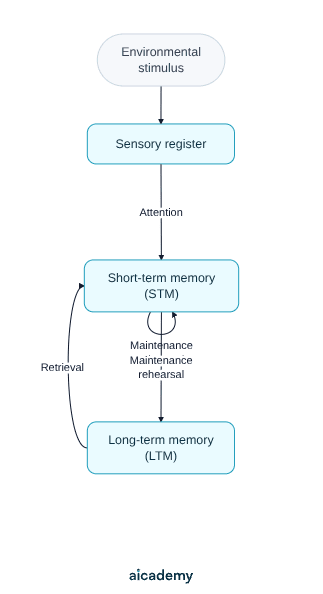
Information that is not attended to (in the sensory register) or not rehearsed (in STM) is forgotten. Only rehearsed information reaches LTM in this model.

The Sensory Register

The sensory register is the store that holds information arriving from the senses, before you have paid it any attention. It is not one store but a set of stores, one for each sense.

  • Coding is modality-specific — it depends on the sense. The store for vision is iconic memory (visual coding); the store for hearing is echoic memory (acoustic coding).
  • Capacity is very large — it briefly holds everything the senses take in.
  • Duration is very brief — under half a second before the trace decays.

Information only moves on to STM if you pay attention to it. Everything else fades almost immediately, which is why you are not consciously aware of the vast majority of what your senses detect.

FeatureSensory register
CodingModality-specific (iconic = visual, echoic = sound)
CapacityVery large
DurationVery brief (under half a second)

"Iconic" and "echoic" are worth memorising: iconic = images (visual), echoic = echo (sound). The whole store lasts a fraction of a second, so attention is the gateway to STM.

Short-Term Memory: The Evidence

Short-term memory (STM) is the temporary store that holds information you are currently thinking about. Each of its three features is supported by a named study.

Coding is mainly acoustic. Baddeley (1966) found that people who were asked to recall a list immediately (from STM) made more errors with acoustically similar words (such as cat, cab, can) than with dissimilar words. Because sound-alike words were confused, STM must code mainly by sound.

Capacity is about 7 plus or minus 2 items. Miller (1956), in "The Magic Number Seven", concluded STM holds around 5 to 9 items. Jacobs (1887) measured digit span and found people could recall on average about 9.3 digits but only 7.3 letters.

Duration is about 18 to 30 seconds. Peterson and Peterson (1959) gave participants nonsense trigrams (such as THX) to recall after various delays, preventing rehearsal by having them count backwards in threes. Recall fell to about 3% correct after 18 seconds.

FeatureStudyFinding
CodingBaddeley (1966)Acoustically similar words confused → acoustic
CapacityMiller (1956); Jacobs (1887)About 7 ± 2 items; ~9.3 digits, ~7.3 letters
DurationPeterson and Peterson (1959)~3% recalled after 18 seconds without rehearsal

STM: codes acoustically, holds 7 ± 2 items, lasts 18 to 30 seconds without rehearsal. Learn the store and its named study together.

Worth saving these ideas?

Turn what you've read into instant revision cards. Free to get started.

Make flashcards

Long-Term Memory: The Evidence

Long-term memory (LTM) is the potentially permanent store that holds information you are not currently using. Its three features contrast sharply with STM.

Coding is mainly semantic. In the same line of research, Baddeley found that when recall was delayed (so it came from LTM), people made more errors with semantically similar words (such as big, large, huge) than with dissimilar ones. Because meaning-alike words were confused, LTM codes mainly by meaning.

Capacity is potentially unlimited. There is no known upper limit to how much LTM can hold; the model treats it as effectively boundless.

Duration can be up to a lifetime. Bahrick et al. (1975) tested people's memory for their old school classmates. Even after about 48 years, participants were around 70% accurate at recognising former classmates from yearbook photographs, showing LTM can last for decades.

FeatureSTMLTM
CodingMainly acoustic (Baddeley)Mainly semantic (Baddeley)
CapacityAbout 7 ± 2 itemsPotentially unlimited
DurationAbout 18 to 30 secondsUp to a lifetime (Bahrick, 1975)

The exam frequently asks you to compare the stores. A single table like this one, with a named study for each cell, is the strongest way to revise the differences.

Evaluation

A 16-mark essay needs AO3 — evaluation, not just description. Aim for a few developed points, each stating the point, the evidence, and why it matters for the model.

Strength: strong supporting research for separate stores. The features of each store are backed by controlled studies: Baddeley's coding work, Peterson and Peterson's duration study, and Miller and Jacobs on capacity. These consistent findings support the idea that STM and LTM are genuinely different stores with different characteristics.

Weakness: the case of patient KF. Shallice and Warrington (1970) studied KF, who had brain damage. His verbal STM was very poor, yet his ability to process visual information was near normal. If STM were a single unitary store, damage should affect it as a whole. That it did not suggests STM has separate components, better explained by the working memory model.

Weakness: rehearsal is more complex than the model claims. The MSM says maintenance rehearsal is the route to LTM. Craik and Watkins found that the type of rehearsal matters more than the amount: elaborative rehearsal, which links information to meaning, is what actually transfers information to LTM. Simply repeating information is often not enough.

Weakness: low ecological validity. Much of the supporting evidence uses artificial materials such as nonsense trigrams and lists of digits. These have little in common with the meaningful things people remember day to day, so the findings may not reflect how everyday memory works.

A good evaluation paragraph names the study, states what it found, and then explicitly links it back to the MSM. "KF had poor verbal STM but intact visual STM, so STM is not unitary as the model claims" scores far better than just naming KF.

Common Exam Mistakes

1. Confusing coding, capacity and duration

These are three separate features. Coding = the form information is stored in (acoustic or semantic). Capacity = how much fits (7 ± 2, or unlimited). Duration = how long it lasts (seconds, or a lifetime). Do not describe capacity when the question asks for coding.

2. Saying STM codes semantically

STM codes mainly acoustically (Baddeley: acoustically similar words are confused in immediate recall). It is LTM that codes mainly semantically. Swapping these around is one of the most common errors on this topic.

3. Treating STM as a single store despite KF

The evidence from patient KF (Shallice and Warrington, 1970) shows STM is not unitary — verbal and visual short-term memory can be damaged separately. Describing STM as one undivided store ignores this key evaluation point.

4. Claiming maintenance rehearsal is the only route to LTM

The MSM claims this, but Craik and Watkins showed elaborative rehearsal (processing for meaning) is what actually transfers information to LTM. When evaluating, do not repeat the model's claim as if it were an established fact.

5. Confusing "iconic" and "echoic" in the sensory register

Iconic memory is visual (images); echoic memory is acoustic (sound). A simple label swap here loses an easy mark on sensory-register coding questions.

Key terms

Coding
The way information is converted into a form that can be stored in memory, such as acoustically (by sound) or semantically (by meaning).
Capacity
The amount of information that can be held in a memory store at one time.
Duration
The length of time information can be held in a memory store.
Sensory register
The memory store that briefly holds information from the senses; it is modality-specific, has a large capacity and a very short duration.
Short-term memory (STM)
A temporary store that codes mainly acoustically, holds about 7 plus or minus 2 items, and lasts around 18 to 30 seconds without rehearsal.
Long-term memory (LTM)
A permanent store that codes mainly semantically, has a potentially unlimited capacity, and can last up to a lifetime.
Maintenance rehearsal
Repeating information over and over to keep it in short-term memory and, with enough repetition, transfer it to long-term memory.

Frequently asked questions

The multi-store model (Atkinson and Shiffrin, 1968) is a linear model with three separate stores: the sensory register, short-term memory and long-term memory. Attention and maintenance rehearsal move information between the stores in a fixed sequence.

STM codes information mainly acoustically (by sound), while LTM codes mainly semantically (by meaning). Baddeley (1966) showed people confuse acoustically similar words in STM but semantically similar words in LTM.

KF (Shallice and Warrington, 1970) had poor verbal STM but near-normal visual STM after brain damage. This suggests STM is not one unitary store, contradicting the multi-store model's claim of a single short-term store.

Generate revision on any topic you study

Type any topic you're studying and Aicademy generates a complete lesson, quiz, and flashcard set, personalised to your level.

Lessons on anything

Structured, level-matched lessons on any topic you study

Practice quizzes

Find out what you actually know before the exam does

Flashcard sets

Lock in key concepts with instant revision cards

Ask Aica

Stuck on something? Get a clear explanation, any time

Prev

Resistance to Social Influence and Minority Influence

Next

The Working Memory Model

Related lessons

Top students don’t revise more. They revise what counts.

Start revising free

Free to start. No card needed.