Track progress, take quizzes and save notes on this lesson.

Free forever · no card needed

Start free
Intermediate

The Cognitive Approach

4.2.1 Approaches in Psychology

Aligned to the AQA 7182 specification

Level
Intermediate
Reading time
9 min
Published
1 July 2026
On this page
  1. 1.Studying the Mind Scientifically
  2. 2.The Role of Schema
  3. 3.Making Inferences About the Mind
  4. 4.The Use of Models
  5. 5.Evaluation
  6. 6.Common Exam Mistakes

Key takeaways

  • The cognitive approach argues that internal mental processes such as memory, perception, attention and thinking can and should be studied scientifically, even though they cannot be observed directly.
  • A schema is a mental framework of ideas built from experience; schemas speed up processing and fill gaps, but can distort perception and memory, causing errors and biases.
  • Because mental processes are private, cognitive psychologists study them indirectly by observing behaviour and making inferences, which are reasoned assumptions about the internal processes at work.
  • Cognitive psychologists use models such as the information processing model (input, processing, output) and computer models to explain and make inferences about how the mind works.
  • The approach has real-world value through CBT, improvements to eyewitness testimony and AI, but is criticised for machine reductionism and relying on inference from artificial lab tasks.

Studying the Mind Scientifically

The cognitive approach is the study of internal mental processes such as memory, perception, attention and thinking. Its central assumption is that these processes can and should be studied scientifically.

This was a direct reaction against behaviourism. Behaviourists argued that only observable behaviour counts as valid data, and they treated the mind as an inaccessible "black box" that science should ignore. The cognitive approach rejects this. It accepts that mental processes cannot be observed directly, but insists they can still be investigated rigorously, using controlled experiments and careful measurement.

FeatureBehaviourist approachCognitive approach
Focus of studyObservable behaviour onlyInternal mental processes
View of the mindA "black box" to be ignoredA system that mediates stimulus → response
How the mind is studiedNot studied — only behaviour isStudied indirectly, through inference
Methods valuedLab experiments on behaviourLab experiments plus models of the mind

The cognitive approach argues that internal mental processes come between a stimulus and a response, and that understanding those processes is essential to explaining behaviour.

This slide sets up the three pillars of the approach that the rest of the lesson unpacks: the role of schema, the use of inference, and the use of models.

The Role of Schema

A schema is a mental framework of beliefs and expectations, built up from experience, that the mind uses to organise and interpret information. You can think of a schema as a "package" of ideas about a person, object, situation or event.

Schemas develop and become more detailed with age and experience. A young child may have a simple schema for "dog" (four legs, furry), which is refined over time to distinguish breeds, temperaments and behaviours.

Schemas are useful because they let us process large amounts of information quickly. They allow us to take mental shortcuts and to fill in gaps when information is missing or ambiguous, so we are not overwhelmed by every detail of a new situation.

But the same shortcuts create problems. Because a schema shapes what we expect, it can distort what we perceive and remember:

  • We may ignore or fail to notice information that does not fit an existing schema.
  • We may "remember" details that were never there, because the schema fills the gap with what it expects.
  • Schemas can lead to perceptual errors and memory biases, and can underpin stereotyping.

Schemas are a double-edged sword: they make processing fast and efficient, but they can cause errors and biases when new information is forced to fit an old framework. A strong exam answer names both sides.

Making Inferences About the Mind

Internal mental processes are private — they happen inside the head and cannot be watched directly. So how can they be studied scientifically? The answer is inference.

An inference is a reasoned assumption about the mental processes that are occurring, drawn from observing a person's behaviour. The cognitive psychologist measures something they can see (such as how long a task takes, or which words are recalled) and reasons backwards to what must be happening in the mind to produce that result.

Worked example — inferring memory capacity. A researcher reads out lists of digits of increasing length and asks participants to repeat each list back in order. The observable data is the point at which recall breaks down — typically around seven items. From this behaviour, the psychologist infers that short-term memory has a limited capacity of around five to nine items. Nobody has directly observed the "store"; its capacity is an inference from behaviour.
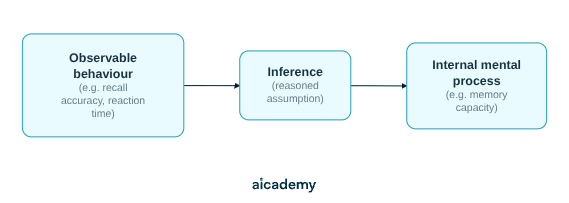
An inference is not a direct observation. This distinction matters: the cognitive approach never claims to see mental processes, only to reason about them from measurable behaviour.

The Use of Models

To explain and make inferences about mental processes, cognitive psychologists build models — simplified representations of what the mind might be doing. Two types appear in the specification.

Theoretical models are usually shown as diagrams that break a mental process into a sequence of stages. The most important example is the information processing model, which treats the mind like a system that handles information in steps:
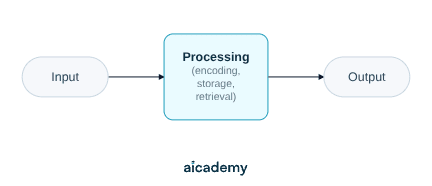
Information enters through the senses (input), is worked on by the mind (processing — encoding it, storing it, and later retrieving it), and produces a behavioural response (output).

Computer models take this further by using the computer analogy: the mind is compared to a computer, with the senses as input devices, mental processes as the central processor and software, and behaviour as the output. Researchers can even write computer programs to simulate a theory of how the mind works and test whether it produces human-like results.

Model typeWhat it isExample
Theoretical modelA diagram of the stages in a mental processThe information processing model
Computer modelThe mind compared to, or simulated on, a computerPrograms that mimic problem-solving

A model is a simplified representation, not a literal claim. Its job is to explain a process and let researchers make testable inferences about the mind.

(Note — in the current AQA 7182 specification, cognitive neuroscience is placed under the biological approach, so it is examined there, not as part of the cognitive approach.)

Worth saving these ideas?

Turn what you've read into instant revision cards. Free to get started.

Make flashcards

Evaluation

The cognitive approach must be evaluated (AO3) as well as described. Aim for a few developed points, each stating the point, explaining it, and drawing out its consequence.

Strength — scientific and objective methods. The approach relies on controlled laboratory experiments to study mental processes. This means data is gathered under carefully controlled conditions, giving the approach scientific credibility and making its findings replicable. This is a clear advantage over approaches, such as the psychodynamic approach, that rest on less measurable concepts.

Strength — real-world application. The approach has produced valuable practical benefits. Understanding faulty thinking underpins cognitive behaviour therapy (CBT), a widely used treatment for depression. Cognitive research into memory has improved the reliability of eyewitness testimony (for example, the cognitive interview), and the field has contributed to the development of artificial intelligence. This demonstrates the approach's value beyond the laboratory.

Limitation — machine reductionism. The computer analogy can be criticised as too simplistic. Comparing the mind to a computer ignores the influence of human emotion and motivation on how we process information. For instance, research shows that anxiety can distort memory in ways that a computer, which processes data identically every time, would not — so the analogy may weaken the validity of its conclusions.

Limitation — reliance on inference and artificial tasks. Because mental processes cannot be observed, conclusions rest on inference, and much research uses artificial laboratory tasks (such as recalling nonsense word lists). This can make findings abstract and low in ecological validity, so they may not represent how the mind works in everyday life.

A good evaluation weighs strengths against limitations rather than listing them. The scientific rigour of the approach is genuine, but it is bought at the cost of artificial tasks and a machine analogy that strips out emotion.

Common Exam Mistakes

1. Listing cognitive neuroscience as part of the cognitive approach

In the current AQA 7182 specification, cognitive neuroscience is under the biological approach, not the cognitive approach. Writing about brain scanning as cognitive-approach content here can lose relevance credit — cover it in the biological-approach material instead.

2. Describing schemas as only helpful

Schemas speed up processing and fill gaps, but they also distort perception and memory, causing errors and biases. An answer that only praises schemas as efficient misses half the point the examiner is looking for.

3. Confusing inference with direct observation

The cognitive approach infers mental processes from behaviour; it does not observe them directly. Saying that cognitive psychologists "observe memory" or "see thinking happen" misrepresents the whole method.

4. Saying the cognitive approach ignores mental processes

This confuses it with behaviourism. The behaviourist approach ignores internal mental processes; the cognitive approach was founded precisely to study them. Getting these the wrong way round is a frequent and costly error.

5. Treating the computer analogy as literal

The computer model is a simplified representation, not a claim that the brain is a computer. Presenting the analogy as literal truth leaves an answer open to the machine reductionism criticism without acknowledging it.

Key terms

Internal mental processes
Private operations of the mind, such as memory, perception, attention and thinking, that mediate between a stimulus and a response and cannot be observed directly.
Schema
A mental framework of beliefs and expectations, built from experience, that organises and interprets information and helps the brain process it quickly.
Inference
A reasoned assumption made about the internal mental processes occurring, based on observing a person's behaviour, since the processes themselves cannot be seen.
Theoretical model
A simplified, often diagrammatic representation of the steps involved in a mental process, such as the information processing model, used to explain how the mind works.
Information processing model
A model that describes the mind as handling information in a sequence of stages: input from the senses, processing, and output as a response, involving encoding, storage and retrieval.

Frequently asked questions

The cognitive approach assumes that internal mental processes, such as memory, perception and thinking, can be studied scientifically. Because these processes cannot be seen directly, it studies them indirectly by observing behaviour and making inferences, often using models such as the information processing model and the computer analogy.

A schema is a mental framework of beliefs and expectations built from experience. Schemas let us process large amounts of information quickly and fill in gaps, but they can also distort perception and memory, leading to errors and biases when new information is forced to fit an existing schema.

Not in the current AQA 7182 specification. Cognitive neuroscience is now listed under the biological approach, so it is examined there. In older specifications it sat under the cognitive approach, which is a common source of confusion.

Generate revision on any topic you study

Type any topic you're studying and Aicademy generates a complete lesson, quiz, and flashcard set, personalised to your level.

Lessons on anything

Structured, level-matched lessons on any topic you study

Practice quizzes

Find out what you actually know before the exam does

Flashcard sets

Lock in key concepts with instant revision cards

Ask Aica

Stuck on something? Get a clear explanation, any time

Prev

Social Learning Theory

Next

The Biological Approach

Related lessons

9 min

Lesson

The Behaviourist Approach

A-Level Psychology · AQA 7182

20 days ago

10 min

Lesson

Social Learning Theory

A-Level Psychology · AQA 7182

20 days ago

8 min

Top students don’t revise more. They revise what counts.

Start revising free

Free to start. No card needed.