Track progress, take quizzes and save notes on this lesson.

Free forever · no card needed

Start free
Intermediate

Trigonometry: SOHCAHTOA

G20·G21

Aligned to the Pearson Edexcel 1MA1 specification

Level
Intermediate
Reading time
7 min
Published
12 June 2026
Updated
1 July 2026
On this page
  1. 1.The Three Trigonometric Ratios
  2. 2.Labelling the Sides
  3. 3.Finding a Missing Side
  4. 4.Finding a Missing Angle
  5. 5.Exact Trigonometric Values
  6. 6.Choosing the Right Ratio
  7. 7.Common Exam Mistakes

Key takeaways

  • SOH CAH TOA: sin(theta) = opposite/hypotenuse, cos(theta) = adjacent/hypotenuse, tan(theta) = opposite/adjacent. These ratios are not on the formula sheet.
  • Label sides relative to the angle you are working with, not the right angle: hypotenuse is always longest and opposite the right angle; opposite faces theta; adjacent is next to theta.
  • To find a missing angle, use the inverse function: if sin(theta) = 0.6, then theta = sin^-1(0.6). Writing sin(0.6) applies the wrong operation.
  • Always check your calculator is in degree mode (D) before any trig calculation; radian mode gives completely wrong answers with no obvious error message.
  • Exact trig values for 30, 45, 60 degrees must be memorised for non-calculator papers: sin(30) = 1/2, sin(45) = sqrt(2)/2, sin(60) = sqrt(3)/2, and tan(45) = 1.

The Three Trigonometric Ratios

In a right-angled triangle, three ratios connect each acute angle to the side lengths. These are sine, cosine, and tangent, remembered with the mnemonic SOH CAH TOA:

Mnemonic partRatioFormula
SOHSineOpposite ÷ Hypotenuse
CAHCosineAdjacent ÷ Hypotenuse
TOATangentOpposite ÷ Adjacent

These ratios are the same for any right-angled triangle containing that angle — the side lengths scale, but the ratios do not change. A 35° angle always produces the same sine value, no matter how large the triangle is.

SOHCAHTOA is not given on the formula sheet. You must know all three ratios.

Labelling the Sides

The three sides are named relative to the angle θ you are working with — not the right angle.

Hypotenuse — always the longest side; always opposite the right angle. Does not change when you switch angles.

Opposite — the side directly facing angle θ.

Adjacent — the remaining side, next to θ (not the hypotenuse).

If you move to a different angle in the same triangle, opposite and adjacent swap — the hypotenuse stays the same.

Worked example — In a right-angled triangle with sides 5, 12, and 13, label all three sides for the angle θ at the bottom-left (the angle facing the side of length 5):
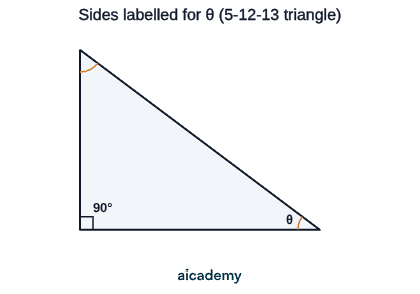
SideLengthReason
Hypotenuse13Longest side; opposite the right angle
Opposite5Directly facing θ
Adjacent12Remaining side; next to θ

If instead θ is the angle facing the side of length 12: opposite = 12, adjacent = 5, hypotenuse = 13 (unchanged).

Always label all three sides before choosing a ratio. Skipping this step is the single most common reason students pick the wrong ratio.

Finding a Missing Side

Choose the ratio that links the known angle, the known side, and the unknown side. Substitute, then rearrange.

Worked example 1 — Find the side opposite a 35° angle in a right-angled triangle with hypotenuse 12 cm.

Sides involved: opposite (unknown) and hypotenuse (12 cm) → use sin.

Worked example 2 — The side adjacent to a 48° angle is 9 cm. Find the hypotenuse.

Sides involved: adjacent (9 cm) and hypotenuse (unknown) → use cos.

When the unknown side is on the bottom of the fraction, divide the known value by the trig ratio. Multiplying instead is one of the most common errors on this topic.

Finding a Missing Angle

To find an angle from a known ratio, use the inverse trig functions: , , (also written arcsin, arccos, arctan on some calculators).

If , then .

Worked example 1 — Find angle θ where opposite = 7 cm and adjacent = 10 cm.

Sides involved: opposite and adjacent → use tan.

Worked example 2 — Find angle θ where the adjacent side is 9 cm and hypotenuse is 15 cm.

Before pressing any trig key, confirm your calculator shows D (degrees), not R (radians) or G (gradians). In radian mode, sin(35) = 0.428 not 0.574 — answers will be wrong by a large margin.

How much of this have you taken in?

Quiz yourself on this section, free, no card needed.

Test myself

Exact Trigonometric Values

For specific angles, exact trig values must be known without a calculator. These appear in Paper 1 (non-calculator) and in questions requiring exact answers.

θsin θcos θtan θ
30°
45°
60°
90°

G21 requires tan values for 0°, 30°, 45°, and 60° only. Tan 90° is undefined (adjacent side has zero length) but is not required by the specification.

Key patterns: sin and cos for 30° and 60° are swapped (); because opposite = adjacent in a 45–45–90 triangle.

Worked example — Without a calculator, find the exact hypotenuse in a right-angled triangle where the opposite side to 60° is 8 cm.

Choosing the Right Ratio

The two sides you are working with (one known, one unknown) determine the ratio. Use the table below to read off the ratio directly.

Sides involvedRatioStandard form
Opposite + Hypotenusesin
Adjacent + Hypotenusecos
Opposite + Adjacenttan

Process to use every time:

  1. Mark the right angle, then mark angle θ.
  2. Label hypotenuse (longest), opposite (facing θ), adjacent (next to θ).
  3. Identify the two sides you know or need.
  4. Read the ratio from the table.
  5. Write the equation, substitute, solve.

Worked example — A ladder 6 m long leans against a wall with its base 2 m from the wall. Find the angle the ladder makes with the ground.

The 6 m ladder is the hypotenuse. The 2 m base is adjacent to the ground angle θ. Sides: adjacent and hypotenuse → use cos.

Common Exam Mistakes

1. Calculator set to radians instead of degrees

Trig values in radian mode are completely different from degree mode. Check for D on the display before every trig calculation. This error produces answers that are wrong by a large, hard-to-spot margin.

2. Mislabelling opposite and adjacent

The labels depend on which angle θ you are using. Students often label the sides once and forget to re-label when a question asks about a different angle. Hypotenuse is always safe — it never changes.

3. Forgetting the inverse function when finding an angle

gives a ratio, not an angle. You must press to get . Writing applies the wrong operation.

4. Dividing in the wrong direction

If , then , not . A quick sanity check: the hypotenuse is always the longest side, so the result must be greater than 8.

5. Not giving exact answers on non-calculator questions

When a question involves 30°, 45°, or 60° and says "give an exact answer", leave the result in surd form — for example , not a decimal approximation.

Key terms

hypotenuse
The longest side of a right-angled triangle, always opposite the right angle. It does not change when you switch reference angles.
opposite
The side of a right-angled triangle that faces the angle theta being worked with.
adjacent
The side of a right-angled triangle that is next to angle theta but is not the hypotenuse.
sine (sin)
A trigonometric ratio equal to opposite divided by hypotenuse in a right-angled triangle.
cosine (cos)
A trigonometric ratio equal to adjacent divided by hypotenuse in a right-angled triangle.
tangent (tan)
A trigonometric ratio equal to opposite divided by adjacent in a right-angled triangle.
inverse trig function
sin^-1, cos^-1, or tan^-1; used to find an angle when the ratio is known.

Frequently asked questions

Identify the two sides involved: opposite and hypotenuse use sin, adjacent and hypotenuse use cos, opposite and adjacent use tan. Label all three sides relative to angle theta before choosing.

Check your calculator is in degree mode, shown by a D on the display. In radian mode, sin(35) gives 0.428 instead of 0.574, making all answers incorrect by a large margin.

You must know sin and cos for 0, 30, 45, 60, 90 degrees and tan for 0, 30, 45, 60 degrees. Key values: sin(30) = cos(60) = 1/2; sin(45) = cos(45) = sqrt(2)/2; tan(45) = 1; tan(60) = sqrt(3).

Generate revision on any topic you study

Type any topic you're studying and Aicademy generates a complete lesson, quiz, and flashcard set, personalised to your level.

Lessons on anything

Structured, level-matched lessons on any topic you study

Practice quizzes

Find out what you actually know before the exam does

Flashcard sets

Lock in key concepts with instant revision cards

Ask Aica

Stuck on something? Get a clear explanation, any time

Prev

The Quadratic Formula

Related lessons

6 min

Lesson

Pythagoras and Trigonometry

Edexcel GCSE Mathematics · Pearson Edexcel 1MA1

1 month ago

7 min

Lesson

Circle Theorems

Edexcel GCSE Mathematics · Pearson Edexcel 1MA1

1 month ago

Top students don’t revise more. They revise what counts.

Start revising free

Free to start. No card needed.