Probability Trees

Aligned to the Pearson Edexcel 1MA1 specification
- Topic
- Probability
- Level
- Intermediate
- Reading time
- 7 min
- Published
- 12 June 2026
- Updated
- 16 August 2026
On this page
Key takeaways
- Multiply probabilities along a path (AND rule) to find the probability of a combined outcome; add probabilities across paths (OR rule) when the outcome can happen in more than one way.
- All branch probabilities from the same point must sum to 1. Always check this before multiplying along any path.
- For without-replacement problems, the probabilities on the second set of branches change after the first pick because the total number of items decreases.
- For 'at least one' questions, the complement method 1 - P(none) is usually faster and safer than listing every path containing the outcome.
- Write the probability on the branch itself, not at the tip, to avoid layout errors that lead to wrong calculations.
Drawing a Tree Diagram
Start from a single point on the left. Draw one branch for each outcome of the first event, labelling each branch with its probability. From the end of each branch, draw another set of branches for the second event.
Worked example — A spinner has outcomes Red (probability 0.3) and Blue (probability 0.7). It is spun twice. Draw the tree diagram.
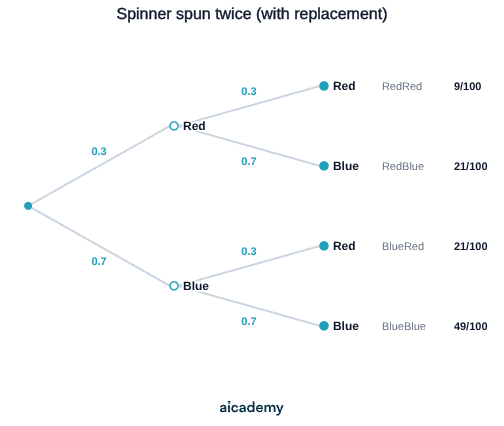
Each stage has probabilities that sum to 1: ✓ at every branch point.
Always write the probability on the branch, not at the end of the branch. Placing probabilities at the tips is a common layout error that confuses calculations.
How much of this have you taken in?
Quiz yourself on this section, free, no card needed.
Dependent Events: Without Replacement
When items are selected without replacement, the probability on the second branch depends on what happened on the first branch. The branches at the second stage change based on the first outcome.
Worked example — A bag contains 3 red balls and 2 blue balls. Two balls are drawn without replacement. Find the probability that both are red, and the probability of getting one of each colour.
After drawing 1 red: 2 red and 2 blue remain (4 total). After drawing 1 blue: 3 red and 1 blue remain (4 total). Notice how the second-stage probabilities differ between the two top branches because the contents of the bag have changed.
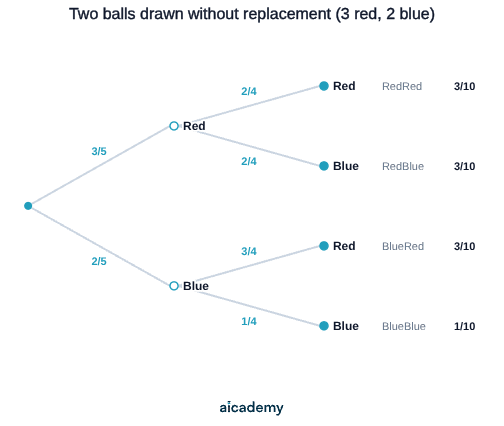
| Path | Calculation | Probability |
|---|---|---|
| Red then Red | ||
| Red then Blue | ||
| Blue then Red | ||
| Blue then Blue |
Check: ✓
Key terms
- Tree diagram
- A branching diagram where each branch shows one outcome of one event and the probability along that branch; paths represent combined outcomes.
- Independent events
- Events where the outcome of the first does not affect the probabilities of the second; used in with-replacement problems.
- Dependent events
- Events where the outcome of the first changes the probabilities at the next stage; occurs in without-replacement problems.
- Complement
- The complement of event A is everything that is not A; P(A) = 1 - P(not A).
Frequently asked questions
Multiply along a path for outcomes that happen in sequence on the same path (AND). Add across separate paths when more than one path satisfies your condition (OR).
The probabilities on the second stage change because one item has been removed. The denominator decreases by 1 after each pick, so use the updated total at each branch.
Use the complement: P(at least one) = 1 - P(none). This avoids listing every individual path and reduces the chance of missing one.
Generate revision on any topic you study
Type any topic you're studying and Aicademy generates a complete lesson, quiz, and flashcard set, personalised to your level.
Lessons on anything
Structured, level-matched lessons on any topic you study
Practice quizzes
Find out what you actually know before the exam does
Flashcard sets
Lock in key concepts with instant revision cards
Ask Aica
Stuck on something? Get a clear explanation, any time
nth Term of Linear Sequences
Simultaneous Equations
Related lessons
7 min
Probability — Basics and Possibility Spaces
Edexcel GCSE Mathematics · Pearson Edexcel 1MA1
4 months ago
7 min
Combined and Conditional Probability
Edexcel GCSE Mathematics · Pearson Edexcel 1MA1
4 months ago