Combined and Conditional Probability

Aligned to the Pearson Edexcel 1MA1 specification
- Topic
- Probability
- Level
- Advanced
- Reading time
- 7 min
- Published
- 12 June 2026
- Updated
- 16 August 2026
On this page
Key takeaways
- For independent events, P(A and B) = P(A) x P(B). For dependent events without replacement, adjust both the numerator and denominator for the second draw.
- Conditional probability P(A given B) = P(A and B) / P(B). The denominator is P(B) or n(B), not the total sample size.
- For non-mutually exclusive events, P(A or B) = P(A) + P(B) - P(A and B). Forgetting to subtract the overlap is a common error.
- Two events are independent if and only if P(A and B) = P(A) x P(B). If items are drawn without replacement, the events are dependent.
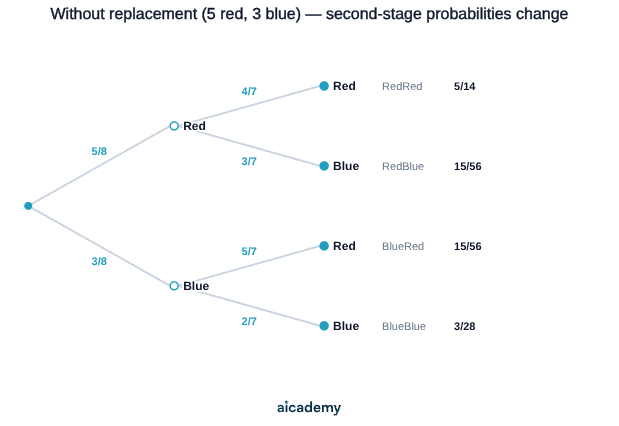
Dependent Events — Without Replacement (P8)
When an item is not replaced, the probabilities on the second draw depend on what happened first.
Worked example — a bag has 5 red and 3 blue balls. Two balls are drawn without replacement. Find .
First draw:
Second draw (given red drawn first): (4 red remain out of 7 total)
✓
Worked example — find :
;
✓
Conditional Probability from Venn Diagrams (P9 Higher)
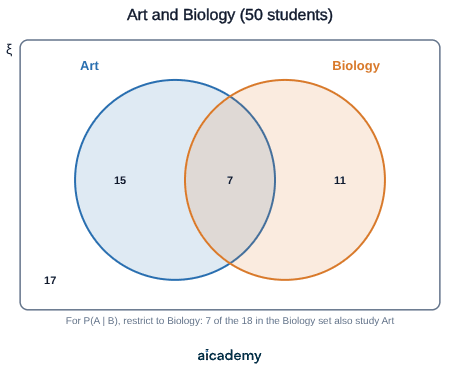
Using a Venn diagram with known frequencies, conditional probabilities are found by restricting to the given set.
Worked example — students: studies Art (), studies Biology (), .
— given the student studies Biology, look only within the Biology set.
✓
Expected frequencies approach (P9 Higher): instead of fractions, set up a 100-person (or 1000-person) table with expected counts matching the given probabilities, then read off the conditional probability directly.
Worked example — , , . Use a frequency tree of 1000 people to find .
From 1000: : 400 people; : ; : 600 people; : .
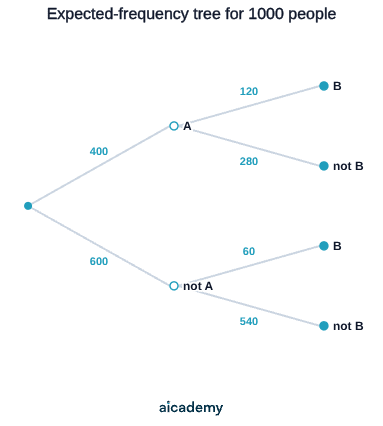
Total : . ✓
Want more lessons like this one?
Generate lessons on anything you study. Free account, no card needed.
Key terms
- Independent events
- Two events where the outcome of one does not affect the probability of the other; valid only when sampling with replacement.
- Dependent events
- Two events where the outcome of the first changes the probability of the second, as occurs when sampling without replacement.
- Conditional probability
- The probability of event A given that event B has already occurred, written P(A given B) = P(A and B) / P(B).
- Mutually exclusive events
- Events that cannot both occur at the same time; P(A and B) = 0 and P(A or B) = P(A) + P(B).
- Tree diagram
- A branching diagram showing the probabilities of sequences of events; multiply along branches and add across outcomes.
Frequently asked questions
Read the relevant row or column totals. For conditional probability, restrict to the given row or column. For example, P(coffee given male) uses only the male row total as the denominator.
After the first draw, reduce the total count by 1 and reduce the count for whichever item was drawn by 1. The second-branch probabilities are different from the first-branch probabilities.
Start with a large number (e.g. 1000 people) and apply each probability as a multiplier to get expected counts. Then P(A given B) = number in both A and B divided by total number in B.
Generate revision on any topic you study
Type any topic you're studying and Aicademy generates a complete lesson, quiz, and flashcard set, personalised to your level.
Lessons on anything
Structured, level-matched lessons on any topic you study
Practice quizzes
Find out what you actually know before the exam does
Flashcard sets
Lock in key concepts with instant revision cards
Ask Aica
Stuck on something? Get a clear explanation, any time
Probability — Basics and Possibility Spaces
Data Representation and Averages
Related lessons
7 min
Probability — Basics and Possibility Spaces
Edexcel GCSE Mathematics · Pearson Edexcel 1MA1
4 months ago
7 min