Track progress, take quizzes and save notes on this lesson.

Free forever · no card needed

Start free
Intermediate

The UK Supreme Court

Paper 2, 4.1 The Supreme Court and its interactions with, and influence over, the legislative and policy-making processes

Aligned to the Pearson Edexcel 9PL0 specification

Level
Intermediate
Reading time
17 min
Published
9 September 2026
On this page
  1. 1.Creating the Supreme Court: Why 2009 Changed the Judiciary
  2. 2.Judicial Independence: What Guarantees It
  3. 3.Judicial Neutrality and the Charge of Activism
  4. 4.Judicial Review and the Doctrine of Ultra Vires
  5. 5.Case Study: UNISON and the Employment Tribunal Fees
  6. 6.Case Study: The Two Miller Rulings
  7. 7.How Far Does the Court Actually Influence Parliament and the Executive?
  8. 8.Exam Focus: Common Mistakes

Key takeaways

  • The Constitutional Reform Act 2005 created the Supreme Court, which opened on 1 October 2009 and took the UK's final court of appeal out of the House of Lords for the first time.
  • Judicial independence is protected by security of tenure, Consolidated Fund salaries and the sub judice rule; judicial neutrality is protected by political restriction and reasoned public judgments.
  • Judicial review lets the courts quash executive action and secondary legislation that is ultra vires, irrational or procedurally improper — UNISON (2017) struck down employment tribunal fees on exactly this basis.
  • The Court can rule an Act of Parliament incompatible with the Human Rights Act, but it cannot strike the Act down: Parliament decides whether to change the law.
  • Parliament can legislate around a ruling it dislikes, as it did with the Safety of Rwanda Act 2024 after the Court held in 2023 that removals to Rwanda were unlawful.

Creating the Supreme Court: Why 2009 Changed the Judiciary

The Supreme Court is the final court of appeal in the UK political system. It was created by the Constitutional Reform Act 2005 and opened on 1 October 2009 in the Middlesex Guildhall, directly across Parliament Square from the Palace of Westminster.

Before 2009 the top court in the land was the Appellate Committee of the House of Lords, staffed by senior judges known as the Law Lords, who sat physically inside the legislature and could speak and vote there. The same 2005 Act stripped the Lord Chancellor of the roles of head of the judiciary and Speaker of the House of Lords. Together these changes separated the top of the judiciary from the other two branches for the first time.

FeatureBefore October 2009Since October 2009
Final court of appealAppellate Committee of the House of LordsThe Supreme Court
LocationInside the Palace of WestminsterMiddlesex Guildhall, a separate building
Judges' statusLife peers, entitled to sit and vote in the LordsJustices, disqualified from sitting in the Lords while in office
Head of the judiciaryThe Lord Chancellor, a serving Cabinet ministerThe Lord Chief Justice

Composition. The Court has twelve Justices, led by a President and a Deputy President. Cases are heard by odd-numbered panels — usually five, and seven or nine for constitutionally significant appeals. As of September 2026:

OfficeHolderNote
PresidentLord ReedSucceeded Lady Hale in January 2020
President-designateLord Briggs of WestbourneAppointed to take office in January 2027; he will be the Court's fifth President since 2009
Deputy PresidentLord SalesIn post since 12 January 2026
Most recent appointmentLord DohertyJoined the Court on 12 January 2026

Jurisdiction. The Court hears civil appeals from all four nations, criminal appeals from England, Wales and Northern Ireland, and disputes about the powers of the devolved institutions. Scottish criminal appeals end at the High Court of Justiciary in Edinburgh, so the Supreme Court is not the final criminal court for Scotland.

Judicial Independence: What Guarantees It

Judicial independence means judges decide cases free from pressure by the executive, Parliament or any outside interest. It is protected by a stack of specific mechanisms, and you should be able to name them rather than assert the principle in the abstract.

  • Security of tenure. Senior judges hold office during good behaviour and can be removed only on an address from both Houses of Parliament. No senior judge has been removed by this route in modern times, so a Justice who rules against the government of the day faces no career risk.
  • Guaranteed salaries. Judicial pay is charged to the Consolidated Fund, which means it is not voted on annually by MPs. Ministers cannot squeeze a court's budget in response to a judgment.
  • The sub judice rule. MPs and peers refrain from debating cases that are live before the courts, insulating a hearing from parliamentary pressure.
  • A statutory duty on ministers. Section 3 of the Constitutional Reform Act 2005 obliges the Lord Chancellor and other ministers to uphold the continued independence of the judiciary and bars them from seeking to influence particular decisions.
  • An independent appointments route. A Justice is chosen by an ad hoc selection commission chaired by the Court's President and including members drawn from the judicial appointments bodies of England and Wales, Scotland and Northern Ireland, with lay membership. The Lord Chancellor may ask the commission to reconsider, but cannot simply pick a preferred candidate.
  • Physical and institutional separation. Since 2009 the Justices sit outside Parliament and are disqualified from the House of Lords while in office.

Eligibility is set by statute: two years in high judicial office, or fifteen years as a qualifying legal practitioner. In practice appointees are drawn from the senior appeal courts, which narrows the field considerably.

Where independence is questioned. The Lord Chancellor retains a role in the process, and is a serving politician. Governments have also legislated to narrow the courts' reach — the Judicial Review and Courts Act 2022 gave judges the option of suspended and prospective-only quashing orders and abolished "Cart" judicial reviews, one route by which Upper Tribunal permission decisions could be challenged in the High Court. Critics argued this was the executive trimming the check on itself; the government argued it was Parliament, not ministers, setting the courts' jurisdiction.

Judicial Neutrality and the Charge of Activism

Judicial neutrality is a separate idea from independence. Independence concerns pressure from outside; neutrality concerns bias from within — a judge's own political preferences.

How neutrality is protected:

  • Justices are politically restricted: they do not campaign, hold party office or make partisan public interventions.
  • Every judgment is published with full legal reasoning, so the argument can be tested in public and in the academic literature.
  • Panels of five, seven, nine or eleven Justices dilute any individual's outlook, and dissenting opinions are published openly.
  • An appeals hierarchy exists precisely so that an aberrant decision can be corrected.

Where neutrality is challenged:

CriticismThe evidenceThe counter-argument
Narrow social backgroundThe 2019 Elitist Britain study by the Sutton Trust and the Social Mobility Commission found around 65% of senior judges had attended independent schools, against about 7% of the populationBackground is not the same as bias; judgments are reasoned in public and can be scrutinised line by line
Slow progress on diversityLady Hale became the first female Law Lord in 2004 and the Court's first female President in 2017; women remained a small minority of JusticesThe pool is drawn from senior appellate judges appointed decades earlier, so change lags
Judicial activismRulings such as the 2019 prorogation case took the Court into territory previously treated as politicalThe Court decided a question of law about the limits of a prerogative power, and said so expressly

A concrete flashpoint. After the High Court ruled against the government at first instance in the Article 50 litigation, the Daily Mail front page of 4 November 2016 labelled the three judges "Enemies of the People". The then Lord Chancellor was widely criticised for a slow and thin defence of the judiciary — a live test of the section 3 duty. Use this example to argue that the statutory protection of independence depends on ministers being willing to enforce it.

Judicial Review and the Doctrine of Ultra Vires

Judicial review is the process by which the courts test whether a public body acted lawfully. It is the main channel through which the Supreme Court influences the executive and the policy-making process.

Judicial review examines how a decision was reached, not whether it was wise. The classic grounds were set out by Lord Diplock in the 1985 GCHQ case:

  • Illegality — the body acted outside the powers Parliament gave it. This is the doctrine of ultra vires, "beyond the powers".
  • Irrationality — the decision was so unreasonable that no sensible authority could have reached it.
  • Procedural impropriety — required consultation, notice or fairness was skipped.
  • Where Convention rights are engaged, courts also ask whether the interference was proportionate.

The remedy depends on what is being challenged, and this fork is the single most examined point in the topic.
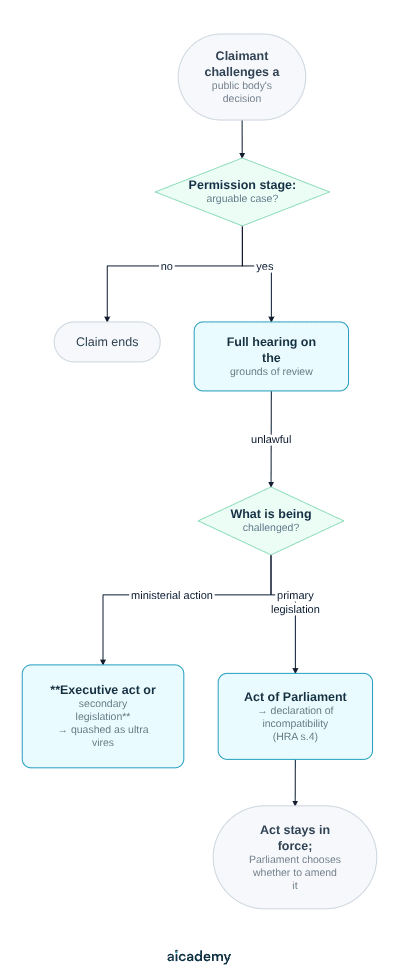
Flowchart of a judicial review claim: permission, then a hearing, then a fork — executive acts and secondary legislation are quashed as ultra vires, while an Act of Parliament gets only a declaration of incompatibility and stays in force until Parliament amends it.

Under section 3 of the Human Rights Act 1998 courts must read legislation compatibly with Convention rights so far as it is possible to do so. Only where that is impossible do they fall back on the section 4 declaration — which changes nothing legally, and is a signal to Parliament rather than an order to it.

Something not quite clicking?

Ask Aica to explain any part of this differently. Free, takes 30 seconds.

Ask Aica

Case Study: UNISON and the Employment Tribunal Fees

R (UNISON) v Lord Chancellor [2017] UKSC 51, decided on 26 July 2017, is the cleanest worked example of ultra vires in the specification, because the ruling turned on the scope of a delegated power rather than on politics.

The facts. In July 2013 the Lord Chancellor made an order requiring claimants to pay fees to bring an employment tribunal claim — up to £1,200 for the more serious categories, including discrimination and unfair dismissal. The order was secondary legislation, made under a power granted by the Tribunals, Courts and Enforcement Act 2007.

What happened next. The number of single claims brought to employment tribunals fell by roughly two-thirds in the years after the fees took effect. The trade union UNISON argued that a fee regime which priced low-paid workers out of enforcing their statutory rights defeated the purpose of the rights themselves.

The ruling. A seven-Justice panel found unanimously for UNISON. The reasoning ran in three steps:

  1. Access to the courts is a constitutional right at common law, long predating the Human Rights Act.
  2. Parliament, when it delegated a fee-setting power in 2007, did not authorise the minister to set fees at a level that effectively prevents access.
  3. The order was therefore ultra vires — outside the power granted — and was quashed from the moment it was made.

The consequences. Fees were abolished immediately and the government undertook to refund those already paid, a sum reported in the tens of millions of pounds. Note carefully what the Court did not do: it did not rule that tribunal fees are unconstitutional in principle. Parliament could authorise them by primary legislation. The Court policed the boundary of a delegated power; it did not remove Parliament's ability to redraw that boundary.

Case Study: The Two Miller Rulings

The two cases brought by Gina Miller are the most cited examples of the Court's influence over the executive, and they make different points. Do not merge them.

Miller 1 (2017): the executive cannot bypass Parliament

R (Miller) v Secretary of State for Exiting the European Union [2017] UKSC 5 was decided on 24 January 2017 by eight Justices to three. The government argued it could give notice under Article 50 using the royal prerogative, the residual executive powers exercised in the monarch's name. The Court disagreed: withdrawal would remove rights created by an Act of Parliament, and only an Act of Parliament could do that.

Parliament responded within seven weeks by passing the European Union (Notification of Withdrawal) Act 2017, and notice was given on 29 March 2017. The Court also held unanimously that the Sewel Convention, under which Westminster does not normally legislate on devolved matters without consent, is a political convention the courts cannot enforce.

Read carefully, Miller 1 is a ruling for parliamentary sovereignty. The Court restrained the executive by insisting that Parliament, not ministers, must take the decision.

Miller 2 (2019): prerogative powers have legal limits

R (Miller) v The Prime Minister; Cherry v Advocate General for Scotland [2019] UKSC 41 was decided on 24 September 2019 by all eleven sitting Justices, unanimously. Boris Johnson had advised the Queen to prorogue Parliament for five weeks at the height of the Brexit deadlock.

The Court held that a prorogation which frustrates Parliament's ability to carry out its constitutional functions, without reasonable justification, is unlawful. The prorogation was declared null and of no effect, and the Commons resumed sitting the following day.

Miller 1 (2017)Miller 2 (2019)
QuestionCould ministers trigger Article 50 alone?Could the PM prorogue Parliament for five weeks?
Decision8–3 against the government11–0 against the government
Principle establishedPrerogative cannot remove statutory rightsPrerogative cannot frustrate Parliament's functions
OutcomeParliament legislated, then notice givenParliament resumed the next day

How Far Does the Court Actually Influence Parliament and the Executive?

This is the evaluative heart of section 4.1, and the honest answer is asymmetric: substantial influence over the executive, sharply limited influence over Parliament.

The case that the Court's influence is significant:

  • Ministers lose. UNISON, Miller 1 and Miller 2 were each defeats for a sitting government on a flagship policy or tactic.
  • Judicial review has grown from a specialised remedy into a routine feature of government, and departments now legal-proof policy before announcing it. This anticipatory effect is invisible in case reports but shapes policy continuously.
  • Under the Human Rights Act the Court can force a public argument about rights, and most declarations of incompatibility that survived appeal have been answered by changing the law.
  • The Court decides where devolved competence ends, giving it a settled role in the constitutional architecture.

The case that its influence is limited:

  • It cannot strike down an Act of Parliament. Parliamentary sovereignty is the fixed constraint.
  • Parliament can reverse it. In HM Treasury v Ahmed (January 2010) the Court quashed a terrorist asset-freezing order as ultra vires; Parliament restored the freezes by statute within weeks.
  • Parliament can legislate against a factual finding. In November 2023 the Court held unanimously in R (AAA) v Home Secretary that removing asylum seekers to Rwanda was unlawful because Rwanda was not a safe third country. Parliament responded with the Safety of Rwanda (Asylum and Immigration) Act 2024, which required decision-makers to treat Rwanda as safe. The policy was then abandoned by the incoming government after the 2024 general election — a political decision, not a judicial one.
  • The Court is reactive. It waits for a claimant, a set of facts and a legal question. It has no power to initiate.
  • Governments can narrow its reach, as the Judicial Review and Courts Act 2022 did.

A defensible judgement: the Supreme Court is a strong check on ministers and a weak check on Parliament. Because a governing party with a Commons majority controls Parliament, a determined government can usually legislate its way past a ruling — which is why the Court's influence looks larger in a hung Parliament than in one with a large majority.

Exam Focus: Common Mistakes

1. Saying the Court can "overrule" or "strike down" laws

It can quash executive action and secondary legislation. Against an Act of Parliament its only tool is a declaration of incompatibility, which leaves the Act fully in force. An answer that blurs the two is describing a power the Court does not have.

2. Treating independence and neutrality as one idea

Section 4.1 names both, and they are protected by different mechanisms. Tenure, Consolidated Fund salaries and the sub judice rule protect independence. Political restriction, reasoned judgments and dissenting opinions protect neutrality. An answer that only discusses one has covered half the bullet point.

3. Confusing the UK Supreme Court with the US Supreme Court

A useful synoptic contrast, but the two are structurally different. The US Court can declare an Act of Congress unconstitutional; the UK Court cannot. US Justices are nominated by the President and confirmed by the Senate; UK Justices are chosen by an independent selection commission.

4. Merging Miller 1 and Miller 2

They were decided nearly three years apart, on different questions, by panels of different sizes, and they establish different principles. Name and date each one separately.

5. Using only pre-2010 examples

Section 4.1 rewards current evidence. UNISON (2017), Miller 2 (2019), the Rwanda ruling (2023) and the Safety of Rwanda Act (2024) are the workhorse examples; date each one.

6. Asserting bias from background alone

The narrow social composition of the senior judiciary is worth citing, with its 2019 source. Treating it as proof of biased judgments is an overclaim — say what it shows about the appearance of neutrality, and what it does not show about outcomes.

7. Reaching no judgement

The 30-mark command word is Evaluate, which carries 10 marks for AO3. Set out the Court's power over the executive against its weakness before Parliament, then commit to a line and justify it.

Key terms

Supreme Court
The final court of appeal in the UK political system, sitting at the top of the court hierarchy since October 2009.
Judicial independence
The principle that judges decide cases free from pressure or interference by the executive, Parliament or any other outside body.
Judicial neutrality
The principle that judges set aside their own political views and party loyalties, deciding each case on the law rather than on personal preference.
Judicial review
The process by which courts examine the lawfulness of decisions and secondary legislation made by public bodies, and set aside those that break the law.
Ultra vires
Latin for 'beyond the powers': a decision taken outside the legal authority Parliament granted, which a court can therefore quash.
Declaration of incompatibility
A formal statement under section 4 of the Human Rights Act 1998 that an Act of Parliament conflicts with a Convention right; the Act stays in force until Parliament amends it.
Sub judice
The rule that MPs and peers avoid discussing cases that are before the courts, so that parliamentary debate cannot influence a judgment.
Judicial activism
The criticism that judges reach beyond applying the law and instead make decisions that are properly political, expanding the courts' role at the expense of elected bodies.

Frequently asked questions

No. Parliamentary sovereignty means the Court cannot strike down primary legislation. It can quash secondary legislation and executive action that is ultra vires, and it can issue a declaration of incompatibility under the Human Rights Act 1998, which leaves the Act in force until Parliament changes it.

Independence is freedom from the other branches of government, especially the executive — protected by tenure, pay arrangements and the sub judice rule. Neutrality is freedom from a judge's own political preferences, protected by political restriction, reasoned judgments and the appeals system.

Ultra vires means acting beyond the legal powers granted to you. If a minister uses a power in a way Parliament did not authorise, the courts can quash the decision. It is the central ground of judicial review and the main way the judiciary constrains the executive.

Generate revision on any topic you study

Type any topic you're studying and Aicademy generates a complete lesson, quiz, and flashcard set, personalised to your level.

Lessons on anything

Structured, level-matched lessons on any topic you study

Practice quizzes

Find out what you actually know before the exam does

Flashcard sets

Lock in key concepts with instant revision cards

Ask Aica

Stuck on something? Get a clear explanation, any time

Prev

Prime Ministerial Power: Thatcher and Blair

Next

Executive and Parliament: Where Power Lies

Related lessons

17 min

Lesson

Where Sovereignty Lies in the UK

A-Level Politics · Pearson Edexcel 9PL0

2 hours ago

21 min

Lesson

Rights in Context

A-Level Politics · Pearson Edexcel 9PL0

2 hours ago

13 min

14 min

Lesson

Comparing the Supreme Courts and Rights

A-Level Politics · Pearson Edexcel 9PL0

2 hours ago

Top students don’t revise more. They revise what counts.

Start revising free

Free to start. No card needed.