Prime Ministerial Power: Thatcher and Blair

Aligned to the Pearson Edexcel 9PL0 specification
- Level
- Advanced
- Reading time
- 17 min
- Published
- 9 September 2026
On this page
- 1.Why the Specification Makes You Study Two Prime Ministers
- 2.Thatcher Dictating Events: The Falklands and the Miners
- 3.Thatcher Determining Policy: Monetarism, Selling the State, and Remaking the Cabinet
- 4.Where Thatcher Lost Control
- 5.Blair Dictating Events: 1997, Belfast and Iraq
- 6.Blair Determining Policy: Independence, Devolution and Public Services
- 7.Where Blair Lost Control
- 8.Comparing the Two: What Actually Determines Prime Ministerial Power
- 9.Exam Focus: Writing a 30-Mark Answer on Prime Ministerial Power
Key takeaways
- Section 3.3.2 requires one Prime Minister from 1945–97 and one from 1997 onwards, studied in equivalent depth, covering events and policy, with examples of both control and a lack of control.
- Thatcher dictated events through the Falklands War of 1982 and the miners' strike of 1984–85, and drove policy through monetarism, privatisation and the Right to Buy.
- Thatcher lost control over Westland in 1986, the poll tax after 1989 and Europe; she led the leadership ballot of 20 November 1990 by 204 votes to 152 but fell four short of the margin the rules required, and withdrew.
- Blair dictated events with the Belfast Agreement of April 1998 and the Iraq vote of 18 March 2003, and set policy through Bank of England independence and the devolution programme.
- Blair could not move Gordon Brown, lost the euro decision in June 2003, won tuition fees by five votes in January 2004 and was defeated on 90-day detention in November 2005.
Where Thatcher Lost Control
Prime ministerial power is easiest to see when it fails. Thatcher's failures were cumulative rather than sudden.
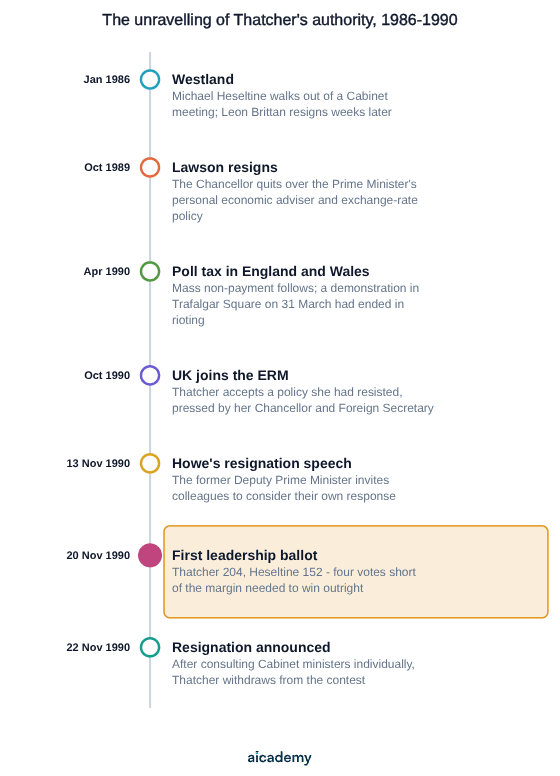
Westland, January 1986. A dispute over the rescue of a helicopter manufacturer became a constitutional argument about whether the Prime Minister was manipulating Cabinet procedure. Michael Heseltine walked out of a Cabinet meeting and resigned; Trade and Industry Secretary Leon Brittan resigned just over two weeks later, on 24 January 1986, over the leaking of a law officer's letter. A Prime Minister who could not hold a Cabinet meeting together over a mid-sized company had shown how much of her authority rested on consent.
The poll tax. The community charge replaced domestic rates with a flat-rate charge on individual adults: a duke and a labourer in the same authority paid the same. It reached Scotland in April 1989 and England and Wales in April 1990. Non-payment became a mass movement, and Conservative MPs in marginal seats concluded the policy would cost them their seats. John Major abolished it, replacing it with the council tax from 1993.
Europe. Her hostility to deeper integration divided her own Cabinet. Nigel Lawson resigned as Chancellor in October 1989; she was pressed into joining the Exchange Rate Mechanism in October 1990 against her instincts; and Geoffrey Howe resigned in November 1990, his resignation speech on 13 November triggering Heseltine's challenge the next day.
The end. In the first ballot on 20 November 1990 she led by 204 votes to 152 but fell four short of the 15% margin the rules required. She consulted her Cabinet one by one, found that most doubted she could win a second ballot, and announced her resignation on 22 November 1990. The Prime Minister who had dominated her party for eleven years was removed by roughly 150 of her own MPs.
How much of this have you taken in?
Quiz yourself on this section, free, no card needed.
Key terms
- War Cabinet
- A small committee of senior ministers formed to run a military conflict, meeting far more often than full Cabinet and reporting to it afterwards.
- Monetarism
- An economic approach that treats controlling the money supply, rather than managing demand, as the main route to low inflation, accepting higher unemployment as a cost.
- Privatisation
- Transferring a state-owned industry or utility into private ownership, usually by selling shares to the public and institutional investors.
- Poll tax
- The community charge, a flat-rate local tax levied on individual adults rather than on property values, introduced in Scotland in 1989 and in England and Wales in 1990.
- Backbench rebellion
- A vote by MPs of the governing party against their own government's line, which erodes a Prime Minister's authority even when the government still wins.
- Mandate
- The authority a governing party claims to carry out its programme, derived from winning a general election on that manifesto.
Frequently asked questions
You need one from 1945–97 and one from 1997 to the present, studied in equal depth. Margaret Thatcher (1979–90) and Tony Blair (1997–2007) are the best-evidenced pair, because both left clear records of controlling events and policy and of losing that control.
Her own MPs removed her. Europe split the Cabinet, the poll tax was widely resisted, and after Geoffrey Howe's resignation speech Michael Heseltine challenged her. She led the first ballot on 20 November 1990 by 204 to 152, four votes short of the required margin, and withdrew.
In style, largely yes: huge majorities, decisions taken in small groups, and an informal method the Butler Review criticised in July 2004. But he could not remove Gordon Brown, lost the euro decision in 2003 and was forced in September 2006 to announce his departure.
Generate revision on any topic you study
Type any topic you're studying and Aicademy generates a complete lesson, quiz, and flashcard set, personalised to your level.
Lessons on anything
Structured, level-matched lessons on any topic you study
Practice quizzes
Find out what you actually know before the exam does
Flashcard sets
Lock in key concepts with instant revision cards
Ask Aica
Stuck on something? Get a clear explanation, any time
The Prime Minister and the Cabinet
The UK Supreme Court
Related lessons
15 min
14 min
13 min
Comparing the President and the Prime Minister
A-Level Politics · Pearson Edexcel 9PL0
2 months ago