Track progress, take quizzes and save notes on this lesson.

Free forever · no card needed

Start free
Intermediate

Rights in Context

Paper 1, 1.4 Rights in context

Aligned to the Pearson Edexcel 9PL0 specification

Level
Intermediate
Reading time
21 min
Published
9 September 2026
On this page
  1. 1.Rights, Liberties and Responsibilities in the UK
  2. 2.From Magna Carta to the Bill of Rights
  3. 3.The Human Rights Act 1998 and How It Works
  4. 4.The Equality Act 2010
  5. 5.Liberty: Civil Liberties Through the Courts
  6. 6.The Howard League for Penal Reform
  7. 7.Where Rights Collide
  8. 8.Exam Focus: Common Mistakes

Key takeaways

  • Magna Carta 1215 established that the Crown is subject to law. Three clauses of its 1297 version remain on the statute book, including the guarantee of lawful judgement and justice that is not sold or delayed.
  • The Human Rights Act 1998 brought the European Convention on Human Rights into UK law from 2 October 2000. Courts read statutes compatibly where possible and may declare an Act incompatible, but cannot strike it down.
  • The Equality Act 2010 consolidated over forty years of anti-discrimination law into one statute built on nine protected characteristics, four forms of prohibited conduct and a duty on public bodies.
  • Liberty works mainly through strategic litigation and parliamentary briefing; the Howard League for Penal Reform works through research, legal casework for children in custody and long-run campaigning.
  • UK rights are not entrenched: the Human Rights Act can be repealed by an ordinary Act of Parliament, which is the central weakness critics identify in the UK's rights-based culture.

Rights, Liberties and Responsibilities in the UK

A right is an entitlement a person can claim and enforce. UK politics uses three overlapping labels for them, and the exam rewards keeping them apart.

  • Civil liberties are freedoms from the state: freedom of speech, assembly, association, and liberty of the person. They are protected by restraining government.
  • Human rights are entitlements held universally, by virtue of being a person, and set out in documents such as the European Convention on Human Rights.
  • Legal rights are whatever a particular legal system actually enforces at a given moment, which may be more or less than either of the above.

The British tradition was negative, not positive. For most of its history the UK had no list of rights at all. Freedom was residual: a citizen was free to do anything the law did not forbid, and the courts protected liberty by holding officials to the limits of their legal powers. That approach relies entirely on Parliament's restraint, because Parliament can forbid whatever it chooses.

UK rights therefore come from four sources at once:

SourceExample
Common lawThe presumption of innocence; the right to a fair hearing developed by judges over centuries
StatuteHuman Rights Act 1998, Equality Act 2010, Freedom of Information Act 2000
International treatyThe European Convention on Human Rights, ratified by the UK in 1951
Constitutional documentsMagna Carta 1215, Bill of Rights 1689

Rights are also paired with responsibilities. Jury service, paying tax, obeying the law and, in some formulations, respecting the rights of others are presented as the duties that make the system work. How far rights should be made conditional on discharging those duties is one of the live arguments in this topic.

Parliamentary sovereignty is the shadow over everything in this lesson. No UK rights statute is entrenched, so each one can be repealed by the same simple majority that passed it.

From Magna Carta to the Bill of Rights

Magna Carta was sealed by King John at Runnymede on 15 June 1215 to end a baronial revolt. Its practical purpose was feudal and self-interested — it dealt with inheritance dues, fish weirs and the rights of barons — and Pope Innocent III annulled it within ten weeks. It survived because it was reissued, and the 1297 confirmation entered the statute book.

Two clauses gave it its long afterlife — clauses 39 and 40 of the 1215 charter, combined into clause 29 of the 1297 confirmation:

Clause 39 provided that a free man could be imprisoned, dispossessed or outlawed only by the lawful judgement of his peers or by the law of the land. Clause 40 promised that justice would not be sold, refused or delayed to anyone.

Those two provisions established ideas the UK constitution still rests on: that the Crown is subject to the law, and that punishment requires lawful process. Almost all of Magna Carta has since been repealed. Three clauses of the 1297 version remain in force: the liberties of the English Church, the liberties and customs of the City of London, and the due process clause described above.
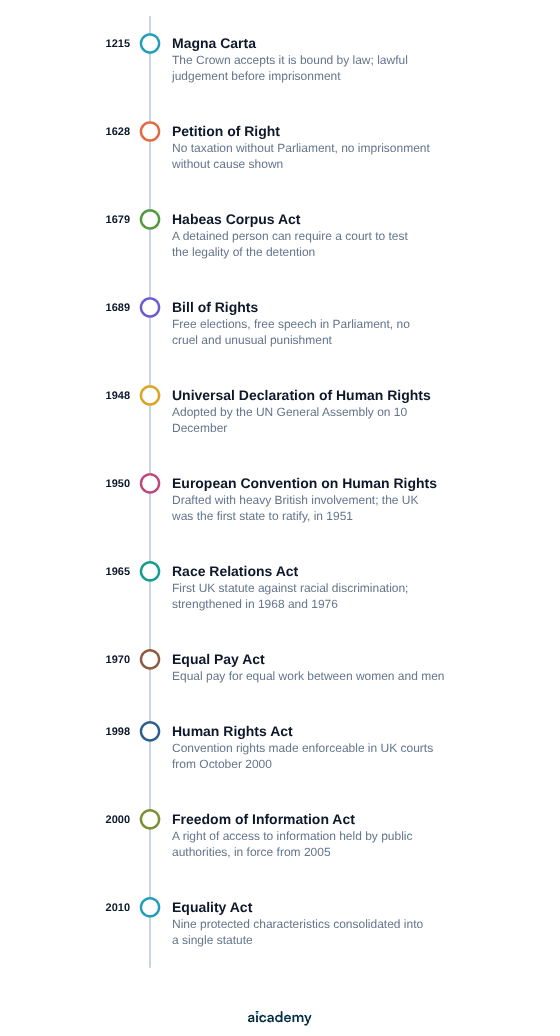
Timeline of UK rights milestones from Magna Carta in 1215 through the Bill of Rights 1689, then a long gap to the post-war treaties of 1948 and 1950, and a dense cluster of domestic statutes between 1965 and 2010.

Notice the shape: four centuries of constitutional documents concerned with limiting the Crown, then a long gap, then a dense cluster of statutory rights after 1945 concerned with what individuals may claim against public bodies and each other.

The Human Rights Act 1998 and How It Works

The Human Rights Act 1998 received royal assent in November 1998 and came fully into force on 2 October 2000. It did not create new rights. It brought the rights of the European Convention on Human Rights, which the UK ratified in 1951 and has been bound by since the Convention entered into force in 1953, into domestic law so they could be enforced in a UK court instead of only in Strasbourg.

Convention rights come in three strengths, and confusing them is a standard error:

TypeMeaningExamples
AbsoluteCannot be restricted in any circumstancesArticle 3 — prohibition of torture and inhuman or degrading treatment
LimitedCan be restricted in specified situations set out in the Article itselfArticle 5 — liberty and security, subject to lawful arrest and detention
QualifiedCan be restricted where doing so is lawful, necessary in a democratic society and proportionateArticles 8 to 11 — private life, religion, expression, assembly

Four sections do the work:

  • Section 2 — UK courts must take account of judgments of the European Court of Human Rights, without being bound to follow them.
  • Section 3 — so far as it is possible to do so, courts must read and give effect to legislation compatibly with Convention rights. This is the most powerful provision, because it lets judges reinterpret rather than confront.
  • Section 4 — where compatible reading is impossible, a senior court may issue a declaration of incompatibility. The Act stays valid and in force. Parliament decides what, if anything, to do.
  • Section 6 — it is unlawful for a public authority to act incompatibly with a Convention right, which is what gives an individual something to sue on.

Worked example — the Belmarsh case, 2004. Section 23 of the Anti-terrorism, Crime and Security Act 2001 allowed the indefinite detention without trial of foreign nationals suspected of terrorism who could not be deported. Nine detainees, held mainly at Belmarsh prison, challenged it.

  1. The government had derogated from Article 5 (liberty), claiming a public emergency threatening the life of the nation.
  2. In December 2004 the House of Lords, sitting as the highest court, held by eight to one that the measure was disproportionate, because it addressed only foreign nationals when the threat also came from British citizens, and discriminatory under Article 14.
  3. The court could not quash the Act. It issued a declaration of incompatibility under section 4.
  4. Parliament responded. The detainees were not released by the court; the government repealed the power and replaced it with control orders in the Prevention of Terrorism Act 2005, later replaced again by TPIMs under the Terrorism Prevention and Investigation Measures Act 2011.

That sequence is the whole design of the Act in miniature: judges expose the incompatibility, elected politicians decide the remedy, and parliamentary sovereignty is formally untouched. Declarations of incompatibility are rare — a few dozen since 2000 — and governments have amended the law in response to most of them. The clearest exception is prisoner voting, where successive governments resisted for over a decade before making a narrow change in 2017.

The Equality Act 2010

The Equality Act 2010 received royal assent in April 2010, with its main provisions in force from October that year. Its achievement was consolidation: it replaced a patchwork built up over four decades, including the Equal Pay Act 1970, the Sex Discrimination Act 1975, the Race Relations Act 1976 and the Disability Discrimination Act 1995, with a single framework applying the same concepts to every ground.

The nine protected characteristics: age; disability; gender reassignment; marriage and civil partnership; pregnancy and maternity; race; religion or belief; sex; sexual orientation.

Four forms of prohibited conduct:

ConductDefinitionIllustration
Direct discriminationTreating someone less favourably because of a protected characteristicRefusing to interview an applicant because of her age
Indirect discriminationApplying a rule that is neutral on its face but puts a protected group at a disadvantage, without objective justificationA minimum height requirement for a job where height is irrelevant
HarassmentUnwanted conduct related to a characteristic that violates dignity or creates a hostile environmentPersistent racial "banter" in a workplace
VictimisationTreating someone badly because they complained about discrimination or supported a complaintCutting a worker's shifts after she gave evidence in a colleague's tribunal claim

The Act also imposes a duty to make reasonable adjustments for disabled people, and a public sector equality duty in section 149 requiring public bodies to have due regard to eliminating discrimination and advancing equality of opportunity when exercising their functions.

Worked example — indirect discrimination in the Supreme Court. In Essop v Home Office (2017) the Home Office required staff to pass a Core Skills Assessment before promotion. Statistics showed that Black and minority ethnic candidates, and older candidates, passed at significantly lower rates than white and younger candidates. Nobody could explain why. The Home Office argued that a claimant must prove the reason the test disadvantaged the group. The Supreme Court disagreed: it is enough to show that the practice causes the group disadvantage and that the individual shares it, after which the employer must justify the practice as a proportionate means of achieving a legitimate aim. The ruling made indirect discrimination claims materially easier to bring, and shows a rights statute being given practical force by judicial interpretation rather than by fresh legislation.

Worth saving these ideas?

Turn what you've read into instant revision cards. Free to get started.

Make flashcards

Liberty: Civil Liberties Through the Courts

Liberty is the best-known general civil liberties group in the UK, and the first of the two contemporary groups studied here. The specification requires the work of two contemporary civil liberties pressure groups but does not name them, so any two current groups will do — these two are chosen because they work in visibly different ways.

What it is. Founded on 22 February 1934 as the National Council for Civil Liberties, prompted by the policing of the unemployed workers' hunger marches, it took the name Liberty in 1989. It is a membership organisation with its own lawyers and policy staff, funded by members and donations rather than by government.

Methods. Liberty is a cause group and an outsider by design, and its distinctive weapon is strategic litigation: choosing cases that will settle a point of principle, and intervening as a third party in other people's cases to put the civil liberties argument to the court. Around that sit parliamentary briefings on bills, freedom of information requests, and public campaigning.

Where it has succeeded.

  • Identity cards. Liberty campaigned for years against the Identity Cards Act 2006 and the National Identity Register it created. The scheme was abolished by the Identity Documents Act 2010 and the register destroyed.
  • Indefinite detention. Liberty campaigned against detention without trial under the Anti-terrorism, Crime and Security Act 2001 — the power the Belmarsh ruling found incompatible with the Convention in 2004.
  • Bulk data retention. Liberty acted for the MPs David Davis and Tom Watson in a challenge to the Data Retention and Investigatory Powers Act 2014. The High Court held the data retention power unlawful in July 2015, and after a reference to the Court of Justice of the European Union the Court of Appeal held in January 2018 that the regime was inconsistent with EU law.
  • The Investigatory Powers Act 2016. In Liberty's own challenge, the High Court held in April 2018 that Part 4 of the Act was incompatible with EU law, and the government amended the Act later that year.

Where it has failed. The Investigatory Powers Act 2016 reached the statute book despite Liberty's sustained opposition, and so did the Police, Crime, Sentencing and Courts Act 2022 and the Public Order Act 2023, both of which Liberty argued would chill lawful protest. Liberty also opposed the proposal to replace the Human Rights Act with a British Bill of Rights; that Bill was introduced in June 2022 and abandoned in 2023, though the pressure came at least as much from within the governing party as from campaigners.

The pattern is instructive. Litigation lets a small organisation trim the edges of a statute after it passes, but it rarely stops a government with a Commons majority from passing it. The courts are an access point, not a veto.

The Howard League for Penal Reform

The Howard League for Penal Reform is the second of the two groups, and it works in a different register from Liberty: narrower in subject, longer in horizon, and closer to the institutions it criticises.

What it is. The Howard Association was founded in 1866, named after the eighteenth-century prison reformer John Howard, and merged with the Penal Reform League in 1921 to become the Howard League. It is the oldest penal reform charity in the world. Its concern is the treatment of people in the criminal justice system — a group with no votes to offer, little public sympathy and no economic leverage, which makes it a good test of whether rights work for the unpopular.

Methods. Research and published evidence; parliamentary and select committee work; media campaigning; awards for good practice inside prisons; and, unusually for a charity of its kind, a legal team providing advice and representation to children and young people in custody.

Where it has succeeded.

  • Books for prisoners. A change to the Incentives and Earned Privileges scheme in November 2013 stopped prisoners in England and Wales receiving parcels, including books. The Howard League and English PEN ran a public campaign backed by prominent authors, and in December 2014 the High Court ruled that the restriction on books was unlawful. The rules were changed.
  • Legal aid for prisoners. In April 2017 the Court of Appeal held, in a case brought by the Howard League and the Prisoners' Advice Service, that removing criminal legal aid from certain areas of prison law was unlawful because the safeguards left behind were inherently unfair.
  • Children in the justice system. The League's long campaign to keep children out of police custody and prison is the clearest measurable success in its recent history: it reports that the number of child arrests in England and Wales fell by roughly three-quarters over the 2010s.

Where it has failed. Its central objective — a smaller prison population — has moved the other way. England and Wales has long had one of the highest imprisonment rates in western Europe, and sentence lengths have risen across the period in which the League has been most active. Reforming conditions inside prisons has proved achievable; reducing the use of prison itself has not.

LibertyHoward League for Penal Reform
Founded19341866
ScopeCivil liberties across the board: surveillance, protest, detention, discriminationPrisons, sentencing and the treatment of offenders
Primary methodStrategic litigation and third-party interventionResearch, casework and long-run persuasion
Best evidence of successID cards abolished; data retention regimes ruled unlawfulPrison book ban overturned; prison legal aid cuts ruled unlawful
Structural weaknessCannot stop legislation a government is determined to passRepresents a constituency with almost no public sympathy

Together the two groups make the specification's point: civil liberties in the UK are defended largely by unelected voluntary organisations using the courts, because no entrenched constitutional document does the job for them.

Where Rights Collide

A rights-based culture generates conflicts that a court, not a philosophy, has to settle. Four fault lines recur in exam questions.

1. One person's right against another's. In Bull v Hall (2013) the Christian owners of a Cornish guest house refused a double room to a same-sex couple in a civil partnership. The Supreme Court held unanimously that the refusal was unlawful discrimination, though it split three to two on which kind: the majority found direct discrimination on grounds of sexual orientation, while two justices found indirect discrimination that could not be justified. All five agreed that the owners' religious freedom under Article 9 was engaged, but that restricting it was a proportionate way of protecting others from discrimination. In Lee v Ashers Baking Company (2018) a bakery refused to produce a cake iced with the slogan "Support Gay Marriage". The Supreme Court found no discrimination, because the objection was to the message rather than to the customer. The two cases together mark the line: a business may decline to endorse a view, but may not refuse a service to a person.

2. Individual liberty against collective security. Belmarsh, control orders, TPIMs and the Investigatory Powers Act 2016 are all attempts to fix the same trade-off. Governments argue that the first duty of the state is protection and that intelligence powers must keep pace with technology; civil liberties groups argue that emergency powers outlive the emergency and that bulk surveillance treats the whole population as suspects.

3. Protest against everyone else's freedom of movement. The Police, Crime, Sentencing and Courts Act 2022 and the Public Order Act 2023 tightened the law on disruptive protest after several years of road and infrastructure blockades. Supporters say a right to assemble does not include a right to stop other people getting to hospital or to work; opponents say the thresholds are so low that ordinary protest becomes a police decision.

4. Free expression against protection from harm. Section 5 of the Public Order Act 1986 criminalises threatening or abusive conduct likely to cause harassment, alarm or distress, and the Online Safety Act 2023 places duties on platforms to remove illegal content and protect children. Both are defended as protecting the vulnerable and attacked as chilling lawful speech.

Is the UK's rights culture strong or weak?

StrongWeak
The Human Rights Act gives every person an enforceable claim against public authoritiesThe Act is ordinary legislation and can be repealed by a simple majority
A senior, independent judiciary willing to rule against ministers, as in BelmarshJudges cannot strike down an Act; a declaration of incompatibility is only advice
The Equality Act gives comprehensive protection across nine characteristicsEnforcement depends on individuals bringing claims, which costs money and time
Active civil liberties groups with real litigation capacityGovernments of both parties have legislated to restrict protest and expand surveillance
Freedom of information and a free press expose abusesNo codified constitution, so rights rest on Parliament's self-restraint

The sharpest evaluative point in this topic is about entrenchment, not content. The UK protects a wide range of rights generously; what it lacks is any legal mechanism preventing a future majority from withdrawing them.

Exam Focus: Common Mistakes

1. Saying the Human Rights Act lets judges strike down laws

It does not. Section 4 produces a declaration of incompatibility, which leaves the Act in force and hands the decision back to Parliament. Getting this wrong undermines every judgement that follows from it.

2. Confusing the European Court of Human Rights with the EU

The Convention and its court belong to the Council of Europe, an entirely separate body founded in 1949. The UK remains bound by the Convention after leaving the EU. Examiners see this error often.

3. Treating Magna Carta as a modern bill of rights

It was a feudal peace treaty, annulled within weeks, most of which has been repealed. Its importance is the principle that the Crown is bound by law, not a list of protections you can cite.

4. Naming Liberty and the Howard League without developing them

Section 1.4 requires the work of two contemporary civil liberties pressure groups. Give each group's methods, a specific success with a date, and a specific limit on its influence.

5. Describing the Equality Act only as "a law against discrimination"

The marks are in the detail: nine protected characteristics, the direct and indirect distinction, reasonable adjustments, and the public sector equality duty.

6. Presenting rights conflicts as having obvious answers

Bull v Hall and Ashers went different ways on facts that look similar. Set out the competing rights, explain how the court weighed proportionality, and then judge — the AO3 marks are for the weighing, not for the verdict.

Key terms

Civil liberties
Freedoms that protect the individual from interference by the state, such as freedom of speech, assembly and personal liberty.
Human rights
Universal entitlements a person holds simply by being a person, which a state recognises rather than grants.
Common law
Law made by judges through decisions in individual cases, binding on later courts through precedent, rather than passed by Parliament.
Statute law
Law made by Act of Parliament, which in the UK overrides common law and can be changed by a simple parliamentary majority.
Declaration of incompatibility
A ruling under section 4 of the Human Rights Act that an Act of Parliament conflicts with a Convention right; it leaves the Act in force and invites Parliament to amend it.
Judicial review
A court process in which a judge examines whether a public body acted within its legal powers and fairly, rather than whether its decision was wise.
Protected characteristic
One of the nine personal attributes listed in the Equality Act 2010 which it is unlawful to discriminate against.
Public sector equality duty
The obligation in section 149 of the Equality Act 2010 requiring public bodies to have regard to eliminating discrimination and advancing equality when they make decisions.
Entrenchment
Legal protection that makes a law harder to repeal than ordinary legislation, for example by requiring a supermajority; UK rights legislation has none.
Derogation
A formal step by which a state suspends part of its obligations under a rights treaty, permitted only in a public emergency threatening the life of the nation.

Frequently asked questions

It made the rights in the European Convention on Human Rights enforceable in UK courts from 2 October 2000, so a claimant no longer had to go to Strasbourg. It also made it unlawful for public authorities to breach those rights.

Age, disability, gender reassignment, marriage and civil partnership, pregnancy and maternity, race, religion or belief, sex, and sexual orientation. Discrimination, harassment and victimisation connected to any of them are unlawful.

Mostly not. Almost all of it is repealed, but three clauses of the 1297 reissue remain in force: the liberties of the English Church, the liberties of the City of London, and the guarantee that no free man may be imprisoned or dispossessed except by lawful judgement, and that justice is not sold, refused or delayed.

Generate revision on any topic you study

Type any topic you're studying and Aicademy generates a complete lesson, quiz, and flashcard set, personalised to your level.

Lessons on anything

Structured, level-matched lessons on any topic you study

Practice quizzes

Find out what you actually know before the exam does

Flashcard sets

Lock in key concepts with instant revision cards

Ask Aica

Stuck on something? Get a clear explanation, any time

Prev

Pressure Groups and Other Influences

Next

Political Parties: Functions and Funding

Related lessons

18 min

Lesson

Pressure Groups and Other Influences

A-Level Politics · Pearson Edexcel 9PL0

2 hours ago

17 min

Lesson

The UK Supreme Court

A-Level Politics · Pearson Edexcel 9PL0

2 hours ago

13 min

Lesson

Civil Liberties and Rights in the USA

A-Level Politics · Pearson Edexcel 9PL0

2 hours ago

Top students don’t revise more. They revise what counts.

Start revising free

Free to start. No card needed.