Where Sovereignty Lies in the UK

Aligned to the Pearson Edexcel 9PL0 specification
- Level
- Advanced
- Reading time
- 17 min
- Published
- 9 September 2026
On this page
- 1.Legal and Political Sovereignty: The Distinction That Runs the Topic
- 2.Legal Sovereignty in Action: What Parliament Can Still Do
- 3.Political Sovereignty: Who Actually Decides
- 4.Sovereignty Dispersed Downwards: Devolution and Referendums
- 5.Sovereignty Dispersed Sideways: The Executive and the Courts
- 6.Sovereignty Returned: The Effect of Leaving the EU
- 7.Reaching a Judgement on Where Sovereignty Lies
- 8.Exam Focus: Common Mistakes
Key takeaways
- Legal sovereignty is the formal authority to make and unmake law; political sovereignty is the practical capacity to decide outcomes. In the UK they sit in different places, which is the whole point of this topic.
- Legal sovereignty rests with the Crown-in-Parliament and has not moved: Parliament legislated to leave the EU, repealed the Fixed-term Parliaments Act in 2022 and overrode a Supreme Court finding in 2024.
- Political sovereignty has moved a great deal: downwards to devolved bodies and referendums, sideways to the executive through delegated powers, and to the courts through the Human Rights Act.
- Devolution disperses power rather than sovereignty, and the Scottish Parliament and Senedd can be abolished only after a referendum in the nation concerned, making reversal politically costly but still legally possible.
- A defensible conclusion is that legal sovereignty is fixed in Westminster while political sovereignty circulates between the executive, the governing party and the electorate.
Worth saving these ideas?
Turn what you've read into instant revision cards. Free to get started.
Reaching a Judgement on Where Sovereignty Lies
Set the movements out chronologically before you judge them. The pattern is not a one-way drain of sovereignty away from Westminster; it is an oscillation.
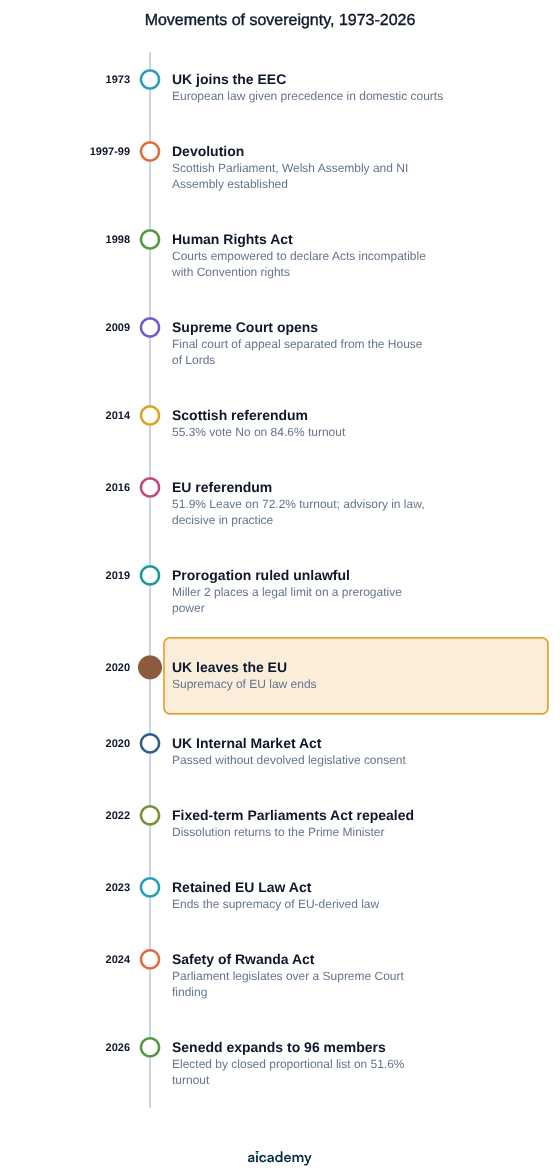
Four answers are defensible, and each needs the qualification attached to it.
| Answer | The case for it | The qualification |
|---|---|---|
| Parliament | Legal sovereignty is intact and repeatedly demonstrated: 2018, 2022, 2023, 2024 | Parliament is controlled by the executive for most of a Parliament, so the legal holder is rarely the effective decider |
| The executive | Controls the timetable, the prerogative and 3,000 statutory instruments a year | Its authority evaporates without a majority, as in 2017–19, and its leader can be removed by the party, as in June 2026 |
| The people | Elections change governments; referendums have settled EU membership, devolution and electoral reform | Referendums happen when the government calls them, and no general election since 1997 has drawn a turnout above 70% |
| Dispersed | Devolution, the courts, the Lords and treaty obligations all constrain Westminster | Each constraint is either statutory, and repealable, or conventional, and unenforceable |
A judgement worth writing. Legal sovereignty has not moved: it remains with the Crown-in-Parliament, and the Acts of 2018, 2022, 2023 and 2024 prove it can be exercised against courts, predecessors and supranational bodies alike. Political sovereignty has moved a great deal, and it now circulates — resting with the electorate at a general election, with the executive between elections, and with the governing party at the moments when a Prime Minister's position collapses, as it did in June 2026. The UK's constitution has become more constrained without becoming less sovereign, and that apparent contradiction is exactly what the legal/political distinction exists to explain.
Key terms
- Legal sovereignty
- The formal, legally recognised authority to make and unmake law, held whether or not the holder can enforce it in practice.
- Political sovereignty
- The real-world capacity to determine outcomes, held by whoever can actually make a decision stick rather than by whoever holds the legal title.
- Parliamentary sovereignty
- The doctrine that Westminster faces no legal limit on the laws it may pass, and that no Parliament can tie the hands of a future one.
- Popular sovereignty
- The claim that ultimate authority rests with the people, exercised through elections and referendums rather than through institutions.
- Pooled sovereignty
- An arrangement in which states agree to exercise certain powers jointly through shared institutions instead of separately.
- Devolution
- The statutory transfer of decision-making powers from Westminster to national institutions, which leaves ultimate legal authority at Westminster.
- Entrenchment
- Protecting a law or institution from ordinary amendment by requiring a special procedure, such as a referendum or a supermajority, to change it.
- Crown-in-Parliament
- The formal holder of legal sovereignty in the UK: the monarch acting together with the House of Commons and the House of Lords to enact statute.
Frequently asked questions
Legal sovereignty lies with the Crown-in-Parliament, which can make or unmake any law. Political sovereignty is contested: the electorate holds it at general elections and referendums, and the executive exercises it between them, constrained by devolution, the courts and the House of Lords.
Legal sovereignty is the formal right to make law, and it belongs to Parliament. Political sovereignty is the real-world power to determine what happens. The 2016 EU referendum shows the gap: it was legally advisory, but no Parliament felt able to ignore the result.
In law, no. Devolution was created by Acts of Parliament that Westminster could amend or repeal. In practice it has transferred substantial political sovereignty, and the Scotland Act 2016 and Wales Act 2017 make abolition conditional on a referendum, which entrenches devolution politically.
Generate revision on any topic you study
Type any topic you're studying and Aicademy generates a complete lesson, quiz, and flashcard set, personalised to your level.
Lessons on anything
Structured, level-matched lessons on any topic you study
Practice quizzes
Find out what you actually know before the exam does
Flashcard sets
Lock in key concepts with instant revision cards
Ask Aica
Stuck on something? Get a clear explanation, any time
The EU and UK Government
Nationalism: Core Ideas and Principles
Related lessons
16 min
20 min
14 min
17 min