Track progress, take quizzes and save notes on this lesson.

Free forever · no card needed

Start free
Intermediate

The UK Constitution: Nature and Sources

Paper 2, 1.1 The nature and sources of the UK Constitution

Aligned to the Pearson Edexcel 9PL0 specification

Level
Intermediate
Reading time
16 min
Published
9 September 2026
On this page
  1. 1.What a Constitution Actually Does
  2. 2.Five Documents That Built the Constitution
  3. 3.Uncodified, Unentrenched, Unitary
  4. 4.The Twin Pillars: Sovereignty and the Rule of Law
  5. 5.Sources One and Two: Statute Law and Common Law
  6. 6.Sources Three to Five: Conventions, Authoritative Works and Treaties
  7. 7.Case Study: A Prime Minister Changed Without an Election, July 2026
  8. 8.Exam Focus: Common Mistakes

Key takeaways

  • The UK constitution is uncodified, unentrenched and unitary: its rules sit in many separate places, can be changed by ordinary legislation, and ultimate legal authority stays at Westminster.
  • Its development is traced through Magna Carta (1215), the Bill of Rights (1689), the Act of Settlement (1701), the Acts of Union (1707) and the Parliament Acts (1911 and 1949).
  • The twin pillars are parliamentary sovereignty — Parliament may pass or repeal any law, and no Parliament can tie the hands of a future one — and the rule of law, under which government itself answers to the courts.
  • The five sources are statute law, common law, conventions, authoritative works and treaties. Statute outranks the others; conventions carry political force but are not enforced by judges.
  • Uncodified does not mean unwritten: most of the constitution is written down, just spread across statutes, court judgments, treaties and expert commentaries rather than one document.

What a Constitution Actually Does

A constitution is the framework of rules that decides how political power is distributed, who may exercise it, and what limits apply to the way government treats citizens.

Every state has one. The question is not whether rules exist but where they are kept and how easily they change. A constitution performs four jobs:

  • It distributes power between the executive, the legislature and the judiciary, and between central and sub-national government.
  • It establishes the limits of state authority — what government may do to a citizen, and what it may not.
  • It confers legitimacy, so that an election result or an Act of Parliament is accepted as rightful rather than merely enforced.
  • It protects rights, either by entrenching them or, in the UK's case, by leaving them to statute and the courts.

The single most common error in this topic is to say the UK has "no written constitution". Most of the UK constitution is written down — in Acts of Parliament, court judgments, treaties and textbooks. What it lacks is codification: one authoritative document that gathers those rules together and stands above ordinary law.

The UK is unusual, not unique. New Zealand and Israel also operate without a codified constitution. Most states codified because a rupture — revolution, defeat, independence, the collapse of a regime — forced them to start again. The UK has not had such a rupture since the seventeenth century, so its rules accumulated instead.

Five Documents That Built the Constitution

The specification traces the constitution's development through five named documents. Each moved power in the same direction: away from the Crown and towards Parliament and the courts.
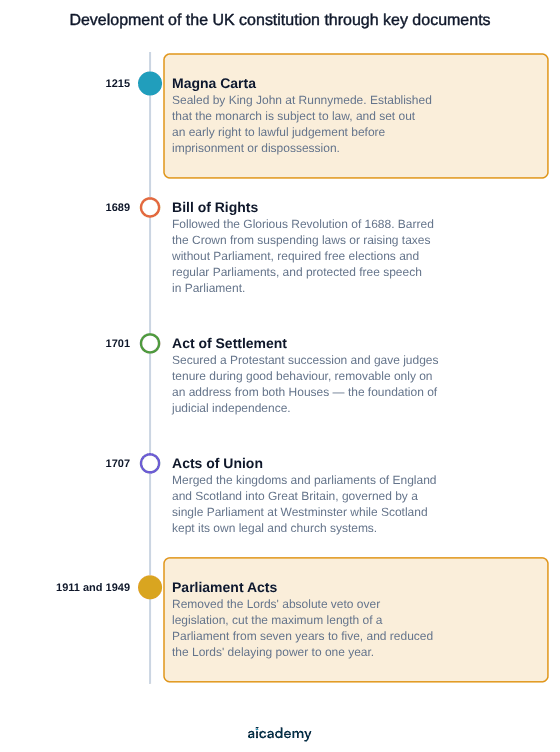
Vertical timeline from 1215 to 1949: Magna Carta subjects the king to law, the Bill of Rights makes the Crown dependent on Parliament, the Act of Settlement secures judicial tenure, the Acts of Union create one British Parliament, and the Parliament Acts end the Lords veto.

Two details are worth carrying into an answer, because they show precision about how the Acts work:

  • The Parliament Act 1911 gave the Lords a two-year delaying power; the Parliament Act 1949 cut that to one year. The 1949 Act was itself forced through using the 1911 Act.
  • The Parliament Acts are used sparingly. The Hunting Act 2004 is the most recent statute passed over the Lords' objection under them.

(Extra context — the Acts of Union with Ireland in 1800 continued the same process of union but are outside the five documents the 9PL0 specification names.)

Uncodified, Unentrenched, Unitary

The specification requires three specific adjectives. Learn what each one denies as well as what it asserts.

FeatureWhat it meansWhat the alternative looks like
UncodifiedThe rules sit in many separate sources — statutes, judgments, conventions, treaties, textbooksCodified: one authoritative document, as in the USA (1787) or Germany (1949)
UnentrenchedAny rule can be changed by an ordinary Act of Parliament passed by a simple majorityEntrenched: change requires a special procedure, such as the US two-thirds-of-Congress plus three-quarters-of-states amendment route
UnitaryLegal sovereignty sits in one place, Westminster, even where powers are devolvedFederal: sovereignty is constitutionally split between levels, as between Washington and the US states

Worked example — how easily the UK constitution changes. Compare what it takes to change one rule about the term of the chief executive in each system.

  1. In the USA, the two-term limit on the presidency is set by the Twenty-second Amendment (1951). Removing it would need a constitutional amendment: two-thirds of both chambers of Congress, then ratification by 38 of the 50 states.
  2. In the UK, the Fixed-term Parliaments Act 2011 removed the Prime Minister's power to call an early election and set a five-year cycle. Eleven years later the Dissolution and Calling of Parliament Act 2022 repealed it and restored the previous position — by an ordinary Act, on ordinary majorities, with no referendum and no special procedure.

That contrast is the whole of "unentrenched" in one example. It is also the strongest evidence for flexibility as a virtue, and the strongest evidence for the risk that a governing majority can rewrite the rules it plays by.

On "unitary": devolution has made the UK look federal in practice, and some writers now describe it as a union state or quasi-federal. The legal position is unchanged: the Scotland Act 1998, the Government of Wales Act 1998 and the Northern Ireland Act 1998 are ordinary statutes, and what an ordinary statute created an ordinary statute can amend.

The Twin Pillars: Sovereignty and the Rule of Law

A. V. Dicey, in Introduction to the Study of the Law of the Constitution (1885), identified two principles as the foundation of the whole system. The specification calls them the twin pillars.

Parliamentary sovereignty holds that Parliament is the supreme law-making body. Three consequences follow:

  • Parliament can pass or repeal any law on any subject.
  • No body, including a court, can strike down an Act of Parliament as unconstitutional.
  • No Parliament can bind its successors — a rule one Parliament entrenches, the next can undo.

The rule of law holds that everyone is subject to the same law, government included, and answerable for breaking it before independent courts. In practice it requires that law be public and applied consistently, that nobody be punished except for a proven breach, and that ministers act only on powers they actually possess.

Worked example — Entick v Carrington (1765). Government messengers, acting on a warrant from the Secretary of State, broke into John Entick's house and seized his papers. The court held the warrant unlawful: no statute and no case authorised it, and the state cannot act simply because it believes the action expedient. The government lost. That case is the rule of law in its purest form — an executive action struck down not because it was unreasonable but because no legal power supported it.

The two pillars pull against each other. If Parliament is sovereign, it can legislate to place a minister beyond challenge; if the rule of law is supreme, courts must be able to strike that legislation down. The UK resolves the tension politically rather than legally: judges apply statute, but they interpret it on the presumption that Parliament did not intend to abolish fundamental rights unless it said so in unmistakable terms.

Worth saving these ideas?

Turn what you've read into instant revision cards. Free to get started.

Make flashcards

Sources One and Two: Statute Law and Common Law

Statute law is law made by Act of Parliament. It is the highest domestic source: where statute conflicts with common law, convention or the terms of a treaty as applied domestically, statute prevails.

Constitutionally significant statutes include:

StatuteConstitutional effect
Human Rights Act 1998Gave domestic effect to the European Convention on Human Rights
Scotland Act 1998; Government of Wales Act 1998; Northern Ireland Act 1998Created the devolved legislatures and executives
Constitutional Reform Act 2005Created the UK Supreme Court and separated it from the House of Lords
Dissolution and Calling of Parliament Act 2022Repealed the Fixed-term Parliaments Act 2011

Common law is law developed by judges through decided cases. It matters constitutionally in two ways: judges fill gaps where statute is silent or ambiguous, and the royal prerogative — the residual powers of the Crown exercised in practice by ministers — is recognised and defined by common law rather than by statute.

Worked example — R (Miller) v The Prime Minister (2019). In August 2019 the government advised the monarch to prorogue Parliament for five weeks. Challengers argued the prorogation frustrated Parliament's ability to scrutinise the executive at a critical moment.

  • Step 1 — is the power justiciable? The government argued prorogation was a prerogative power and therefore a political matter for ministers alone. The Supreme Court held that the limits of a prerogative power are a question of law, so the courts could rule on them.
  • Step 2 — what is the limit? The Court derived one from two constitutional principles: parliamentary sovereignty and parliamentary accountability. A prorogation that frustrates Parliament's constitutional functions without reasonable justification is unlawful.
  • Step 3 — the outcome. Eleven Justices held unanimously that the prorogation was unlawful, void and of no effect. Parliament resumed sitting the next day.

No statute said any of this. The rules the Court applied came from common law reasoning about the constitution's underlying principles — which is exactly how an uncodified constitution grows.

Sources Three to Five: Conventions, Authoritative Works and Treaties

Conventions are long-standing practices treated as binding by the political system, which courts recognise but do not enforce. They do the heavy lifting of everyday government.

ConventionWhat it requires
Royal AssentThe monarch approves legislation passed by both Houses; assent has not been refused since 1708
Collective ministerial responsibilityMinisters publicly support Cabinet decisions or resign
Individual ministerial responsibilityMinisters answer to Parliament for their department and their own conduct
Salisbury conventionThe Lords does not block a bill that was in the governing party's manifesto
Sewel conventionWestminster does not normally legislate on devolved matters without the devolved legislature's consent

Conventions can be converted into statute, which changes their status: the Sewel convention was written into the Scotland Act 2016 and the Wales Act 2017, but the wording preserved the word "normally", and the Supreme Court held in 2017 that this left it politically rather than judicially enforceable.

Authoritative works are expert commentaries used as reference points when a rule is disputed. They bind nobody, but they settle arguments in practice:

  • Erskine May, A Treatise on the Law, Privileges, Proceedings and Usage of Parliament (first published 1844) — the working manual of Commons procedure.
  • Walter Bagehot, The English Constitution (1867) — the "dignified" and "efficient" parts of the constitution.
  • A. V. Dicey (1885) — the twin pillars themselves.
  • The Cabinet Manual (2011) — the government's own guide to the conventions governing its operation.

Treaties are binding agreements with other states, negotiated by the executive under the prerogative and, since the Constitutional Reform and Governance Act 2010, laid before Parliament for 21 sitting days before ratification. Constitutionally significant examples include the European Convention on Human Rights (signed 1950, given domestic effect by the Human Rights Act 1998) and the Belfast/Good Friday Agreement (1998), which underpins power-sharing in Northern Ireland and was endorsed by referendums in both parts of Ireland.

(Extra context — the European Communities Act 1972 and EU law were removed from this section of the 9PL0 specification and are not assessable here. The 1972 Act is worth knowing only as an illustration that Parliament could give another legal order priority by statute and could withdraw that priority the same way.)

Case Study: A Prime Minister Changed Without an Election, July 2026

Nothing demonstrates an uncodified, convention-driven constitution better than a change of Prime Minister between general elections. The events of summer 2026 supply a complete worked example.

The sequence:

  1. At the local elections of May 2026 Labour lost around 35 councils and nearly 1,500 councillors, on a projected national vote share of about 17%. Around 103 Labour MPs called publicly for the Prime Minister to go, and several Cabinet ministers resigned.
  2. Sir Keir Starmer announced his resignation on 22 June 2026.
  3. Andy Burnham, then Mayor of Greater Manchester and not an MP, had already entered the Commons at the Makerfield by-election on 18 June 2026, four days before Starmer's announcement, after the sitting MP stood down to create the vacancy — the first by-election deliberately engineered to bring a party leader into the Commons since Leyton in 1965.
  4. Burnham was elected Labour leader unopposed on 17 July 2026 with 379 MP nominations, over 94% of the parliamentary party.
  5. Burnham became Prime Minister on 20 July 2026.

Which parts of the constitution were doing the work?

ElementSourceWhat it did
The monarch appoints the Prime MinisterRoyal prerogative, recognised by common lawProvided the formal legal act
The monarch appoints whoever can command the confidence of the CommonsConventionRemoved any real choice from the monarch
The Prime Minister sits in the CommonsConventionExplains why Burnham needed a seat first
No fresh general election is requiredConvention plus the absence of any rule requiring oneThe UK elects a Parliament, not a Prime Minister
The party's own leadership rulesNot part of the constitution at allDetermined who the new Prime Minister would be

No statute governs any of the first four steps. A codified constitution would spell out succession in a clause; the UK relied on practice, and the transfer of the most powerful office in the state took place in under a month. Supporters call that flexibility; critics call it a mandate taken without being asked for.

Exam Focus: Common Mistakes

1. Calling the constitution "unwritten"

The correct term is uncodified. Statutes, judgments and treaties are all written; they are simply not gathered into one document that outranks ordinary law. Using "unwritten" as your headline term signals imprecision on the first line of the answer.

2. Listing the five documents without saying what they changed

Magna Carta on its own is a date. Magna Carta as the first assertion that the monarch is bound by law, developed by the Bill of Rights into a Crown that cannot tax or legislate alone, is an argument. AO1 rewards accurate knowledge; AO2 rewards the connection between the documents.

3. Confusing uncodified, unentrenched and unitary

They answer three different questions: where the rules are, how hard they are to change, and where sovereignty sits. A constitution could be codified but unentrenched, or uncodified and quasi-federal in practice. Keep the three separate.

4. Treating conventions as legally binding

Conventions are enforced by political consequence, not by courts. The Supreme Court made this explicit for the Sewel convention in 2017. If you write that a court could strike down a breach of convention, you have lost the distinction the specification is testing.

5. Bringing EU law into a 1.1 answer

The European Communities Act 1972 and EU law were removed from this section of the specification. Material on EU membership is outside the scope of 1.1 and uses time you need for the five sources.

6. Ignoring the tension between the twin pillars

The strongest answers show that parliamentary sovereignty and the rule of law can conflict — a sovereign Parliament could in theory legislate to place ministers beyond legal challenge — and explain how the system manages that conflict through interpretation and political restraint rather than through a higher law.

7. Using only historical examples

Paper 2 rewards current evidence. The change of Prime Minister on 20 July 2026, and the fact that no election was needed to bring it about, illustrates conventions and the prerogative more sharply than any nineteenth-century example.

Key terms

Constitution
The framework of rules that decides how political power is distributed, who may exercise it, and what limits apply to the way government treats citizens.
Uncodified constitution
A constitution whose rules are scattered across many separate sources rather than gathered into one authoritative document.
Unentrenched constitution
A constitution whose rules can be altered by the ordinary law-making process, with no higher hurdle such as a supermajority or a referendum.
Unitary state
A state in which ultimate legal authority rests in one central body, even where day-to-day powers have been handed down to other tiers of government.
Parliamentary sovereignty
The doctrine that Parliament is the supreme law-making body: it may pass or repeal any law, and one Parliament cannot tie the hands of a future one.
The rule of law
The principle that everyone, government included, is subject to the same law and answerable for breaking it before independent courts.
Statute law
Law created by Act of Parliament, which outranks every other domestic source of constitutional rules.
Common law
Law developed by judges through decided cases, filling gaps where statute is silent or unclear and binding later courts through precedent.
Conventions
Long-standing practices that the political system treats as binding, which courts recognise but do not enforce.
Authoritative works
Books by recognised specialists setting out how the system works in practice; they carry no legal force but are used as reference points when a rule is disputed.
Treaties
Binding agreements made with other states, negotiated by the executive and laid before Parliament before they are ratified.

Frequently asked questions

It does have written rules — they are simply not codified into one document. The UK avoided the revolution, defeat or independence that forced other states to start again, so its rules accumulated gradually from 1215 onwards instead of being drafted at a single moment.

Statute law, common law, conventions, authoritative works and treaties. Statute law made by Parliament ranks highest; common law is judge-made; conventions are binding by practice, not law; authoritative works are expert commentaries; treaties are agreements with other states.

Uncodified is about location: the rules are scattered rather than gathered in one document. Unentrenched is about protection: they can be altered by an ordinary Act of Parliament, with no supermajority or referendum required.

Generate revision on any topic you study

Type any topic you're studying and Aicademy generates a complete lesson, quiz, and flashcard set, personalised to your level.

Lessons on anything

Structured, level-matched lessons on any topic you study

Practice quizzes

Find out what you actually know before the exam does

Flashcard sets

Lock in key concepts with instant revision cards

Ask Aica

Stuck on something? Get a clear explanation, any time

Prev

Socialist Thinkers

Next

Constitutional Reform since 1997

Related lessons

15 min

Lesson

Constitutional Reform since 1997

A-Level Politics · Pearson Edexcel 9PL0

2 hours ago

20 min

Lesson

Devolution in the UK

A-Level Politics · Pearson Edexcel 9PL0

2 hours ago

17 min

Lesson

Where Sovereignty Lies in the UK

A-Level Politics · Pearson Edexcel 9PL0

2 hours ago

17 min

Lesson

The US Constitution

A-Level Politics · Pearson Edexcel 9PL0

2 hours ago

Top students don’t revise more. They revise what counts.

Start revising free

Free to start. No card needed.