The US Constitution

Aligned to the Pearson Edexcel 9PL0 specification
- Level
- Intermediate
- Reading time
- 17 min
- Published
- 9 September 2026
- Updated
- 9 September 2026
On this page
- 1.A Codified Constitution Agreed in 1787
- 2.Entrenchment and the Vagueness of the Text
- 3.The Constitutional Framework of the Three Branches
- 4.Amending the Constitution: Article V
- 5.Separation of Powers and Checks and Balances
- 6.Bipartisanship: Cooperation Written Into the Rules
- 7.Federalism and Limited Government
- 8.Exam Focus: Common Mistakes
Key takeaways
- The US Constitution is codified (one document, agreed in 1787) and entrenched (alterable only through the supermajorities of Article V), which makes it both authoritative and extremely hard to change.
- Only 27 amendments have been ratified since 1789, ten of them in the 1791 Bill of Rights, despite more than 11,000 amendment proposals being introduced in Congress.
- Vague wording — the necessary and proper clause, the commerce clause, 'advice and consent' — leaves the Supreme Court, not the text, to settle what the Constitution means in practice.
- The 1787 design rests on federalism, separation of powers with checks and balances, bipartisanship and limited government; each is tested by modern partisanship.
- Checks still bite: Congress overrode Trump's veto of the defence authorisation bill on 1 January 2021, and the Supreme Court struck down his tariff regime in February 2026.
Worth saving these ideas?
Turn what you've read into instant revision cards. Free to get started.
Separation of Powers and Checks and Balances
The 1787 design separates personnel as well as function: no person may serve in two branches at once, so a Cabinet secretary must resign a congressional seat, and the President cannot sit in Congress. That is a sharper separation than the UK, where ministers must be parliamentarians.
Separation on its own would produce three isolated branches. Checks and balances deliberately overlap them, so each needs the others' acquiescence to act.
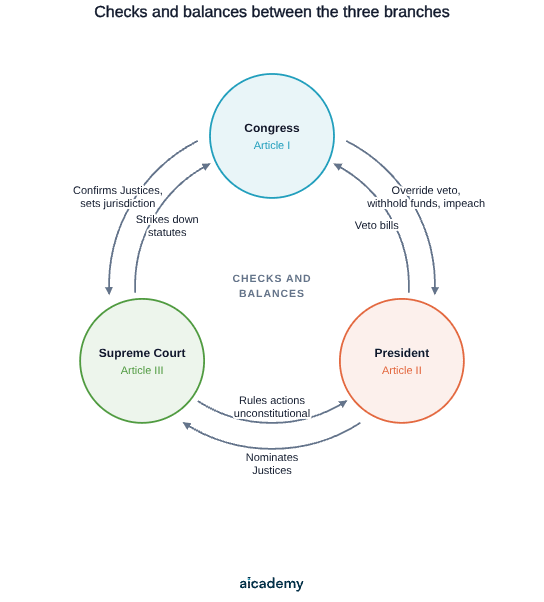
Do the checks still work? The evidence since 2000 cuts both ways, and a strong answer uses recent cases on each side.
- Congress checking the President. Congress overrode Trump's veto of the National Defense Authorization Act, completing the two-thirds vote in both chambers on 1 January 2021 — the only override of his first term. It succeeded partly because he was days from leaving office.
- The Court checking the President. In February 2026 the Supreme Court held that Trump could not use the International Emergency Economic Powers Act 1977 to impose sweeping import tariffs, since Article I reserves taxing powers to Congress. Chief Justice Roberts, Amy Coney Barrett and Neil Gorsuch joined the three liberal Justices. In December 2025 the same six had ruled that he lacked authority to take control of the Illinois National Guard and deploy it to Chicago.
- The checks failing. Of 26 rulings on challenges to Trump administration actions during 2025, the administration won 21. And where one party holds the presidency and both chambers — as Republicans have done in the 119th Congress since January 2025 — congressional checks weaken, because the majority has little incentive to investigate its own President.
Key terms
- Constitution
- The framework of fundamental rules that creates a state's institutions, allocates authority between them, and defines the limits of what government may do to citizens.
- Codification
- Gathering a constitution's rules into a single authoritative written text rather than leaving them scattered across statutes, court rulings and conventions.
- Entrenchment
- Legal protection that makes a constitution harder to alter than ordinary law, achieved in the USA through the demanding supermajorities of Article V.
- Enumerated powers
- Powers written out expressly in the constitutional text, such as those Article I, Section 8 grants to Congress.
- Implied powers
- Powers not written down but read into the text as reasonable means of carrying out an enumerated power, a doctrine established in McCulloch v Maryland (1819).
- Separation of powers
- The arrangement by which legislative, executive and judicial authority is placed in three institutions with distinct functions and no overlapping membership.
- Checks and balances
- The specific powers each branch holds over the others, so that no branch can complete a significant action without the acquiescence of at least one of the others.
- Bipartisanship
- Cooperation across party lines, which the Constitution encourages by setting thresholds — two-thirds and three-quarters majorities — that a single party rarely reaches on its own.
- Limited government
- The doctrine that government may act only within boundaries fixed in advance by the constitutional text, leaving a protected sphere for the states and for individual rights.
- Principle
- In this topic, one of the foundational design ideas the framers built into the 1787 text, which continues to shape how US government operates.
Frequently asked questions
Article V requires two supermajorities: two-thirds of both houses of Congress to propose an amendment, then ratification by three-quarters of the states — 38 of 50. In a closely divided party system neither threshold is reachable by one party alone, so most proposals die.
Codification is about form: the rules sit in one authoritative written document. Entrenchment is about protection: those rules can be changed only by a special procedure harder than passing ordinary law. The US Constitution is both; the UK's is neither.
It is deliberately short and open-textured, which has let it survive since 1789 without constant redrafting. The cost is that key phrases such as 'necessary and proper' carry no fixed meaning, so unelected Justices decide what they permit.
Generate revision on any topic you study
Type any topic you're studying and Aicademy generates a complete lesson, quiz, and flashcard set, personalised to your level.
Lessons on anything
Structured, level-matched lessons on any topic you study
Practice quizzes
Find out what you actually know before the exam does
Flashcard sets
Lock in key concepts with instant revision cards
Ask Aica
Stuck on something? Get a clear explanation, any time
Nationalist Thinkers
US Federalism
Related lessons
17 min
12 min
16 min