The Media and Opinion Polls

Aligned to the Pearson Edexcel 9PL0 specification
- Level
- Intermediate
- Reading time
- 15 min
- Published
- 9 September 2026
On this page
- 1.Where Voters Get Their Politics
- 2.The Partisan Press and Media Bias
- 3.Do Newspapers Change Votes, or Confirm Them?
- 4.Television Debates and Broadcast Impartiality
- 5.Social Media and the Targeted Campaign
- 6.The Media Between Elections: Watchdog and Agenda-Setter
- 7.Opinion Polls: Uses, Failures and the Exit Poll
- 8.Exam Focus: Judging Media Influence
Key takeaways
- Broadcasters owe a statutory duty of due impartiality under the Communications Act 2003, enforced through the Ofcom Broadcasting Code; newspapers owe no such duty and may campaign openly for a party.
- The reinforcement model — that papers mostly confirm what readers already think — fits the evidence better than direct persuasion, since titles tend to switch towards parties already rising in the polls.
- Televised leaders' debates have lost reach: about 9.4 million watched the first in 2010, 6.7 million in 2019 and 4.8 million for the first ITV debate of 2024.
- Opinion polls misread 1992, 2015 and 2017, were close in 2019, and overstated Labour's 2024 lead at 15–20 points when the actual margin was about 10. Exit polls have a markedly better record than campaign polls.
- Publishing exit poll findings before polls close is a criminal offence under section 66A of the Representation of the People Act 1983, inserted by the Representation of the People Act 2000.
Worth saving these ideas?
Turn what you've read into instant revision cards. Free to get started.
Opinion Polls: Uses, Failures and the Exit Poll
An opinion poll surveys a sample designed to represent the electorate. UK polls are published freely throughout a campaign — there is no publication blackout — but section 66A of the Representation of the People Act 1983, inserted by the Representation of the People Act 2000, makes it an offence to publish exit poll findings before the close of poll.
The accuracy record is uneven.
| Election | What the polls said | What happened |
|---|---|---|
| 1992 | Final polls pointed to a hung parliament or narrow Labour lead | Conservatives won 41.9% to 34.4% and a majority of 21 |
| 2015 | A hung parliament | Conservative majority of 12 |
| 2017 | Ipsos MORI an 8-point Conservative lead, ICM 12 | Actual lead about 2.5 points; May lost her majority |
| 2019 | Average of Con 43, Lab 33, LD 12, Brexit 3 | Con 43.6, Lab 32.1, LD 11.6, Brexit 2.0 |
| 2024 | Labour lead of 15–20 points | Labour lead about 10 points |
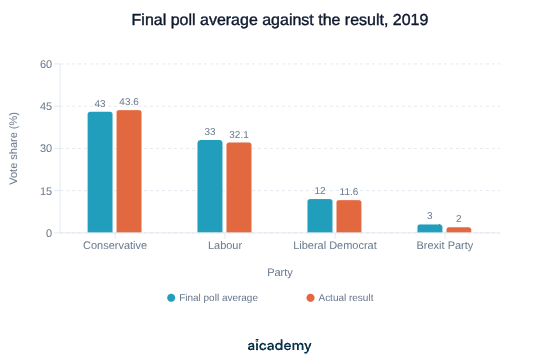
2019 shows that polls can be accurate on vote share. The failures have specific causes: the 1992 inquiry pointed to late swing and to Conservative supporters declining to disclose their intention, and the inquiry into 2015 commissioned by the British Polling Council and the Market Research Society, chaired by Professor Patrick Sturgis, identified unrepresentative samples as the main problem. Even an accurate poll converts badly into seats, because first past the post rewards concentration rather than volume — which is why Reform UK's 14.3% of the national vote in 2024 returned only five seats.
Exit polls are a different instrument and have a much better record. Respondents report how they have voted, not how they might. The 2019 exit poll predicted a Conservative majority of 86 within minutes of polls closing, against an actual 80. In 2024 the Ipsos exit poll gave Labour 410 seats and the Conservatives 131, against an actual 411 and 121.
Why polls matter politically, whether or not they are accurate:
- They shape party strategy. Labour's 2024 campaign concentrated resources on marginal seats identified by private polling, while the Conservatives were tied to defending seats won heavily in 2019.
- They influence election timing. Callaghan's decision not to call an autumn 1978 election and Sunak's decision to call one in May 2024 were both judgements about which way the polls would move next, and both went badly for the incumbent.
- They enable tactical voting. Voters can only vote tactically if they know which candidate is best placed locally, which is what constituency polling and the guidance issued by campaign groups in 2024 supplied.
- The bandwagon and underdog arguments cut in opposite directions. A published lead may attract support to the likely winner or, equally plausibly, encourage complacency and depress its turnout. Neither effect is firmly established, so hedge any claim about them.
As of early September 2026 the polls describe genuine four- and five-party competition: YouGov on 6–7 September 2026 had Labour 23%, Reform UK 23%, the Conservatives 20%, the Greens 12% and the Liberal Democrats 11–12%. Attribute and date every poll you cite.
Key terms
- Media bias
- Systematic slanting of coverage towards a party, leader or position, through selection of stories, prominence, language or the choice of who is quoted.
- Due impartiality
- The regulatory duty on UK broadcasters to give appropriate weight to significant viewpoints on controversial matters, applied more strictly during an election campaign.
- Agenda-setting
- The power of the media to shape which issues voters treat as important, even where coverage does not change their opinion on those issues.
- Reinforcement theory
- The argument that media coverage mostly strengthens views an audience already holds, because people select outlets that fit their existing outlook.
- Exit poll
- A survey of voters conducted as they leave polling stations, recording how they say they have actually voted rather than how they intend to vote.
- Bandwagon effect
- The claim that publishing a party's poll lead attracts further support to it, as voters move towards the side that appears to be winning.
- Poll of polls
- An average of several published voting intention polls, used to smooth out the sampling error and house effects of any single survey.
Frequently asked questions
The evidence points to reinforcement rather than persuasion. Readers largely choose papers that already match their views, and titles such as The Sun tend to switch to parties already ahead in the polls, as in 1997 and 2024, which makes causation hard to establish.
Broadcasting is regulated by Ofcom under a statutory duty of due impartiality, tightened during election periods. The press is self-regulated, mainly through IPSO, with no impartiality requirement, so a newspaper may endorse and campaign for a party.
Mixed. They misjudged 1992, 2015 and 2017, were close on vote shares in 2019, and put Labour's 2024 lead at 15–20 points when it was about 10. Polls are less reliable for seats than for votes, because first past the post translates votes into seats unevenly.
Generate revision on any topic you study
Type any topic you're studying and Aicademy generates a complete lesson, quiz, and flashcard set, personalised to your level.
Lessons on anything
Structured, level-matched lessons on any topic you study
Practice quizzes
Find out what you actually know before the exam does
Flashcard sets
Lock in key concepts with instant revision cards
Ask Aica
Stuck on something? Get a clear explanation, any time
Factors Influencing Voting Behaviour
Conservatism: Core Ideas and Principles
Related lessons
22 min
16 min
18 min