Track progress, take quizzes and save notes on this lesson.

Free forever · no card needed

Start free
Intermediate

Tensions within Socialism

Paper 1, Socialism 2: differing views and tensions within socialism

Aligned to the Pearson Edexcel 9PL0 specification

Level
Intermediate
Reading time
15 min
Published
9 September 2026
On this page
  1. 1.Three Routes Out of Capitalism
  2. 2.Revolutionary Socialism: Capitalism Cannot Be Reformed
  3. 3.Social Democracy: Humanising Capitalism
  4. 4.The Third Way: The Market with a Social Conscience
  5. 5.Where Socialists Still Agree
  6. 6.Tensions in Practice: Applying the Three Strands
  7. 7.Exam Focus: Common Mistakes

Key takeaways

  • Edexcel names three strands: revolutionary socialism, social democracy and the Third Way. The dividing question is whether capitalism must be abolished, corrected or accepted.
  • Revolutionary socialists hold that capitalism rests on exploitation, so reform can soften it but cannot end it; only overthrowing the existing political and societal structures delivers socialism.
  • Social democracy seeks to humanise capitalism in the interests of social justice, using a mixed economy, Keynesian demand management and universal welfare rather than common ownership.
  • The Third Way accepts the market, replaces redistribution with social investment in skills and infrastructure, and prioritises equality of opportunity over equality of outcome.
  • The strands still share collectivism, common humanity, a belief that inequality is unjust and a commitment to social justice, so an answer claiming total disagreement overstates the case.

Three Routes Out of Capitalism

Socialists share a diagnosis and split over the cure. All three strands in this content area regard capitalism as producing unjust inequality; they disagree over whether it must be abolished, corrected, or accepted and worked with.
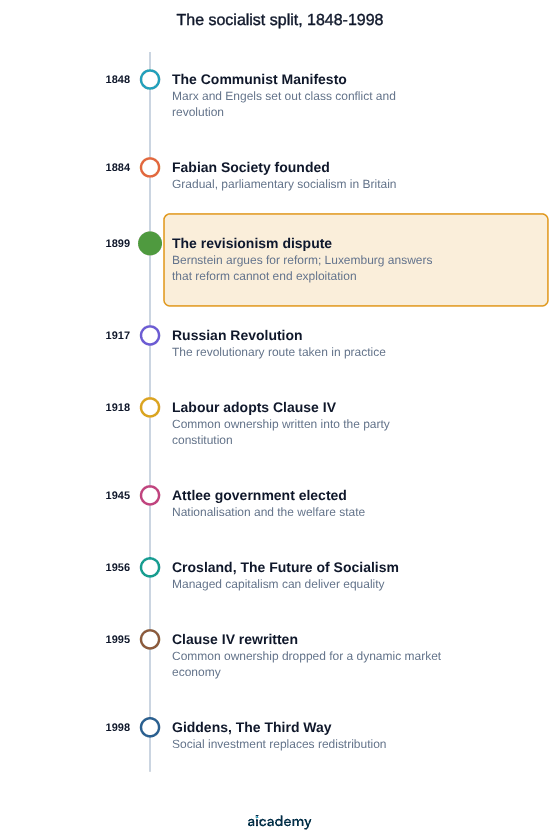
Timeline of the socialist split running from the Communist Manifesto in 1848 and the Fabian Society in 1884, through the 1899 revisionism dispute and the 1917 Russian Revolution, to Clause IV in 1918, Attlee in 1945, Crosland in 1956 and the Third Way in 1998.
Revolutionary socialismSocial democracyThird Way
Verdict on capitalismExploitative at its rootUnjust but reformableEfficient, and the only workable engine of wealth
MethodOverthrow of existing structuresParliamentary legislationParliamentary legislation
Economy soughtCommon ownershipMixed economyRegulated market economy
Equality soughtEquality of outcomeRelative equalityEquality of opportunity
View of the stateThe existing state serves the owning classThe state is a neutral instrument for reformThe state enables, rather than provides

Do not present these as three stages of a single journey. The Third Way is a rival to social democracy, not its completion, and revolutionary socialists regard both as abandonments rather than versions of socialism.

Revolutionary Socialism: Capitalism Cannot Be Reformed

Revolutionary socialism holds that socialism can be brought about only by overthrowing the existing political and societal structures.

The argument rests on a claim about what capitalism is. Profit, on this analysis, comes from paying workers less than the value their labour creates. That is a relationship of exploitation, not merely an unequal distribution — so raising wages, taxing the wealthy or providing free healthcare improves workers' conditions while leaving the mechanism producing the injustice fully intact.

Four supporting claims follow:

  • The state is not neutral. Its laws, courts, civil service and media reflect the interests of those who own productive wealth, so capturing it through elections changes the driver rather than the vehicle.
  • Reform buys off resistance. Concessions reduce the pressure for fundamental change, which is why revolutionary socialists treat welfare gains with suspicion.
  • Class consciousness is required. Workers must come to recognise their shared position before they can act on it.
  • The transition is a rupture, not a drift. A new economic order cannot be assembled piece by piece inside the old one.

Case study — the revisionism dispute of 1899. This exchange is the cleanest illustration of the split, and it is directly examinable through the named thinkers.

  1. The challenge. Eduard Bernstein argued that Marx's predictions had failed: wages were rising, the middle class was growing, and capitalism showed no sign of collapse. Socialism should therefore be pursued through the ballot box and trade unions.
  2. The answer. Rosa Luxemburg replied in Social Reform or Revolution (1899) that reforms address the effects of exploitation and leave the economic relationship producing it untouched. Improvement is not transition.
  3. The twist. Luxemburg did not dismiss reform campaigns. She valued the struggle for reform and democracy precisely because it teaches workers their collective strength and builds the class consciousness a revolution requires.
  4. The legacy. The dispute set the terms for every later argument between socialists about parliamentary strategy, including Labour's own.

The criticism of the revolutionary route is historical. Where revolutions succeeded in the twentieth century they produced concentrated state power rather than workers' control, and in liberal democracies with a wide franchise the parliamentary route has delivered concrete gains the revolutionary route has not.

Social Democracy: Humanising Capitalism

Social democracy is the ideological view that capitalism should be humanised in the interests of social justice. It accepts the market as a producer of wealth and directs the state to correct how that wealth is distributed.

Three intellectual supports hold it up:

  • Keynesian economics. Government spending and taxation can be used to manage demand, so slumps and mass unemployment are treated as policy failures rather than natural cycles.
  • The mixed economy. Key industries and utilities are publicly owned; the rest is left in private hands under regulation.
  • Universal welfare. Services provided to everyone as of right, funded through progressive taxation, on the argument that universal provision commands wider support than means-tested relief.

Case study — the post-war settlement. The Beveridge Report of 1942 identified five obstacles to a decent life — want, disease, ignorance, squalor and idleness — and proposed a comprehensive system of social insurance. The 1945 Labour government built on it: National Insurance, the NHS in 1948, mass council house building and the nationalisation of the Bank of England, coal, rail, gas, electricity and steel between 1946 and 1951.

Anthony Crosland gave the settlement its theory in The Future of Socialism (1956). His argument was that capitalism had changed: ownership had separated from control as professional managers ran firms owned by dispersed shareholders, and the state now had the tools to steer the economy. If capitalism could be managed, then nationalising it was unnecessary — socialism should be redefined as the pursuit of equality, funded out of the growth that managed capitalism generated.

Social democratic claimRevolutionary socialist objection
The state can be used by workers if they win electionsThe state's structures serve the owners of capital whoever is in office
Growth funds redistribution without confiscationRedistribution depends on growth, so a downturn reverses the gains
Welfare removes the worst effects of capitalismRemoving the effects removes the pressure to remove the cause
Equality can be achieved without common ownershipOwnership is what generates inequality in the first place

The vulnerability Crosland's model carried is the one his critics identified: it is funded by economic growth. When growth stalled in the 1970s, the redistributive programme lost its financing, and the strand has been arguing about how to respond ever since. It is the question any social democratic government still has to answer, including the Labour government that has been in office since the 2024 general election and, since 20 July 2026, under Prime Minister Andy Burnham.

The Third Way: The Market with a Social Conscience

The Third Way presents itself as a middle-ground route between traditional socialism and free-market capitalism. Its theorist is Anthony Giddens; its clearest political expression in Britain was New Labour between 1997 and 2010.

The starting analysis is that both older strands were answering a vanished world. Globalised capital markets limit what a national government can tax and spend; a service economy has fragmented the industrial working class; and voters in prosperous democracies have shown limited appetite for redistribution.

What follows from that analysis:

ElementThird Way position
The marketAccepted as the engine of wealth creation; regulated, not replaced
The stateEnables and invests rather than owns and provides — the social investment state
EqualityEquality of opportunity, pursued through education and skills
ClassDisplaced by social exclusion: the problem is being cut off from work and networks
CommunityRights are paired with responsibilities; obligation replaces class solidarity

Case study — New Labour in office, 1997–2010. Read the programme as the theory applied:

  1. Market acceptance. The Bank of England was given operational independence over interest rates in 1997, and the industries privatised in the 1980s were left in private hands.
  2. Regulated floors, not ownership. The National Minimum Wage Act 1998 created a statutory wage floor, in force from April 1999 — an intervention in the labour market that stopped well short of controlling it.
  3. Social investment. Sure Start centres, large increases in school and NHS spending, and the expansion of higher education were framed as investment in people's earning capacity.
  4. Targeted transfers with conditions. Tax credits topped up low wages for people in work, tying support to employment rather than to need alone.
  5. The constitutional break. Clause IV had been rewritten in 1995, so the party entered office without a commitment to common ownership.

Critics on the left argue the Third Way is revisionism carried to its conclusion: a programme that manages capitalism competently while giving up the socialist objective. Its defenders answer that it delivered a minimum wage, sustained increases in public spending and falling child poverty — outcomes traditional social democracy had promised and had not recently delivered.

A well-judged answer treats "is the Third Way still socialism?" as a genuine question. It retains collectivism in public services and a commitment to social justice; it abandons common ownership, equality of outcome and class analysis.

Studying this for an exam?

Generate a personalised learning path for this subject. Free to get started.

Create a learning path

Where Socialists Still Agree

A question asking how far socialists disagree is unbalanced if it lists only differences. Four commitments survive across all three strands.

1. Collectivism. Every strand holds that some goods must be provided collectively. The Third Way retained and expanded public education and healthcare even while accepting the market elsewhere.

2. Common humanity. All three treat people as social beings shaped by their environment rather than as self-made individuals. This is why every strand supports state action in education: if circumstances form character, then improving circumstances is a public duty.

3. Inequality is unjust and reversible. They differ over how much inequality is tolerable and how to reduce it, but none treats the existing distribution of wealth as natural or deserved.

4. Social justice. The phrase is shared. Its content is contested — equality of outcome, relative equality, or fair opportunity — but the underlying commitment to a morally defensible distribution runs through the family.

QuestionRevolutionarySocial democraticThird Way
Is capitalism unjust?Yes, inherentlyYes, in its outcomesIts outcomes need correcting
Are people shaped by society?YesYesYes
Should the state act on inequality?It must be replaced firstYes, through redistributionYes, through investment
Is class the main political divide?YesIt is a major oneIt has fragmented

The safest evaluative line is that socialists agree on ends and divide on means — with the qualification that the Third Way's redefinition of equality changes the end as well, which is why the strand's socialist credentials are disputed within the movement.

Tensions in Practice: Applying the Three Strands

The most reliable way to show analysis rather than description is to run a single policy question through all three strands. Two worked examples follow.

Worked example 1 — should the railways be publicly owned?

StrandPositionReasoning
Revolutionary socialismSupports public ownership, but expects little from itTransferring one industry to state managers leaves the wage relationship and the wider capitalist economy untouched
Social democracySupports it directlyA natural monopoly serving the public should not extract profit from passengers; public ownership is the mixed economy working as intended
Third WayJudges it case by caseOwnership matters less than outcomes; if regulation and competition deliver good services, ownership is a secondary question

Parliament passed the Passenger Railway Services (Public Ownership) Act in 2024, returning passenger rail franchises to public ownership as their contracts expire — a social democratic measure enacted by a party that had spent the previous decades arguing about whether ownership matters.

Worked example 2 — should a government tax wealth to fund public services?

  • Revolutionary socialism: a wealth tax accepts that wealth may be privately held and merely trims it. It relieves symptoms while confirming the principle that produces them.
  • Social democracy: this is the core method. Progressive taxation transfers resources from those with most to services used by everyone, narrowing inequality without abolishing the market.
  • Third Way: cautious. Taxing capital risks driving investment abroad in an open economy; spending on skills and early years raises the earning power of those at the bottom instead.

When a 24-mark question asks how far socialists agree, structure by theme — human nature, the state, society, the economy — and place all three strands inside each theme. Structuring by strand produces three descriptions in sequence and little comparison.

Exam Focus: Common Mistakes

1. Treating the three strands as a chronological sequence

They are rival positions that coexist. Revolutionary socialism did not stop existing in 1956, and social democrats argue with the Third Way rather than having become it.

2. Confusing social democracy with democratic socialism

Democratic socialism pursues the transformation of capitalism through democratic means and retains common ownership as a goal. Social democracy accepts capitalism and sets out to correct its outcomes. Use the spec's term, social democracy, and define it as humanising capitalism.

3. Saying revolutionary socialists oppose reform

Luxemburg's position is more interesting than that. She valued the struggle for reform and democracy because it generates class consciousness — while denying that reform could ever complete the transition.

4. Reducing the Third Way to a slogan

"Neither left nor right" is a description of positioning, not an argument. The substance is the social investment state, equality of opportunity, responsibility alongside rights, and social exclusion in place of class.

5. Listing differences with no areas of agreement

Collectivism, common humanity, the injustice of inequality and social justice survive across all three strands. An answer that omits them is unbalanced before the judgement is reached.

6. Leaving thinkers out of a tensions question

Section B of Paper 1 is a 24-mark "To what extent" question and expects thinkers as evidence. Attach Marx and Engels and Luxemburg to the revolutionary strand, Webb and Crosland to social democracy, and Giddens to the Third Way.

Key terms

Revolutionary socialism
The view that socialism can be achieved only by overthrowing the existing political and societal structures rather than reforming them.
Evolutionary socialism
The view that socialism can be reached gradually and peacefully through elections, legislation and the existing state machinery.
Revisionism
A redefinition of socialism that takes a less hostile view of capitalism and settles for reforming it rather than replacing it.
Social democracy
A strand of socialism that keeps a capitalist economy but corrects its outcomes through welfare, public services and redistribution in the interests of social justice.
Third Way
A middle route between traditional social democracy and free-market capitalism, accepting the market while investing in opportunity and community.
Keynesian economics
The use of government spending and taxation to manage overall demand in the economy, aiming at full employment and stable prices.
Mixed economy
An economy in which some industries are publicly owned and the rest are left in private hands, regulated by the state.
Social investment state
Giddens's model of a state that spends on education, skills and infrastructure to widen opportunity rather than transferring income directly.

Frequently asked questions

Revolutionary socialism, social democracy and the Third Way. Revolutionary socialism seeks to overthrow capitalism, social democracy seeks to humanise it in the interests of social justice, and the Third Way accepts the market and focuses on opportunity.

Social democracy corrects capitalist outcomes through public ownership of key industries, progressive taxation and universal welfare. The Third Way leaves the market largely alone and invests in education, skills and infrastructure to equalise opportunity instead.

Because they see capitalism as an exploitative relationship, not just an unfair distribution. Reform can raise wages and provide welfare, but the wage relationship that produces profit remains, so the injustice survives every reform.

Generate revision on any topic you study

Type any topic you're studying and Aicademy generates a complete lesson, quiz, and flashcard set, personalised to your level.

Lessons on anything

Structured, level-matched lessons on any topic you study

Practice quizzes

Find out what you actually know before the exam does

Flashcard sets

Lock in key concepts with instant revision cards

Ask Aica

Stuck on something? Get a clear explanation, any time

Prev

Socialism: Core Ideas and Principles

Next

Socialist Thinkers

Related lessons

16 min

Lesson

Socialism: Core Ideas and Principles

A-Level Politics · Pearson Edexcel 9PL0

2 hours ago

18 min

Lesson

Socialist Thinkers

A-Level Politics · Pearson Edexcel 9PL0

2 hours ago

17 min

Lesson

The Established Parties

A-Level Politics · Pearson Edexcel 9PL0

2 hours ago

Top students don’t revise more. They revise what counts.

Start revising free

Free to start. No card needed.