The Franchise and Debates over Suffrage

Aligned to the Pearson Edexcel 9PL0 specification
- Level
- Intermediate
- Reading time
- 14 min
- Published
- 9 September 2026
On this page
Key takeaways
- The 1832 Great Reform Act raised the electorate from about 400,000 to 650,000 men and abolished 56 rotten boroughs, but its wording 'male persons' barred women in statute for the first time.
- The 1918 Representation of the People Act gave the vote to all men over 21 and to women over 30 who met a property qualification, tripling the electorate to around 21 million.
- The 1928 Equal Franchise Act extended the vote to women at 21 on the same terms as men; the 1969 Representation of the People Act lowered the voting age from 21 to 18.
- The suffragists (NUWSS, 1897, Millicent Fawcett) used constitutional methods and had around 50,000 members; the suffragettes (WSPU, 1903, Emmeline Pankhurst) used militant direct action and were far smaller.
- Votes at 16 is the leading current movement to extend the franchise: 16-year-olds already vote in Scottish and Welsh elections, and the Representation of the People Bill passed the Commons on 2 September 2026.
Who Could Vote Before 1832
The franchise is the legal right to vote. Britain's began as a narrow property right and took almost two centuries to become universal.
Before 1832, roughly 400,000 men in England and Wales could vote — around 5% of the adult population. The qualification was property, applied inconsistently: county voters needed freehold land worth 40 shillings a year, while borough qualifications varied from town to town.
The distribution of seats was worse than the qualification:
- Rotten boroughs had shrunk to almost nothing but kept their MPs. Old Sarum in Wiltshire had seven voters and returned two MPs.
- Pocket boroughs were controlled outright by a landowner who chose the MP.
- Manchester, Birmingham and Leeds — the fastest-growing industrial cities in the world — had no MPs of their own at all.
- There was no secret ballot, so voters could be watched, bribed or intimidated.
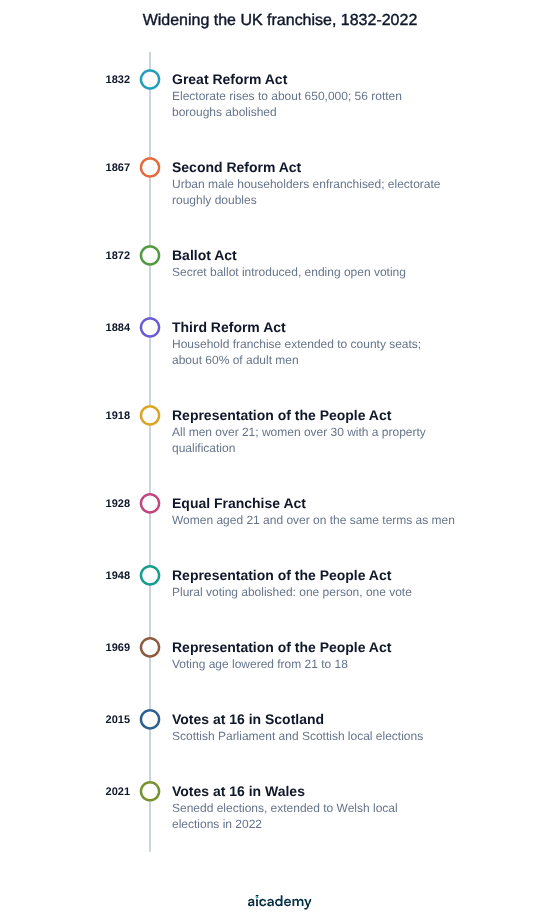
Notice the pace: three widenings spread over fifty years, then almost everything else compressed into the half-century after 1918.
Want more lessons like this one?
Generate lessons on anything you study. Free account, no card needed.
Key terms
- Franchise
- The legal right to vote in public elections.
- Suffrage
- The right to vote, used interchangeably with franchise; universal suffrage means the vote is held by all adult citizens.
- Rotten borough
- A constituency with very few voters that still returned MPs to Parliament, typically controlled by a single wealthy patron, abolished in large numbers by the 1832 Great Reform Act.
- Plural voting
- The practice of casting more than one vote at a general election, through business premises or a university seat, abolished by the Representation of the People Act 1948.
- Suffragist
- A campaigner for votes for women who used peaceful, constitutional methods, chiefly through the National Union of Women's Suffrage Societies.
- Suffragette
- A campaigner for votes for women who used militant direct action, chiefly through the Women's Social and Political Union.
Frequently asked questions
In two stages. The Representation of the People Act 1918 enfranchised women over 30 who met a property qualification. The Equal Franchise Act 1928 lowered this to 21, the same age as men, giving women the vote on equal terms.
Suffragists (the NUWSS, founded 1897) campaigned peacefully through petitions, lobbying and public meetings. Suffragettes (the WSPU, founded 1903) used militant direct action — window-smashing, arson and hunger strikes — under the slogan 'Deeds not words'.
Yes, in some elections. 16- and 17-year-olds can vote in Scottish Parliament and Scottish local elections, and in Senedd and Welsh local elections. They cannot yet vote in UK general elections. The Representation of the People Bill would change that: it passed the Commons on 2 September 2026 and went to the Lords.
Generate revision on any topic you study
Type any topic you're studying and Aicademy generates a complete lesson, quiz, and flashcard set, personalised to your level.
Lessons on anything
Structured, level-matched lessons on any topic you study
Practice quizzes
Find out what you actually know before the exam does
Flashcard sets
Lock in key concepts with instant revision cards
Ask Aica
Stuck on something? Get a clear explanation, any time
Democracy and Participation
Pressure Groups and Other Influences
Related lessons
12 min
18 min
22 min