Track progress, take quizzes and save notes on this lesson.

Free forever · no card needed

Start free
Advanced

Series and Parallel Circuits

4.2.2 Series and parallel circuits

Aligned to the AQA 8463 specification

Level
Advanced
Reading time
6 min
Published
2 July 2026
On this page
  1. 1.Two Ways to Connect Components
  2. 2.Series Circuit Rules
  3. 3.Worked Example: A Series Circuit
  4. 4.Parallel Circuit Rules
  5. 5.Worked Example: A Parallel Circuit
  6. 6.Series vs Parallel at a Glance
  7. 7.Common Exam Mistakes

Key takeaways

  • In a series circuit the current is the same through every component, the total potential difference is shared between components, and the total resistance is the sum of the resistances: R_total = R1 + R2.
  • In a parallel circuit each branch has the same potential difference across it, the total current is the sum of the branch currents, and the total resistance is less than the smallest single resistor.
  • Adding resistors in series increases the total resistance; adding resistors in parallel decreases the total resistance.
  • Both V = IR and the series total-resistance rule R_total = R1 + R2 must be recalled; neither is on the equation sheet.
  • For AQA you are not required to calculate the total resistance of two resistors in parallel.

Two Ways to Connect Components

Components can be joined in two arrangements, and each follows its own set of rules.

  • Series: components are connected in a single loop, one after another, so charge flows through each in turn along one path.
  • Parallel: components are connected on separate branches between the same two points, so charge can flow through more than one path.

The diagram below shows a series loop with two lamps; a parallel circuit would instead split into branches so each lamp sits on its own branch.
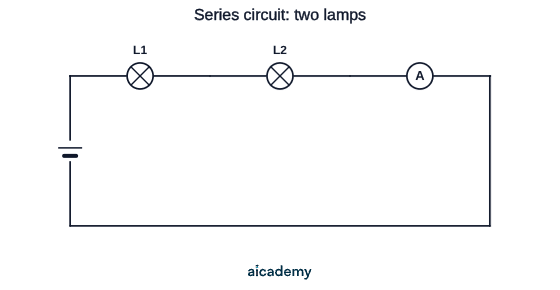
The rest of this lesson works through the current, potential difference and resistance rules for each arrangement, then applies them to worked calculations. The key equation throughout is .

You must recall and apply . It is not given on the Physics equation sheet.

Series Circuit Rules

In a series circuit there is only one loop, so:

  • Current is the same through every component (one path, so the same charge passes each point).
  • Potential difference is shared between the components: the individual potential differences add up to the source potential difference.
  • Total resistance is the sum of the individual resistances:

You must recall the series rule . It is not on the equation sheet.

Adding a resistor in series increases the total resistance, because the charge, following its single path, has to pass through more opposition. A larger total resistance means a smaller current from the source (for the same source potential difference).

The potential difference splits in proportion to resistance: the largest resistor takes the largest share of the potential difference.

Worked Example: A Series Circuit

Two resistors, 4 Ω and 8 Ω, are connected in series to a 6 V battery. Find the total resistance, the current, and the potential difference across each resistor.

Step 1 — Total resistance.

Step 2 — Current from the source (same everywhere in series). Rearranging :

Step 3 — Potential difference across each resistor (same 0.5 A through each):

Check: the two potential differences add to V, the source potential difference, as they must in series. The 8 Ω resistor, being larger, takes the bigger share.

Parallel Circuit Rules

In a parallel circuit each branch connects across the same two points, so:

  • Potential difference across each branch is the same, and equal to the source potential difference.
  • Current splits between the branches: the branch currents add up to the total current drawn from the source.
  • Total resistance is less than the smallest individual resistor.

Adding a resistor in parallel decreases the total resistance, because each new branch gives the current another path. More paths make it easier overall for charge to flow, so the equivalent resistance falls.

(Note) For AQA you are not required to calculate the total resistance of two resistors in parallel. You need only state that it is less than the smallest resistor, and explain why qualitatively.

A useful consequence: because each branch gets the full source potential difference, a branch with lower resistance carries a larger current, following .

Want more lessons like this one?

Generate lessons on anything you study. Free account, no card needed.

Start generating

Worked Example: A Parallel Circuit

A 12 V supply is connected to two resistors in parallel: 6 Ω on one branch and 4 Ω on the other. Find the current in each branch and the total current.

Step 1 — Note the potential difference across each branch. In parallel, each branch has the full supply potential difference:

Step 2 — Current in the 6 Ω branch. Using :

Step 3 — Current in the 4 Ω branch.

Step 4 — Total current (branch currents add):

The supply delivers 5 A, which splits into 2 A and 3 A. The lower-resistance 4 Ω branch carries the larger current, as expected.

Series vs Parallel at a Glance

FeatureSeriesParallel
Number of pathsOneMore than one
CurrentSame through all componentsSplits; branch currents add to the total
Potential differenceShared between componentsSame across every branch
Total resistanceSum: Less than the smallest resistor
Effect of adding a componentTotal resistance increasesTotal resistance decreases

A real-world reason homes are wired in parallel: each appliance gets the full mains potential difference, and switching one off does not break the path for the others.

Common Exam Mistakes

1. Swapping the series and parallel rules

In series, current is the same and potential difference is shared. In parallel, potential difference is the same and current is shared. Mixing these two is the most common error in this topic.

2. Adding resistances in parallel

You do not add resistances in parallel. Adding in parallel gives a total less than the smallest resistor. Only series resistances add: .

3. Trying to calculate a parallel total resistance

AQA does not require the total resistance of two parallel resistors. State that it is less than the smallest resistor and explain why; do not attempt a full calculation.

4. Using the wrong potential difference in a series branch

In series, each resistor has only its share of the source potential difference, not the full source value. Find the current first, then use for each resistor.

5. Forgetting the branch currents must add up

In parallel, check that your branch currents add to the total supply current. If they do not, a value is wrong.

Key terms

Series circuit
A circuit where components are connected in a single loop, so the same current flows through each in turn.
Parallel circuit
A circuit where components are connected on separate branches, so each branch has the same potential difference across it.
Total (equivalent) resistance
The single resistance that would have the same effect as a combination of resistors.

Frequently asked questions

In a series circuit the current is the same at every point, and the total potential difference of the source is shared between the components. The total resistance is the sum of the individual resistances, R_total = R1 + R2.

In a parallel circuit each branch has the full source potential difference across it, and the current from the source splits between the branches, so the branch currents add up to the total current. The total resistance is less than the smallest resistor.

Each extra parallel branch gives the current another path to flow through. More paths means it is easier overall for charge to flow, so the total resistance falls below that of the smallest single resistor.

Generate revision on any topic you study

Type any topic you're studying and Aicademy generates a complete lesson, quiz, and flashcard set, personalised to your level.

Lessons on anything

Structured, level-matched lessons on any topic you study

Practice quizzes

Find out what you actually know before the exam does

Flashcard sets

Lock in key concepts with instant revision cards

Ask Aica

Stuck on something? Get a clear explanation, any time

Prev

Resistors and Circuit Components

Next

Mains Electricity and Safety

Related lessons

5 min

Lesson

Resistance and Ohm's Law

AQA GCSE Physics · AQA 8463

19 days ago

6 min

7 min

Top students don’t revise more. They revise what counts.

Start revising free

Free to start. No card needed.