Track progress, take quizzes and save notes on this lesson.

Free forever · no card needed

Start free
Intermediate

Circuit Symbols, Charge and Current

4.2.1.1 Standard circuit diagram symbols·4.2.1.2 Electrical charge and current

Aligned to the AQA 8463 specification

Level
Intermediate
Reading time
6 min
Published
2 July 2026
On this page
  1. 1.What Electric Current Really Is
  2. 2.Standard Circuit Symbols
  3. 3.Charge, Current and Time: Q = It
  4. 4.Worked Example: Finding the Charge
  5. 5.Worked Example: Finding the Current
  6. 6.Why Current Is the Same All the Way Round a Loop
  7. 7.Common Exam Mistakes

Key takeaways

  • Electric current is the rate of flow of electric charge; it is measured in amperes (A) with an ammeter connected in series.
  • For charge to flow, a circuit must be closed (complete) and contain a source of potential difference, such as a cell or battery.
  • Charge, current and time are linked by Q = It, where Q is charge in coulombs (C), I is current in amperes (A) and t is time in seconds (s). You must recall and apply this equation.
  • The current is the same value at every point in a single closed loop, because charge is not used up as it flows round.
  • Potential difference is measured in volts (V) with a voltmeter connected in parallel across a component.

What Electric Current Really Is

Electric current is the rate of flow of electric charge round a circuit. Charge is carried by tiny particles; in a metal wire the charge carriers are free electrons, which drift through the metal when a source pushes them.

For any charge to flow at all, two things must be true:

  • The circuit must be closed (complete), forming an unbroken loop.
  • The circuit must contain a source of potential difference, such as a cell or a battery, to push the charge round.

If the loop is broken, for example by an open switch, no charge can flow and the current is zero.

Current is measured in amperes (amps, symbol A) using an ammeter. The ammeter is connected in series, so the charge being measured flows straight through it.

Potential difference, which does the pushing, is measured in volts (V) using a voltmeter connected in parallel across the component you are testing.

Standard Circuit Symbols

Circuit diagrams use standard symbols so that any physicist can read them. You must be able to draw and interpret each of the following components. The diagram below shows a simple series circuit built from four of them.
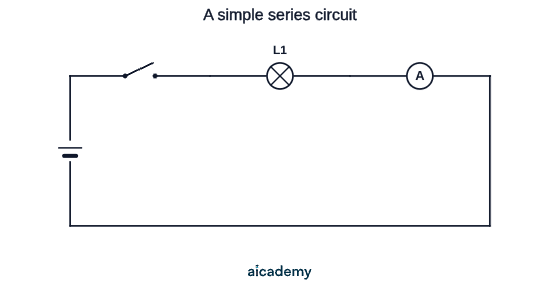
The full set of symbols you must know for AQA 8463:

ComponentWhat it does
CellSingle source of potential difference (longer line = positive)
BatteryTwo or more cells joined together
Switch (open / closed)Breaks or completes the circuit
FuseMelts and breaks the circuit if the current gets too high
ResistorFixed opposition to current
Variable resistorResistance can be changed to control current
DiodeLets current flow one way only
LED (light-emitting diode)A diode that emits light when current flows
LampTransfers energy to light (and heat)
VoltmeterMeasures potential difference (connected in parallel)
AmmeterMeasures current (connected in series)
ThermistorResistance changes with temperature
LDR (light-dependent resistor)Resistance changes with light intensity

Charge, Current and Time: Q = It

The amount of charge that has flowed is linked to the current and the time for which it flows:

where is charge in coulombs (C), is current in amperes (A) and is time in seconds (s).

You must recall and apply this equation. It is not given on the Physics equation sheet.

Reading the equation as words: the larger the current, or the longer it flows, the more charge passes. One coulomb is the charge that flows when a current of one ampere flows for one second.

To find charge, multiply current by time. To find current or time instead, rearrange:

The single most common error is leaving time in minutes. Time must be in seconds before you multiply.

Worked Example: Finding the Charge

A current of 0.5 A flows through a torch bulb for 2 minutes. Calculate the charge that flows.

Step 1 — Convert the time to seconds.

Step 2 — Write the equation.

Step 3 — Substitute and calculate.

The charge that flows is 60 C.

Notice how skipping Step 1 would give C, which is 60 times too small. Converting minutes to seconds first is the step that saves the marks.

Something not quite clicking?

Ask Aica to explain any part of this differently. Free, takes 30 seconds.

Ask Aica

Worked Example: Finding the Current

A charge of 180 C flows through a heater in 90 s. Calculate the current.

Step 1 — Rearrange Q = It to make I the subject.

Step 2 — Substitute the values (time is already in seconds).

Step 3 — Calculate.

The current is 2 A.

A quick sanity check: , which matches the charge given, so the answer is consistent.

Why Current Is the Same All the Way Round a Loop

In a single closed loop (a series circuit) the current has the same value at every point. Charge is never used up or lost as it flows; the same charge simply keeps moving round.

Picture the electrons as beads on a loop of string: if you pull the string, every bead moves at once and the same number pass each point each second. This is why an ammeter placed anywhere in a single loop reads the same value.

The current is the same at every point in a single closed loop. Components in that loop share out the potential difference and transfer energy, but they do not "use up" the current.

A frequent misconception is that a lamp "uses up" current so that less flows out than in. It does not. The lamp transfers energy carried by the charge, but the rate of flow of charge (the current) leaving it equals the rate entering it.

Common Exam Mistakes

1. Leaving time in minutes or hours

needs time in seconds. Convert first: multiply minutes by 60, hours by 3600. This is the error examiners see most often.

2. Connecting the meters the wrong way

An ammeter goes in series (current flows through it); a voltmeter goes in parallel across the component. Swapping them is a guaranteed lost mark on a circuit-drawing question.

3. Thinking current is "used up" by components

The current is the same at every point in a single loop. What a component changes is the energy the charge carries (the potential difference), not the rate of flow of charge.

4. Confusing the units and quantities

QuantitySymbolUnitUnit symbol
ChargeQcoulombC
CurrentIampereA
Timetseconds
Potential differenceVvoltV

Writing charge in amps or current in coulombs loses marks even when the arithmetic is right.

5. Forgetting the circuit must be complete

No closed loop and no source of potential difference means no current. Always check the loop is unbroken and that a switch is closed before doing any calculation.

Key terms

Electric current
The rate of flow of electric charge round a circuit, measured in amperes (A).
Electric charge
A property of matter carried by particles such as electrons; measured in coulombs (C).
Coulomb
The unit of electric charge; one coulomb is the charge that flows when a current of one ampere flows for one second.
Potential difference
The energy transferred per unit charge between two points in a circuit, measured in volts (V); also called voltage.
Ammeter
A meter that measures electric current; it is always connected in series with the component.
Voltmeter
A meter that measures potential difference; it is always connected in parallel across the component.

Frequently asked questions

Electric current is the rate of flow of electric charge round a circuit. It is measured in amperes (amps, A) using an ammeter, which must be connected in series so that the charge flows through it.

Charge = current × time, written Q = It. Charge Q is in coulombs (C), current I is in amperes (A) and time t is in seconds (s). You must recall and apply this equation in the exam; it is not on the equation sheet.

Charge is not created or destroyed as it flows, and in a single loop there is only one path. So the same amount of charge passes every point each second, which means the current reads the same at every point in that loop.

Generate revision on any topic you study

Type any topic you're studying and Aicademy generates a complete lesson, quiz, and flashcard set, personalised to your level.

Lessons on anything

Structured, level-matched lessons on any topic you study

Practice quizzes

Find out what you actually know before the exam does

Flashcard sets

Lock in key concepts with instant revision cards

Ask Aica

Stuck on something? Get a clear explanation, any time

Prev

National and Global Energy Resources

Next

Resistance and Ohm's Law

Related lessons

5 min

Lesson

Resistance and Ohm's Law

AQA GCSE Physics · AQA 8463

19 days ago

7 min

6 min

Top students don’t revise more. They revise what counts.

Start revising free

Free to start. No card needed.

Circuit Symbols, Charge and Current: AQA GCSE Physics | Aicademy