Resistors and Circuit Components

Aligned to the AQA 8463 specification
- Topic
- Electricity
- Level
- Advanced
- Reading time
- 7 min
- Published
- 2 July 2026
- Updated
- 16 August 2026
On this page
Key takeaways
- An ohmic conductor at constant temperature has a constant resistance, so its I–V graph is a straight line through the origin and current is directly proportional to potential difference.
- A filament lamp is non-ohmic: as current rises the filament heats up, its resistance increases, and its I–V graph curves (an S-shape through the origin).
- A diode only lets current flow one way; its resistance is very high in the reverse direction, so its I–V graph shows current only for forward potential difference.
- A thermistor's resistance decreases as temperature increases; an LDR's resistance decreases as light intensity increases.
- Required practical 4 uses a circuit with a variable resistor to obtain the I–V characteristics of a resistor, a filament lamp and a diode.
Want more lessons like this one?
Generate lessons on anything you study. Free account, no card needed.
Required Practical 4: I–V Characteristics
Aim: obtain the I–V characteristics of a fixed resistor, a filament lamp and a diode at constant temperature.
Apparatus: the test component, a cell or power supply, an ammeter (in series), a voltmeter (in parallel across the component), a variable resistor and connecting leads. The circuit below shows the arrangement for the resistor.
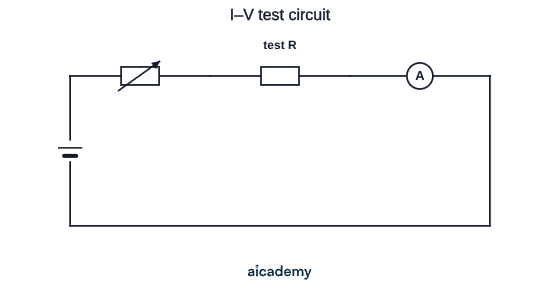
The voltmeter is then connected in parallel across the test component.
Method:
- Build the circuit with the ammeter in series and the voltmeter in parallel across the component under test.
- Adjust the variable resistor to change the current, and record the current and the potential difference at each setting.
- Take several readings across a range of potential differences.
- Reverse the connections to the cell and repeat, so you get negative values of and too.
- Plot (y-axis) against (x-axis) and repeat the whole method for each component.
| Variable | Type | Detail |
|---|---|---|
| Potential difference (set by variable resistor) | Independent | Changed at each reading |
| Current | Dependent | Measured with the ammeter |
| Temperature of the component | Control | Keep readings brief so it stays constant |
Why use a variable resistor: it lets you change the current without changing the component being tested, so you can plot many points on the same characteristic.
Expected results: the resistor gives a straight line through the origin; the filament lamp gives an S-shaped curve; the diode gives current only in the forward direction.
Key terms
- Ohmic conductor
- A component whose resistance stays constant at constant temperature, so current is directly proportional to potential difference.
- I–V characteristic
- A graph of current against potential difference for a component, used to show how its resistance behaves.
- Filament lamp
- A lamp with a thin metal wire (filament) that heats up and glows; its resistance rises as it gets hotter.
- Diode
- A component that lets current flow in one direction only, having very high resistance in the reverse direction.
- Thermistor
- A resistor whose resistance decreases as temperature increases.
- Light-dependent resistor (LDR)
- A resistor whose resistance decreases as light intensity increases.
Frequently asked questions
An ohmic conductor keeps a constant resistance at constant temperature, so its I–V graph is a straight line through the origin. A non-ohmic conductor, such as a filament lamp or diode, has a resistance that changes, so its I–V graph is curved.
As the current increases, the filament gets hotter. A hotter metal filament has a higher resistance, so the current increases less steeply for each extra volt. This gives a curved (S-shaped) I–V graph rather than a straight line.
A thermistor's resistance decreases as its temperature increases. This makes it useful in temperature-sensing circuits such as thermostats, where a change in temperature changes the current in the circuit.
Generate revision on any topic you study
Type any topic you're studying and Aicademy generates a complete lesson, quiz, and flashcard set, personalised to your level.
Lessons on anything
Structured, level-matched lessons on any topic you study
Practice quizzes
Find out what you actually know before the exam does
Flashcard sets
Lock in key concepts with instant revision cards
Ask Aica
Stuck on something? Get a clear explanation, any time
Resistance and Ohm's Law
Series and Parallel Circuits
Related lessons
5 min
6 min
6 min