Track progress, take quizzes and save notes on this lesson.

Free forever · no card needed

Start free
Intermediate

Tropical Rainforests: Deforestation and Sustainable Management

AicademyAicademy
·GCSE Geography
3.1.2.2 Tropical rainforests

Aligned to the AQA 8035 specification

Level
Intermediate
Reading time
11 min
Published
10 June 2026
Updated
1 July 2026
On this page
  1. 1.Changing Rates of Deforestation
  2. 2.Causes of Deforestation: Case Study — The Amazon, Brazil
  3. 3.Impacts of Amazon Deforestation
  4. 4.The Value of Tropical Rainforests
  5. 5.Sustainable Management Strategies
  6. 6.Common Exam Mistakes

Key takeaways

  • Amazon deforestation has multiple simultaneous causes, with commercial cattle ranching dominant (about 80% of cleared land), alongside soy farming, logging, road building, mining, energy development and settlement.
  • Causes and impacts are distinct: causes are why forest is cleared (economic drivers), while impacts are the consequences such as soil erosion, nutrient loss, CO2 release and biodiversity loss.
  • Cleared tropical soil does not stay fertile: nutrients live in the biomass, so once trees are burned the ash supports crops for only two to three seasons before the latosol degrades through leaching and erosion.
  • The Amazon stores about 150-200 billion tonnes of carbon, and clearance disrupts the water cycle, with studies suggesting losing 20-25% of cover could pass a tipping point beyond which it cannot sustain its own rainfall.
  • Sustainable management spans scales: selective logging and replanting (FSC), conservation and ecotourism, agreements like CITES, debt-for-nature swaps, and REDD+, but enforcement in remote areas is difficult.

Changing Rates of Deforestation

Deforestation is the permanent removal of trees and forest cover, converting the land to another use. Tropical rainforests have been cleared at significant rates since the mid-20th century, driven by the economic demands of growing populations and rising global demand for commodities.

Global deforestation picture:

  • Tropical forests cover approximately 6% of the Earth's surface
  • An estimated 10 million hectares of forest are lost globally per year — roughly the size of Iceland
  • Brazil, Indonesia, the Democratic Republic of Congo, Bolivia, and Peru are among the countries with the highest rates of forest loss
  • Deforestation peaked globally in the 1990s and early 2000s; some countries have reduced rates significantly through policy action, while others have seen acceleration

Amazon-specific rates:

  • The Amazon is the world's largest tropical rainforest, covering approximately 5.5 million km² across nine countries
  • Brazil contains around 60% of the Amazon (approximately 4.1 million km²)
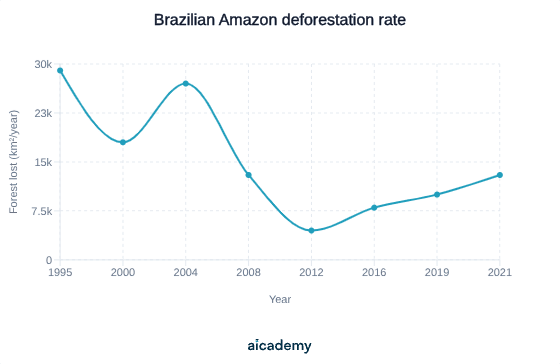
  • Peak deforestation in Brazil reached approximately 27,000 km²/year in the late 1990s
  • Policy action after 2004 reduced this to around 4,500 km²/year by 2012
  • Rates increased again from 2019 before new controls were introduced

The chart below shows Brazil's annual Amazon forest loss: a peak in the late 1990s, a sharp fall after 2004 policy action, then a rise from 2019.
Deforestation is not uniform — it often follows transport corridors, advancing from road frontiers into previously untouched interior forest.

Causes of Deforestation: Case Study — The Amazon, Brazil

The Amazon Basin provides the most studied and data-rich example of tropical deforestation. Multiple drivers operate simultaneously.

CauseDetail
Commercial cattle ranchingThe dominant driver: ~80% of cleared Amazon land is used for cattle grazing. Brazil is the world's largest beef exporter.
Commercial soy farmingCleared land grows soy, primarily for export as animal feed. The Cerrado (savanna) is also heavily cleared for soy.
LoggingBoth legal (certified timber) and illegal logging removes high-value hardwoods (mahogany, rosewood). Logging roads open access for other deforestation.
Road buildingThe BR-163 highway (Cuiabá–Santarém) opened vast interior areas to settlement and farming. Road corridors correlate strongly with deforestation patterns.
Mineral extractionIron ore mining at Carajás (Pará state, world's largest iron ore mine); gold, bauxite, manganese extraction. Mining attracts settlements and infrastructure.
Energy developmentThe Belo Monte hydroelectric dam (completed 2019 on the Xingu River) flooded approximately 500 km² of forest and affected indigenous territories.
Settlement and population pressureGovernment colonisation programmes since the 1970s encouraged migration into Amazonia; spontaneous settlers clear land for subsistence farming.

Population growth underlies many causes: Brazil's population increased from 70 million (1960) to 215 million (2023), intensifying demand for land, food, and energy. Global demand for beef and soy also plays a direct role — deforestation in Brazil is partly driven by consumption patterns in Europe and China.

Impacts of Amazon Deforestation

Deforestation in the Amazon produces interconnected economic, environmental, and social consequences.

Economic impacts:

  • Short-term economic gains from farming, timber sales, and mineral extraction
  • Long-term loss of ecosystem services: pharmaceutical plants not yet discovered, reduced tourism potential, degraded water regulation
  • Carbon trading revenue lost if forest is cleared (REDD+ financial mechanism pays countries to preserve forest)

Environmental impacts:

ImpactMechanism
Soil erosionTree roots bind soil; removal exposes bare ground to heavy tropical rain; topsoil is washed into rivers within one or two seasons
Nutrient lossWith vegetation gone, nutrients leach rapidly from the shallow latosol; soil fertility collapses within 2–3 growing seasons
Contribution to climate changeThe Amazon stores approximately 150–200 billion tonnes of carbon in its vegetation and soils combined; burning and decomposition of cleared forest releases CO₂ — Brazil is a top-ten emitter partly because of land-use change
Water cycle disruptionTrees return 50–70% of rainfall to the atmosphere through transpiration; large-scale clearance reduces regional rainfall — studies suggest that if the Amazon loses 20–25% of its cover, it may pass a "tipping point" beyond which it can no longer sustain its own rainfall
Biodiversity lossSpecies loss is permanent; an estimated 137 species per day globally are lost to deforestation; the Amazon contains an estimated 10% of all species on Earth
Displacement of indigenous peopleApproximately 300 Amazonian tribes, including some uncontacted groups, have lost land, access to traditional resources, and cultural integrity to deforestation and mining

The Value of Tropical Rainforests

Tropical rainforests provide a range of values to both people and the environment that make their preservation in the long-term interest of humanity.

Environmental values:

  • Climate regulation: forests absorb CO₂ and act as major carbon sinks; the Amazon stores an estimated 150–200 billion tonnes of carbon in its vegetation and soils combined
  • Water cycling: "flying rivers" — the Amazon basin releases approximately 20 trillion litres of water vapour daily, supplying rainfall to southern Brazil and Argentina's farmlands
  • Biodiversity: estimated 10% of all Earth's species; the highest concentration of biodiversity on the planet; gene pool for future crop development and medicines

Economic and social values:

  • Medicines: approximately 25% of pharmaceutical drugs are derived from rainforest plants; 70% of plants identified as having anti-cancer properties occur in tropical rainforests
  • Livelihoods: an estimated 60 million indigenous people depend on tropical rainforests for food, medicine, building materials, and cultural identity
  • Ecotourism: rainforests attract significant tourism revenue — Costa Rica's ecotourism sector earned over $3 billion in 2019

The long-term economic value of a standing rainforest — through medicine, water regulation, tourism, and climate stability — exceeds the short-term value of cleared land by many multiples. The challenge is that the short-term gains accrue to individuals; the long-term benefits accrue to everyone.

Studying this for an exam?

Generate a personalised learning path for this subject. Free to get started.

Create a learning path

Sustainable Management Strategies

The spec requires knowledge of strategies to manage tropical rainforests sustainably. These operate at individual, national, and international scales.

StrategyHow it worksExample
Selective logging and replantingOnly mature trees of specified species are removed; seedlings are replanted to maintain forest cover and species diversityFSC (Forest Stewardship Council) certified timber schemes in Brazil, Malaysia, Indonesia
Conservation and educationNational parks and protected reserves ban or restrict commercial activity; local communities educated about the value of forest stewardshipAmazon National Park (Brazil); Yasuní National Park (Ecuador)
EcotourismControlled tourism brings income to local communities, providing economic incentive to preserve rather than clear forestMamirauá Sustainable Development Reserve (Amazon, Brazil); Costa Rica's eco-lodges
International agreements on tropical hardwoodsAgreements regulate and restrict trade in illegally logged hardwoods; importers required to verify legal originCITES (Convention on International Trade in Endangered Species); EU Timber Regulation
Debt reduction (debt-for-nature swaps)Wealthy countries or banks reduce or cancel debts owed by forest nations in exchange for commitments to protect specific areas of rainforestBrazil–US debt-for-nature agreements; Bolivia Debt-for-Nature swap (3.7 million hectares protected)
REDD+ (Reducing Emissions from Deforestation and Forest Degradation)UN financial mechanism pays developing countries per tonne of CO₂ kept out of the atmosphere by preserved forestsNorway pays Brazil ~$1 billion via the Amazon Fund to reduce deforestation

Challenges of sustainable management:

  • Enforcement in remote areas is difficult; illegal logging and land invasions continue
  • Short-term economic pressures make clearance more immediately profitable than conservation
  • Land ownership is disputed; indigenous land rights are not consistently protected by national governments

Common Exam Mistakes

1. Listing only one cause of deforestation

Deforestation has multiple simultaneous drivers. A high-level answer names at least three: commercial farming (cattle/soy), logging, road building, mining, energy development, and settlement. Stating "people cut trees for wood" is insufficient.

2. Confusing deforestation impacts with causes

The distinction matters in exam questions. Causes are why forest is cleared (economic drivers: farming, logging, etc.). Impacts are the consequences (soil erosion, CO₂ release, biodiversity loss). Keep these in separate sections of an extended answer.

3. Stating that cleared tropical soil remains fertile

The opposite is true. Tropical latosols are nutrient-poor; nutrients reside in the living biomass. Once trees are cleared and burned, nutrients in the ash support crops for two to three seasons. After that, the exposed soil degrades rapidly through leaching and erosion.

4. Describing sustainable management without evidence

Naming a strategy is not enough. Support each strategy with a specific example: "Selective logging schemes such as those certified by the Forest Stewardship Council (FSC) in Brazil allow specified mature trees to be removed while seedlings are replanted."

5. Omitting the "value" element in extended answers

If asked "to what extent should the rainforest be preserved," include the economic and environmental values clearly — medicine, water cycling, carbon storage, livelihoods of indigenous people — before evaluating management strategies. Answers that only list damage and strategies, without explaining what is at stake, are not reaching the higher levels.

Key terms

Deforestation
The permanent removal of trees and forest cover, converting the land to another use.
Latosol
The nutrient-poor tropical rainforest soil from which fertility collapses within two to three growing seasons once the vegetation is cleared.
Selective logging
Removing only mature trees of specified species and replanting seedlings to maintain forest cover and species diversity.
Ecotourism
Controlled tourism that brings income to local communities, giving an economic incentive to preserve rather than clear forest.
Debt-for-nature swap
An agreement where wealthy countries or banks reduce or cancel a forest nation's debt in exchange for commitments to protect specific areas of rainforest.
REDD+
A UN financial mechanism that pays developing countries per tonne of CO2 kept out of the atmosphere by preserving forests.
FSC (Forest Stewardship Council)
A certification scheme for timber from forests where mature trees are selectively removed and seedlings replanted.
Flying rivers
Vast columns of water vapour released by the Amazon (around 20 trillion litres daily) that supply rainfall to areas far beyond the forest, such as southern Brazil and Argentina.
Carbon sink
A forest that absorbs and stores CO2; the Amazon stores an estimated 150-200 billion tonnes of carbon in its vegetation and soils.

Frequently asked questions

Amazon deforestation has multiple drivers operating at once. Commercial cattle ranching is dominant, accounting for about 80% of cleared land, alongside soy farming, legal and illegal logging, road building such as the BR-163 highway, mineral extraction, energy development like the Belo Monte dam, and settlement.

No. Tropical latosols are nutrient-poor because nutrients reside in the living biomass, not the soil. Once trees are cleared and burned, the nutrients in the ash support crops for only two to three growing seasons. After that the exposed soil degrades rapidly through leaching and erosion.

REDD+ (Reducing Emissions from Deforestation and Forest Degradation) is a UN financial mechanism that pays developing countries per tonne of CO2 kept out of the atmosphere by preserved forests. For example, Norway pays Brazil around $1 billion via the Amazon Fund to reduce deforestation.

Generate revision on any topic you study

Type any topic you're studying and Aicademy generates a complete lesson, quiz, and flashcard set, personalised to your level.

Lessons on anything

Structured, level-matched lessons on any topic you study

Practice quizzes

Find out what you actually know before the exam does

Flashcard sets

Lock in key concepts with instant revision cards

Ask Aica

Stuck on something? Get a clear explanation, any time

Prev

Tropical Rainforests: Characteristics and Biodiversity

Next

UK Physical Landscapes: Uplands, Lowlands and River Systems

Related lessons

Top students don’t revise more. They revise what counts.

Start revising free

Free to start. No card needed.