Track progress, take quizzes and save notes on this lesson.

Free forever · no card needed

Start free
Intermediate

Tropical Rainforests: Characteristics and Biodiversity

AicademyAicademy
·GCSE Geography
3.1.2.2 Tropical rainforests

Aligned to the AQA 8035 specification

Level
Intermediate
Reading time
12 min
Published
10 June 2026
Updated
1 July 2026
On this page
  1. 1.Location and Climate of Tropical Rainforests
  2. 2.The Layered Structure of the Rainforest
  3. 3.Soils and the Nutrient Cycle
  4. 4.Interdependence: How Components Rely on Each Other
  5. 5.Plant and Animal Adaptations
  6. 6.Biodiversity: Richness and Threats
  7. 7.Common Exam Mistakes

Key takeaways

  • Tropical rainforest soils (latosols) are nutrient-poor, not rich: around 80% of nutrients are stored in the living biomass, and the fast nutrient cycle, not fertile soil, is the basis of the forest's productivity.
  • Competition for sunlight creates four vertical layers (emergent, canopy, understorey, forest floor), with the canopy capturing 70-80% of sunlight and under 2% reaching the forest floor.
  • The rainforest is highly interdependent: trees return 50-70% of rainfall to the air through transpiration, so large-scale deforestation reduces regional rainfall, with 20-30% falls seen in deforested Amazon areas.
  • Tropical rainforests cover about 6% of Earth's land surface but contain an estimated 50-80% of all plant and animal species, making them the most biodiverse ecosystems on Earth.
  • Plant and animal adaptations are specific: drip tips shed rainwater to prevent fungal growth, buttress roots stabilise tall trees in shallow soils, and camouflage, arboreal lifestyles and warning colouration aid animals.

Location and Climate of Tropical Rainforests

Tropical rainforests are dense evergreen forests found in the equatorial zone, broadly between 5°N and 5°S of the equator. The three major areas are:

  • South America — the Amazon Basin (Brazil, Peru, Colombia); the world's largest tropical rainforest
  • Central Africa — the Congo Basin (Democratic Republic of Congo, Cameroon)
  • Southeast Asia — Borneo, Sumatra, Papua New Guinea, and the Philippines

The climate is hot and wet throughout the year because the equatorial zone receives near-vertical solar radiation every day, with no tilt-driven seasons.

Climate variableTypical value
Average temperature26–28°C (little seasonal variation)
Annual rainfall2,000–3,000 mm or more
SeasonalityNone — no distinct dry season
Daily patternWarm mornings; heavy convectional rainfall most afternoons
HumidityConsistently 80–90%

Convectional rainfall drives the daily pattern: intense solar heating evaporates water from trees; warm, moist air rises, cools, condenses into clouds, and falls as afternoon rainstorms. This self-reinforcing cycle means the forest generates much of its own rainfall through transpiration — a key element of interdependence.

The Layered Structure of the Rainforest

Competition for sunlight shapes the tropical rainforest into four distinct vertical layers, each with its own microclimate and community of species.

LayerHeightCharacteristics
Emergent40–70 mIsolated giant trees projecting above the canopy; exposed to full sun, wind, and rain
Canopy20–40 mDense, continuous leaf cover; captures 70–80% of available sunlight; most photosynthesis
Understorey5–20 mShade-adapted shrubs and young trees; broad, dark-green leaves to capture filtered light
Forest floor0–5 mLess than 2% of sunlight reaches here; thin leaf litter; rapid decomposition; fungi and large insects

The cross-section below shows the four layers and how sunlight diminishes from the exposed emergents down to the dark forest floor.
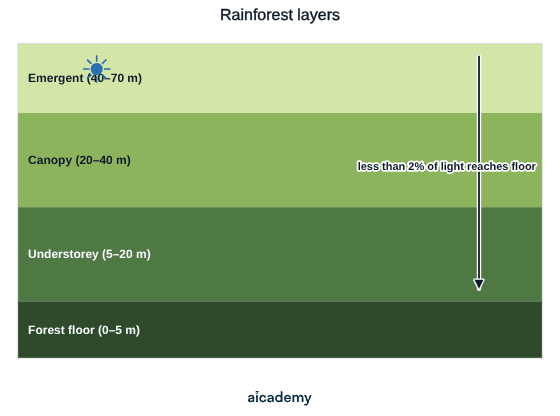
The canopy acts as an umbrella, intercepting most rainfall and sunlight before it reaches the lower layers. Trees compete intensely for height. The forest floor is dark, humid, and relatively clear of vegetation — not because conditions are unsuitable for growth, but because seeds that germinate there struggle to survive long enough to reach the light.

The layered structure creates multiple niches — distinct roles in the ecosystem — which is a key reason for the extraordinary biodiversity of tropical rainforests.

Soils and the Nutrient Cycle

Despite the spectacular density of vegetation, tropical rainforest soils (latosols) are surprisingly nutrient-poor. Understanding where the nutrients actually are explains this apparent paradox.

Distribution of nutrients in a tropical rainforest:

StoreApproximate share of total nutrients
Living biomass (mainly trees)~80%
Litter on the forest floor~10%
Soil~10%

Why soils are nutrient-poor:

  1. Fallen leaves decompose within a few weeks — warm, humid conditions accelerate fungi and bacterial activity to maximum rates
  2. Nutrients released by decomposition are absorbed almost immediately by the dense shallow root network
  3. Heavy daily rainfall leaches (washes) any nutrients not immediately taken up deep into the soil, beyond root reach
  4. The underlying laterite rock weathers rapidly but releases few plant-available minerals

The nutrient cycle operates at high speed. Almost all nutrients circulate continuously through the living biomass rather than accumulating in the soil. The cycle below shows the rapid loop: leaves fall and decompose fast, roots take nutrients straight back up, and the soil store stays small.
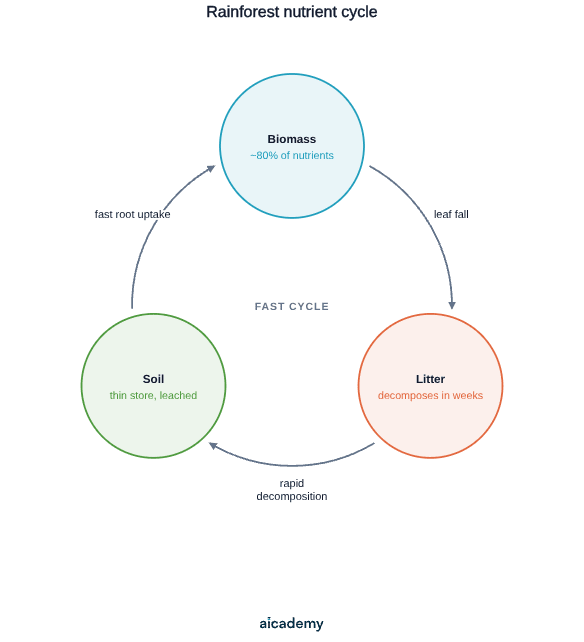
This has a critical implication: clear the forest, and the nutrients disappear with the trees. The thin topsoil beneath is unsuitable for sustained agriculture.

The fast, efficient nutrient cycle is the basis of TRF productivity — it does not indicate rich soils. When deforestation exposes the soil to direct rainfall, nutrient loss through leaching accelerates dramatically.

Interdependence: How Components Rely on Each Other

The tropical rainforest is a tightly interdependent system. Climate, water, soils, plants, animals, and people are all connected — a change to any one affects the rest.

ComponentKey dependencyIf disrupted
SoilsPlant roots prevent erosion; decomposers recycle nutrientsDeforestation exposes bare soil; erosion and leaching intensify
PlantsSoil nutrients; rainfall; animal pollinators and seed dispersersLoss of pollinators reduces reproduction; soil degradation limits regrowth
AnimalsPlants for food, shelter, nestingLoss of canopy removes habitat; food chains collapse from the bottom up
Water cycleTrees return 50–70% of rainfall to the atmosphere through transpirationLarge-scale deforestation reduces regional rainfall — measurably so in the Amazon
Indigenous peoplesForest for food (fruits, fish, bushmeat), medicines, building materials, cultureDisplacement destroys livelihoods and cultural identity

The water cycle link is particularly significant. Studies of deforested Amazon areas show reductions of 20–30% in local precipitation. The Amazon forest generates its own "flying rivers" — vast columns of water vapour transported by wind that supply rainfall to areas far beyond the forest itself. Deforestation in one region can trigger drought conditions hundreds of kilometres away.

Indigenous communities such as the Kayapó (Brazil) and the Penan (Borneo) have managed these forests sustainably for thousands of years, holding detailed knowledge of plant species, ecological relationships, and seasonal patterns. Their practices demonstrate that human activity and ecosystem health are not inherently in conflict.

Worth saving these ideas?

Turn what you've read into instant revision cards. Free to get started.

Make flashcards

Plant and Animal Adaptations

Organisms in the tropical rainforest have evolved specific adaptations to the hot, wet, competitive, and seasonless environment.

Plant adaptations:

AdaptationFunction
Drip tips — elongated leaf tipsAllow rainwater to run off rapidly, preventing waterlogging and fungal/mould growth
Buttress roots — large flanged roots at the tree baseProvide stability for massive emergent trees in shallow, weak soils
Lianas — woody climbing vinesReach the canopy by climbing existing trees, saving energy on trunk growth
Epiphytes (e.g. orchids, bromeliads)Grow on other plants using them for height; gather nutrients from rain and debris
Large, dark leaves (understorey species)Maximise photosynthesis in deep shade where less than 2% of sunlight penetrates
Thin barkRapid evaporation of moisture; no need for thick bark protection against cold

Animal adaptations:

  • Camouflage — stick insects, leaf-tailed geckos, and many frogs blend into vegetation to avoid predators
  • Arboreal (tree-dwelling) lifestyle — howler monkeys, sloths, and tree frogs spend most of their lives in the canopy, accessing food and avoiding ground-level predators
  • Nocturnal activity — bush babies, many frogs, and most large cats reduce competition and predation by being active at night
  • Warning colouration — poison dart frogs display vivid red or yellow skin to signal toxicity, deterring predators
  • Specialised diets — many species depend on a single plant or insect, which drives extraordinary specialisation and co-evolution

Biodiversity: Richness and Threats

Tropical rainforests are the most biodiverse ecosystems on Earth — by a significant margin.

Scale of biodiversity:

  • Cover approximately 6% of Earth's land surface
  • Contain an estimated 50–80% of all plant and animal species on Earth
  • The Amazon Basin alone is home to ~40,000 plant species, 3,000 freshwater fish species, 1,300 bird species, and 430 mammal species
  • An estimated 25% of pharmaceutical medicines originate from rainforest plants — including quinine (malaria treatment) and vincristine (childhood leukaemia treatment)
  • Thousands of species remain undiscovered

Why such high biodiversity?

  • Year-round warmth and moisture removes seasonal barriers to growth and reproduction
  • Multiple canopy layers create multiple distinct niches
  • Long evolutionary history with few mass-extinction disruptions
  • High productivity supports complex, specialised food webs

Threats to biodiversity:

ThreatScale and driver
Deforestation~10 million hectares per year globally; driven by commercial farming, logging, roads, mining
Habitat fragmentationIsolated forest patches reduce genetic diversity and restrict animal movement
Climate changeShifts rainfall patterns; increases drought frequency; threatens species beyond their tolerance range
Hunting and poachingTargets large species; disrupts food webs; drives some species to local extinction

Species are being lost before science has catalogued them. A plant species undiscovered today may contain a compound that treats a disease yet unknown — the cost of biodiversity loss is not only ecological but scientific and medical.

Common Exam Mistakes

1. Stating that TRF soils are nutrient-rich

This is incorrect. The spectacular biomass exists despite nutrient-poor soils, not because of them. Nutrients are stored in the living biomass. Latosols are infertile; slash-and-burn farmers typically exhaust the soil within two to three growing seasons.

2. Describing only one type of plant adaptation

Exam questions on adaptations expect specificity. "Leaves are adapted to the environment" is not a mark-worthy answer. Name the adaptation (e.g. drip tips) and explain its function (prevents fungal growth and waterlogging). Aim for at least two named plant and two named animal adaptations.

3. Treating interdependence as a simple list of links

Interdependence means that components depend on each other — not just that they are related. When asked to explain interdependence, trace a chain of dependency: plants depend on soil nutrients → soil nutrients depend on decomposers → decomposers depend on dead plant material → dead plant material comes from plants.

4. Confusing deforestation impacts with biodiversity issues

Biodiversity (variety of species) is distinct from deforestation (the process of forest removal). The spec asks for both, and they overlap — but a question on "issues related to biodiversity" is asking about species variety, genetic diversity, and threats, not simply about the rate of tree removal.

5. Giving imprecise location statements

"Tropical rainforests are near the equator" is not sufficient. State the equatorial zone between approximately 5°N and 5°S, and name the three major regions: Amazon Basin, Congo Basin, and Southeast Asia.

Key terms

Convectional rainfall
Rainfall driven by intense solar heating evaporating water; warm moist air rises, cools, condenses into clouds and falls as afternoon rainstorms, much of it from the forest's own transpiration.
Canopy
The dense, continuous layer of leaf cover 20-40 m above the ground that captures 70-80% of available sunlight and acts like an umbrella over the lower layers.
Emergent layer
The topmost rainforest layer of isolated giant trees, 40-70 m tall, projecting above the canopy and exposed to full sun, wind and rain.
Latosols
The nutrient-poor soils of tropical rainforests, kept infertile by rapid decomposition, fast root uptake and heavy leaching.
Leaching
The washing of nutrients deep into the soil by heavy daily rainfall, beyond the reach of plant roots.
Interdependence
The way climate, water, soils, plants, animals and people in the rainforest all rely on each other, so a change to one component affects the rest.
Niche
A distinct role or position in the ecosystem; the layered rainforest structure creates many niches, a key reason for its biodiversity.
Drip tips
Elongated leaf tips that allow rainwater to run off rapidly, preventing waterlogging and fungal or mould growth.
Buttress roots
Large flanged roots at the base of a tree that provide stability for massive emergent trees in shallow, weak soils.
Epiphytes
Plants such as orchids and bromeliads that grow on other plants for height and gather nutrients from rain and debris.
Biodiversity
The variety of plant and animal species in an ecosystem; tropical rainforests hold an estimated 50-80% of all species on Earth.

Frequently asked questions

No, tropical rainforest soils (latosols) are surprisingly nutrient-poor. About 80% of nutrients are stored in the living biomass, leaves decompose within weeks and nutrients are taken up almost immediately by shallow roots, while heavy rainfall leaches the rest beyond root reach.

Tropical rainforests cover about 6% of Earth's land but hold an estimated 50-80% of all species. Year-round warmth and moisture remove seasonal barriers, the multiple canopy layers create many niches, the long evolutionary history had few mass extinctions, and high productivity supports complex food webs.

The four layers are the emergent layer (40-70 m, isolated giant trees in full sun), the canopy (20-40 m, dense leaf cover capturing 70-80% of sunlight), the understorey (5-20 m, shade-adapted shrubs and young trees), and the forest floor (0-5 m), where less than 2% of sunlight reaches.

Generate revision on any topic you study

Type any topic you're studying and Aicademy generates a complete lesson, quiz, and flashcard set, personalised to your level.

Lessons on anything

Structured, level-matched lessons on any topic you study

Practice quizzes

Find out what you actually know before the exam does

Flashcard sets

Lock in key concepts with instant revision cards

Ask Aica

Stuck on something? Get a clear explanation, any time

Prev

The UK's Changing Economy

Next

Tropical Rainforests: Deforestation and Sustainable Management

Top students don’t revise more. They revise what counts.

Start revising free

Free to start. No card needed.