Ecosystems: Components, Food Webs and Global Biomes

Aligned to the AQA 8035 specification
- Topic
- The living world
- Level
- Intermediate
- Reading time
- 11 min
- Published
- 10 June 2026
- Updated
- 16 August 2026
On this page
Key takeaways
- An ecosystem is a natural system where organisms interact with each other and their non-living environment; biotic components are the living parts and abiotic components are non-living parts like soil, rainfall and air.
- Organisms are classified by how they obtain energy into producers, consumers and decomposers; decomposers are as vital as producers because they return nutrients to the soil so the nutrient cycle can continue.
- Nutrients cycle repeatedly through three stores (biomass, litter and soil) while energy flows in one direction through a food chain and cannot be recycled.
- Ecosystems are in dynamic equilibrium, so changing one component triggers knock-on effects, shown by grey squirrels harming red squirrels and oaks, and Dutch elm disease killing an estimated 25 million UK elms.
- A biome is a large-scale global ecosystem whose distribution is determined primarily by temperature and precipitation, controlled by latitude, ranging from tropical rainforest at the equator to tundra above 70N.
Nutrient Cycling
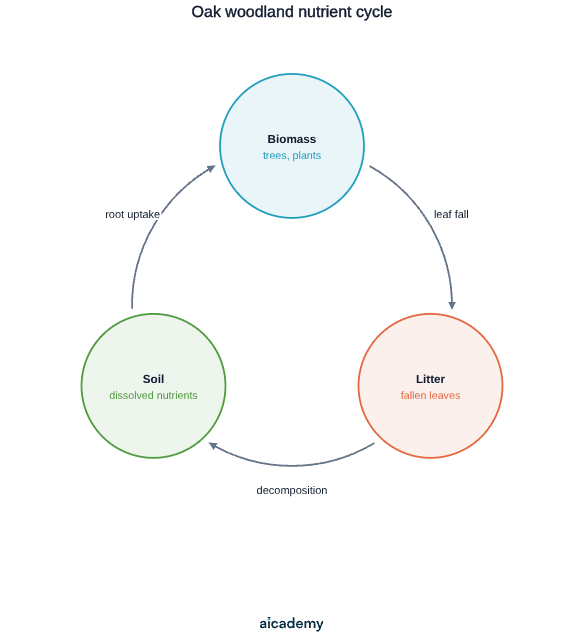
Nutrients move continuously through the ecosystem in a nutrient cycle. There are three main stores:
- Biomass — nutrients held in living organisms (mainly plants and trees)
- Litter — nutrients in dead organic matter on the ground surface
- Soil — nutrients dissolved in soil water, available for plant root uptake
How the cycle works in an oak woodland:
- Oak trees absorb nitrates and phosphates from the soil through roots
- Nutrients are stored in leaves, trunk, and branches (the biomass store)
- When leaves fall in autumn, they form leaf litter on the ground
- Decomposers (fungi, bacteria, earthworms) break down litter into inorganic nutrients
- Nutrients return to the soil and the cycle restarts in spring
The cycle below shows the three stores and the transfers that link them.
Leaching — the washing of nutrients downward through the soil by rainfall — removes nutrients from the upper layers. In very wet upland areas, leaching can be severe, leaving soils nutrient-poor despite high vegetation cover. Decomposer activity must replenish what leaching removes.
The speed of the nutrient cycle varies enormously between biomes. In a tropical rainforest, decomposition takes a few weeks and nutrients cycle rapidly. In Arctic tundra, frozen ground slows decomposition to almost nothing, and nutrients accumulate in the litter store for years.
How much of this have you taken in?
Quiz yourself on this section, free, no card needed.
Global Ecosystems: Distribution of Biomes
A biome is a large-scale global ecosystem characterised by a distinctive climate, vegetation and wildlife. Biome distribution is determined primarily by temperature and precipitation, which are controlled by latitude and, secondarily, by distance from the ocean and prevailing wind patterns.
| Biome | Location | Annual rainfall | Temperature | Key vegetation |
|---|---|---|---|---|
| Tropical rainforest | 5°N–5°S (equatorial) | 2,000–3,000 mm+ | 26–28°C year-round | Dense, multi-layered evergreen forest |
| Tropical grassland (savanna) | 5–15°N and S | 500–1,500 mm (seasonal) | 20–30°C; wet/dry seasons | Grass with scattered flat-topped trees |
| Hot desert | 15–30°N and S (sub-tropical) | Under 250 mm | 35–45°C days; cold nights | Sparse cacti, succulents, dry scrub |
| Temperate deciduous forest | 40–60°N | 500–1,500 mm | 4–20°C; four seasons | Oak, beech, ash; seasonal leaf fall |
| Boreal forest (taiga) | 55–70°N | 300–600 mm | –15 to +20°C; short summer | Spruce, fir, pine (coniferous) |
| Tundra | Above 70°N (Arctic) | Under 250 mm | –30 to +10°C | Mosses, lichens, dwarf shrubs |
The map below shows how biomes form latitude bands, broadly mirrored north and south of the equator. The pattern follows temperature and rainfall, which are governed by latitude.
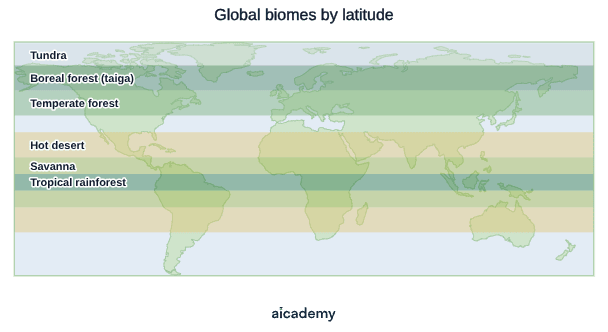
Moving from the equator towards the poles, vegetation becomes progressively less dense as temperature drops and growing seasons shorten. The pattern is not perfectly symmetrical because oceans, mountains, and atmospheric circulation modify it — deserts occur where descending dry air (Hadley cell) suppresses rainfall, while monsoon circulations create the seasonal wet periods that define savanna.
Key terms
- Ecosystem
- A natural system in which living organisms interact with each other and with their non-living environment.
- Biotic
- All the living parts of an ecosystem, such as plants, animals and decomposers.
- Abiotic
- All the non-living parts of an ecosystem, such as soil, rainfall, temperature, sunlight and air.
- Producer
- A plant that converts sunlight into energy by photosynthesis, forming the first trophic level.
- Decomposer
- An organism such as fungi, bacteria or earthworms that breaks down dead organic matter into inorganic nutrients.
- Food chain
- A single linear sequence showing how energy transfers between organisms.
- Food web
- A more realistic representation that maps multiple interlinking food chains within an ecosystem.
- Trophic level
- Each position in a food chain, indicating an organism's place in the energy transfer sequence.
- Nutrient cycle
- The continuous movement of nutrients through the biomass, litter and soil stores of an ecosystem.
- Leaching
- The washing of nutrients downward through the soil by rainfall, removing them from the upper layers.
- Biome
- A large-scale global ecosystem characterised by a distinctive climate, vegetation and wildlife.
- Dynamic equilibrium
- The state in which an ecosystem adjusts continuously to maintain a working balance.
Frequently asked questions
Biotic components are all the living parts of an ecosystem, such as oak trees, rabbits and earthworms. Abiotic components are all the non-living parts, such as soil, rainfall, temperature and sunlight. Bacteria in the soil are biotic, because if something is alive, or was once alive, it is biotic.
A food chain is a single linear sequence showing energy transfer between organisms, such as oak leaves to caterpillar to blue tit to sparrowhawk. A food web maps all the overlapping and interconnected food chains in an ecosystem, so it shows multiple crossing pathways.
Decomposers break down dead leaves, wood and animal remains into inorganic nutrients like nitrates and phosphates, which return to the soil for plants to absorb. Without decomposers, nutrients would lock up permanently in dead organic matter and the nutrient cycle would stop.
Generate revision on any topic you study
Type any topic you're studying and Aicademy generates a complete lesson, quiz, and flashcard set, personalised to your level.
Lessons on anything
Structured, level-matched lessons on any topic you study
Practice quizzes
Find out what you actually know before the exam does
Flashcard sets
Lock in key concepts with instant revision cards
Ask Aica
Stuck on something? Get a clear explanation, any time
Economic Development: Nigeria as a NEE Case Study
Energy Security: Demand, Supply and Sustainable Solutions