Cold Environments: Characteristics, Development and Conservation

Aligned to the AQA 8035 specification
- Topic
- The living world
- Level
- Intermediate
- Reading time
- 13 min
- Published
- 10 June 2026
- Updated
- 9 September 2026
On this page
Key takeaways
- Cold environments cover about 17% of Earth's land surface and split into polar regions with permanent ice sheets and tundra, the treeless permafrost zone at 60 to 70N with a short 2 to 3 month growing season.
- Permafrost is ground frozen for at least two consecutive years; its impermeable frozen layer stops meltwater draining, creating waterlogged muskeg, and it is the central constraint on cold environment construction.
- Plants and animals show specific adaptations: low cushion growth and shallow roots in plants, and thick insulating fur, seasonal colour change, migration and hibernation in animals, each linked to surviving extreme cold.
- Alaska shows the development opportunities of cold environments through the Prudhoe Bay oil field, the Trans-Alaska Pipeline, the Red Dog zinc mine, a large fishing industry, and tourism to Denali National Park.
- Arctic permafrost holds an estimated 1,500 billion tonnes of carbon, so as it thaws it releases CO2 and methane in a dangerous positive feedback that accelerates global warming.
Permafrost, Soils and Interdependence
Permafrost is ground that has been continuously frozen for at least two consecutive years. It underlies approximately 24% of the Northern Hemisphere's land surface. Its presence shapes soils, vegetation, drainage, and human activity.
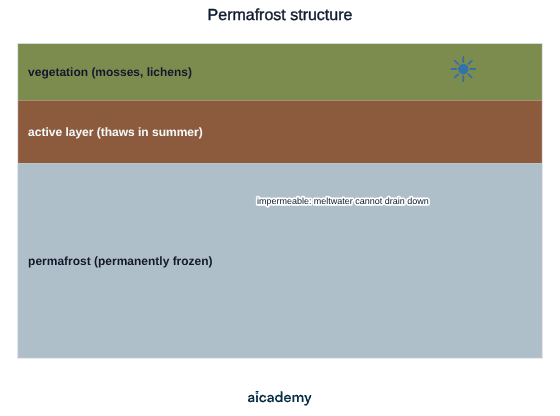
Permafrost structure:
- Active layer: the surface layer (0.3–1 m deep) that thaws in summer and refreezes in winter; the only layer available for plant root growth
- Permafrost layer: permanently frozen ground, extending tens to hundreds of metres deep
The frozen ground acts as an impermeable layer — summer meltwater cannot drain downward, creating waterlogged soils (peat bogs and muskeg) across vast areas of tundra. The cross-section below shows the thin active layer that thaws each summer sitting on top of the permanently frozen permafrost.
Interdependence of cold environment components:
| Component | Depends on | Effect if disrupted |
|---|---|---|
| Soils | Permafrost to restrict drainage; freeze-thaw creates surface patterned ground | Climate warming thaws permafrost → thermokarst subsidence; drainage patterns change |
| Plants | Short growing season and active layer depth; meltwater pools | Permafrost thaw allows taller shrubs to colonise; this changes albedo and accelerates warming further |
| Animals | Plant cover for food; frozen ground for denning; sea ice for hunting | Loss of sea ice threatens polar bears; caribou migration disrupted by industrial development |
| Indigenous peoples (e.g. Inuit, Gwich'in) | Sea ice for hunting and travel; caribou migration routes; traditional knowledge of seasonal patterns | Warming seas disrupt traditional hunting; industrial development fragments migration corridors |
Want more lessons like this one?
Generate lessons on anything you study. Free account, no card needed.
Key terms
- Cold environments
- Polar regions and tundra where temperatures are so low and growing seasons so short that trees cannot survive.
- Tundra
- The treeless permafrost zone at 60 to 70N with a short summer of 2 to 3 months, supporting mosses, lichens and dwarf shrubs.
- Permafrost
- Ground that has been continuously frozen for at least two consecutive years, underlying about 24% of the Northern Hemisphere's land.
- Active layer
- The surface layer of soil (0.3 to 1m deep) that thaws in summer and refreezes in winter, the only layer available for plant roots.
- Thermokarst
- Uneven ground subsidence that occurs when permafrost thaws, causing structures above to sink or tilt.
- Interdependence
- The way the soils, plants, animals and indigenous peoples of a cold environment depend on each other, so disrupting one affects the whole system.
- Muskeg
- Boggy, waterlogged terrain that forms in summer where the impermeable permafrost stops meltwater draining downward.
- Positive feedback
- A self-reinforcing process, such as thawing permafrost releasing CO2 and methane that accelerate further warming.
Frequently asked questions
Polar environments have permanent ice sheets, as in the Arctic Ocean and Antarctica, with winter temperatures below -40C. Tundra is the treeless permafrost zone at 60 to 70N where a short summer thaw of 2 to 3 months allows mosses, lichens and dwarf shrubs to grow.
Permafrost is the central physical constraint on construction. If heat from a building melts the permafrost beneath, the ground subsides unevenly as thermokarst and the structure tilts. Buildings must be elevated on piles or gravel pads, and the Trans-Alaska Pipeline uses refrigerated supports to prevent thaw.
The Antarctic Treaty (1959) bans military activity and mineral extraction south of 60S and designates Antarctica a scientific reserve. It does not ban scientific research, tourism, or fishing in adjacent waters, which are managed separately.
Generate revision on any topic you study
Type any topic you're studying and Aicademy generates a complete lesson, quiz, and flashcard set, personalised to your level.
Lessons on anything
Structured, level-matched lessons on any topic you study
Practice quizzes
Find out what you actually know before the exam does
Flashcard sets
Lock in key concepts with instant revision cards
Ask Aica
Stuck on something? Get a clear explanation, any time
Coastal Processes and Landforms
Economic Development: Nigeria as a NEE Case Study
Related lessons
11 min