Coastal Processes and Landforms

Aligned to the AQA 8035 specification
- Level
- Intermediate
- Reading time
- 15 min
- Published
- 10 June 2026
- Updated
- 25 August 2026
On this page
Key takeaways
- Constructive waves have low frequency, strong swash and weak backwash and deposit sediment to build beaches, while destructive waves have high frequency, weak swash and strong backwash and erode the cliff base.
- The four marine erosion processes are hydraulic action (compressed air widening cracks), abrasion (fragments hurled at the cliff), attrition (fragments colliding and rounding), and solution (seawater dissolving rock).
- Longshore drift moves sediment along the coast: swash carries it diagonally up the beach in the wind direction and backwash returns it straight down; on England's south coast, prevailing SW winds drive eastward drift.
- Caves, arches, stacks and stumps form at headlands attacked from two sides; the erosional sequence runs cave to arch to stack to stump, as seen at Old Harry Rocks and Durdle Door on the Dorset coast.
- Concordant coastlines have rock running parallel to the coast giving uniform resistance, while discordant coastlines have rock perpendicular to the coast, so soft rock erodes into bays and hard rock forms headlands.
Transportation and Deposition
Material removed by erosion is transported along and up the coast before being deposited where energy falls.
Coastal transportation:
- Solution: dissolved minerals carried in seawater (e.g. calcium carbonate from chalk and limestone cliffs)
- Suspension: fine particles (fine sand, silt, clay) carried within the water body
- Saltation: sand-sized particles bounce along the seabed/beach in a leapfrog motion
- Traction: large pebbles and boulders are rolled along the seabed by strong waves
Longshore drift: Where waves approach the shore at an angle (driven by prevailing winds), swash moves sediment diagonally up the beach in the direction the wave is travelling. Backwash moves sediment straight down the beach slope (gravity). The repeated zigzag motion gradually moves sediment along the coast in the direction of the prevailing wind. On the south coast of England, prevailing SW winds drive longshore drift eastward.
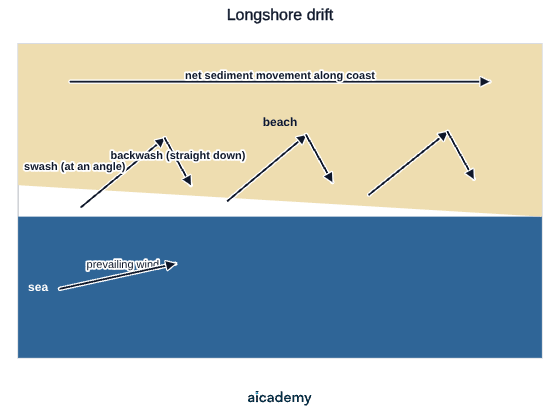
Deposition occurs when wave energy falls below the level needed to transport sediment:
- In sheltered bays, where wave energy is low
- In the lee of headlands, where waves refract and lose energy
- Where a river mouth or bay interrupts the longshore drift pathway
How much of this have you taken in?
Quiz yourself on this section, free, no card needed.
Erosional Landforms
Erosion over time produces a characteristic sequence of landforms at cliff-fronted coasts.
Cliff and wave-cut platform (development sequence):
- Waves attack the cliff at sea level, exploiting weaknesses through hydraulic action and abrasion
- A wave-cut notch forms at the base of the cliff
- The cliff above is unsupported and collapses (rock fall, slumping)
- The cliff retreats landward; the collapsed material is removed by waves
- A gently sloping wave-cut platform (also called a shore platform) is left at the base, covered at high tide, exposed at low tide
- As the platform extends seaward, waves expend energy crossing it; cliff retreat eventually slows
Headlands: caves → arches → stacks → stumps:
- Waves attack weaknesses (joints, faults) in a headland
- Hydraulic action and abrasion cut a cave into the cliff face
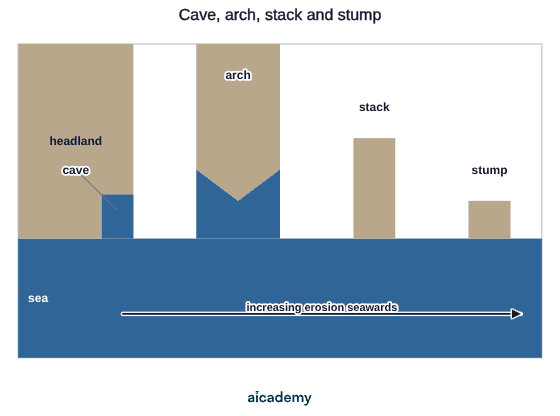
- The cave extends through the headland from both sides until the roof collapses, creating an arch (a natural rock bridge spanning the sea)
- The arch roof is further weakened by weathering and erosion; it collapses, leaving an isolated pillar of rock — a stack
- The stack is undercut at sea level; it collapses, leaving a low-lying stump, visible only at low tide
The cross-section below shows the four stages as they appear along a headland, with the most eroded feature furthest out to sea.
Dorset Coast examples:
- Old Harry Rocks (Handfast Point, near Studland): chalk stacks and stumps; Old Harry (the main stack) stands approximately 30 m high; Old Harry's Wife (an adjacent stack) collapsed in 1896 leaving a stump
- Durdle Door (near Lulworth): a natural limestone arch; one of the most photographed coastal landforms in England; the arch is approximately 30 m wide at its base
- Lulworth Cove: a near-circular bay behind a breach in the Portland limestone belt; the cove is approximately 750 m across; rapid erosion of the softer Wealden Clay inside has produced the distinctive rounded shape
Key terms
- Swash
- The water that surges up the beach after a wave breaks.
- Backwash
- The water that returns down the beach slope under gravity after the swash.
- Fetch
- The distance over which wind blows across open water before reaching a coast; a longer fetch allows waves to gather more energy.
- Hydraulic action
- Erosion where waves trap and compress air in cracks, and pressure release on retreat causes explosive expansion that widens joints.
- Abrasion (corrasion)
- Erosion where waves hurl sand, pebbles and boulders against the cliff face, cutting and grinding the rock.
- Attrition
- The process where rock fragments carried by waves collide and become progressively smaller, rounder and smoother.
- Longshore drift
- The zigzag movement of sediment along the coast as swash carries it diagonally up the beach and backwash returns it straight down.
- Wave-cut platform
- A gently sloping rocky platform left at the cliff base as the cliff retreats, covered at high tide and exposed at low tide.
- Concordant coastline
- A coast where rock bands run parallel to the shore, so the same rock type faces the sea along its length.
- Discordant coastline
- A coast where rock bands run perpendicular to the shore, so alternating hard and soft rock forms headlands and bays.
- Spit
- A long, narrow strip of sand or shingle extending from the coast into the sea, formed where longshore drift continues past a bend or estuary.
- Bar
- A spit that has grown completely across a bay, sealing off a lagoon, as at Slapton Sands.
Frequently asked questions
Constructive waves have low frequency, are low and gently sloping, and have strong swash and weak backwash that deposit sediment and build beaches. Destructive waves have high frequency, are steep and tall, and have weak swash and strong backwash that remove sediment and erode the cliff base.
They form at headlands, which are attacked from two sides. Hydraulic action and abrasion cut a cave, which extends through the headland to form an arch. The arch roof collapses leaving a stack, which is undercut and collapses into a low-lying stump visible only at low tide.
On a concordant coastline rock bands run parallel to the coast, giving uniform resistance and no alternating headlands and bays until breached, as at Lulworth Cove. On a discordant coastline rock runs perpendicular, so soft rock erodes into bays and hard rock forms headlands, as at Swanage Bay.
Generate revision on any topic you study
Type any topic you're studying and Aicademy generates a complete lesson, quiz, and flashcard set, personalised to your level.
Lessons on anything
Structured, level-matched lessons on any topic you study
Practice quizzes
Find out what you actually know before the exam does
Flashcard sets
Lock in key concepts with instant revision cards
Ask Aica
Stuck on something? Get a clear explanation, any time
Coastal Management: Strategies and Conflicts
Cold Environments: Characteristics, Development and Conservation
Related lessons
11 min
UK Physical Landscapes: Uplands, Lowlands and River Systems
GCSE Geography · AQA 8035
4 months ago