Economic Development: Nigeria as a NEE Case Study

Aligned to the AQA 8035 specification
- Level
- Intermediate
- Reading time
- 19 min
- Published
- 10 June 2026
- Updated
- 16 August 2026
On this page
Key takeaways
- Nigeria is a Newly Emerging Economy in West Africa, Africa's most populous country (~220 million) and largest economy by GDP, but its GNI per capita (~$2,200) and HDI (0.548) stay far below HIC levels due to inequality.
- Nigeria's economy is shifting from primary toward secondary and tertiary sectors, but oil still provides about 90% of export revenues and 70% of government revenue, a vulnerability exposed when oil prices fall.
- TNCs such as Shell bring jobs, government revenue, technology transfer and infrastructure, but also repatriate profits, cause environmental damage, create an enclave economy and are linked to corruption.
- The 2011 UNEP assessment of Ogoniland found oil contamination in soils to 5 metres depth and estimated restoration would take 25 to 30 years and cost at least $1 billion, the key environmental example for Nigeria.
- Nigeria's trade has shifted from the colonial model of exporting raw materials to Britain toward China, now its largest import source and a major infrastructure investor, alongside regional leadership through ECOWAS.
Nigeria: Location and Context
Nigeria is a Newly Emerging Economy (NEE) in West Africa and one of the most examined LIC/NEE case studies for AQA GCSE Geography 8035.
Location and global importance:
| Dimension | Detail |
|---|---|
| Location | West Africa; borders Niger, Chad, Cameroon, Benin; Gulf of Guinea coastline |
| Population | ~220 million (2024) — Africa's most populous country; approximately 2.7% of world population |
| Economy | Largest economy in Africa by GDP (~$477 billion, 2022); major oil exporter |
| Political | Member of OPEC, African Union, Commonwealth of Nations, G77, UN Security Council non-permanent member; federal democratic republic (1999-present) |
| Cultural | Over 500 ethnic groups; major languages — Hausa-Fulani (north), Yoruba (southwest), Igbo (southeast); world's largest Nollywood film industry after Bollywood |
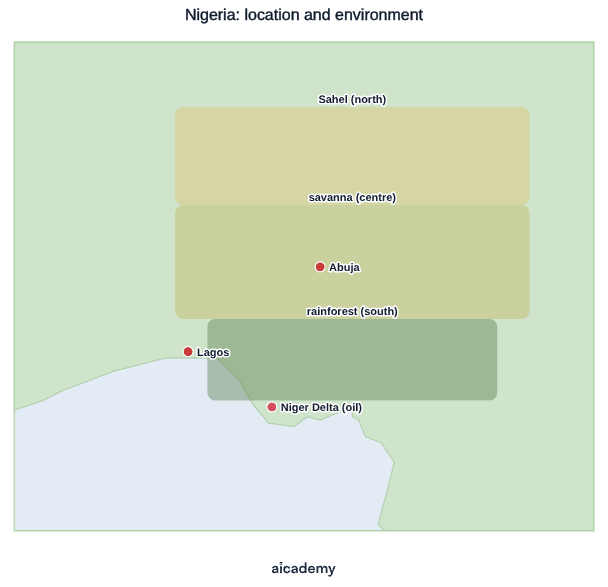
| Environmental | Diverse biomes — Sahel scrubland in north, tropical savanna in centre, rainforest and mangrove swamps in south; Niger Delta: one of the world's largest river deltas and most important oil-producing regions |
The map below locates Nigeria in West Africa and shows its north-to-south environmental gradient, from Sahel scrubland down to the rainforest and the oil-rich Niger Delta on the Gulf of Guinea.
Why Nigeria is classified as an NEE, not an HIC: Nigeria's GNI per capita (~$2,200) and HDI (0.548 — Low human development tier) remain far below HIC thresholds, despite its large total GDP. Extreme inequality means most Nigerians do not benefit proportionally from the country's oil wealth.
Want more lessons like this one?
Generate lessons on anything you study. Free account, no card needed.
Key terms
- Newly Emerging Economy (NEE)
- A country experiencing rapid industrialisation and rising GNI as it transitions from LIC toward HIC status; Nigeria is a key NEE case study.
- Transnational corporation (TNC)
- A large company that operates in more than one country; in Nigeria, oil TNCs such as Shell, Chevron and TotalEnergies are central to economic development.
- Profit repatriation
- When a TNC sends the majority of its profits back to its home country rather than reinvesting them in the host country.
- Enclave economy
- An economy where wealth is concentrated in isolated areas, such as offshore oil platforms and expatriate enclaves, with limited benefit to surrounding communities.
- Bilateral aid
- Aid given directly from one country's government to another, such as the UK's Girls' Education Project in northern Nigeria.
- Multilateral aid
- Aid provided through international organisations such as the World Bank, funded by many countries.
- Remittances
- Money sent home by migrants working abroad; Nigeria's diaspora sends about $21 billion a year, exceeding oil revenue in some years.
- ECOWAS
- The Economic Community of West African States, a 15-member regional trade bloc in which Nigeria is the dominant economy.
Frequently asked questions
Nigeria is industrialising rapidly with a large total GDP, a growing middle class and significant TNCs, which makes it a Newly Emerging Economy. But its GNI per capita of about $2,200 and HDI of 0.548 are far below HIC thresholds, and extreme inequality means most Nigerians live in poverty despite the oil wealth.
Advantages include tens of thousands of direct jobs, government revenue from oil royalties and taxes, technology transfer, and infrastructure such as roads and electricity. Disadvantages include profit repatriation abroad, oil spills and gas flaring in the Niger Delta, an enclave economy, and corruption.
China has become Nigeria's largest single import source since 2019, overtaking the UK and EU, supplying machinery, electronics and consumer goods. It has funded major infrastructure such as the Lagos-Ibadan railway and Lekki Deep Sea Port and buys Nigerian oil, but Nigeria has taken on significant Chinese debt.
Generate revision on any topic you study
Type any topic you're studying and Aicademy generates a complete lesson, quiz, and flashcard set, personalised to your level.
Lessons on anything
Structured, level-matched lessons on any topic you study
Practice quizzes
Find out what you actually know before the exam does
Flashcard sets
Lock in key concepts with instant revision cards
Ask Aica
Stuck on something? Get a clear explanation, any time
Cold Environments: Characteristics, Development and Conservation
Ecosystems: Components, Food Webs and Global Biomes
Related lessons
15 min
10 min