Group 7: The Halogens

Aligned to the AQA 8462 specification
- Level
- Intermediate
- Reading time
- 7 min
- Published
- 2 July 2026
- Updated
- 16 August 2026
On this page
Key takeaways
- The halogens in Group 7 all have seven electrons in their outer shell, so they gain one electron to form 1− ions and share similar reactions.
- The halogens are non-metals that exist as diatomic molecules (pairs of atoms), such as Cl₂, Br₂ and I₂.
- Going down Group 7, relative molecular mass, melting point and boiling point all increase, while reactivity decreases.
- A more reactive halogen displaces a less reactive halogen from an aqueous solution of its salt, for example chlorine displaces bromine: Cl₂ + 2KBr → 2KCl + Br₂.
- Reactivity decreases down Group 7 because the outer shell is further from the nucleus and more shielded, so the atom gains an electron less easily.
The Halogens
Group 7, near the right of the periodic table, contains the halogens: fluorine, chlorine, bromine and iodine (and astatine below them). They are reactive non-metals with strong colours and, in the case of chlorine, a choking smell.
Every halogen atom has seven electrons in its outer shell. Needing just one more electron to complete the shell, each atom tends to gain one electron, forming a negative ion with a 1− charge (for example Cl⁻). This shared electron arrangement is why the whole group reacts in similar ways.
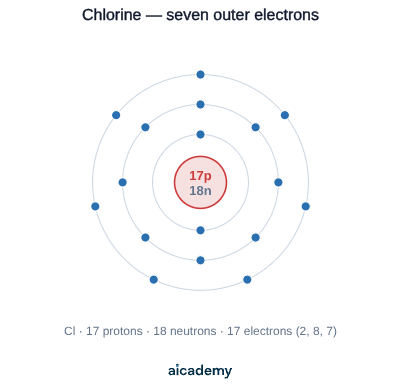
All Group 7 atoms have seven outer electrons and gain one electron to reach a full outer shell, forming a 1− ion (a halide). Gaining the same number of electrons is why the group shares its reactions.
The 1− ions they form are called halides: chloride, bromide, iodide.
Worth saving these ideas?
Turn what you've read into instant revision cards. Free to get started.
Key terms
- Halogen
- A non-metal element in Group 7 with seven outer electrons; it gains one electron to form a 1− ion (a halide).
- Diatomic molecule
- A molecule made of two atoms bonded together, such as Cl₂; the halogens exist as diatomic molecules.
- Displacement reaction
- A reaction in which a more reactive element takes the place of a less reactive element in one of its compounds.
- Halide
- A compound of a halogen with a metal, containing the 1− halogen ion, such as sodium chloride or potassium bromide.
Frequently asked questions
Reactivity decreases down Group 7 because each element down the group has its outer shell further from the nucleus, with more inner shells shielding it. The nucleus attracts an incoming electron less strongly, so the atom gains an electron less easily and reacts more slowly.
A displacement reaction is where a more reactive halogen takes the place of a less reactive halogen in a salt solution. For example, chlorine displaces bromine: Cl₂ + 2KBr → 2KCl + Br₂. The solution changes colour as the displaced halogen is released.
Halogen atoms have seven outer electrons and need one more for a full outer shell, so two atoms share a pair of electrons in a covalent bond. This gives molecules of two atoms (diatomic), such as Cl₂, Br₂ and I₂, rather than single atoms.
Generate revision on any topic you study
Type any topic you're studying and Aicademy generates a complete lesson, quiz, and flashcard set, personalised to your level.
Lessons on anything
Structured, level-matched lessons on any topic you study
Practice quizzes
Find out what you actually know before the exam does
Flashcard sets
Lock in key concepts with instant revision cards
Ask Aica
Stuck on something? Get a clear explanation, any time
Group 1: The Alkali Metals
Transition Metals
Related lessons
8 min
6 min
6 min
7 min