Electronic Structure

Aligned to the AQA 8462 specification
- Level
- Intermediate
- Reading time
- 7 min
- Published
- 2 July 2026
- Updated
- 16 August 2026
On this page
Key takeaways
- Electrons occupy the lowest available energy levels first, filling the innermost shell before the next one begins.
- The shells fill 2, then 8, then 8 for the first 20 elements, so the maximum electrons are 2 in the first shell and 8 in the second and third for these elements.
- Electronic structure is written as numbers separated by commas from the inside out, for example sodium is 2,8,1.
- The number of occupied shells equals the period number, and the number of electrons in the outer shell equals the group number for the main groups.
- You can draw an electronic structure as circles (shells) around the nucleus with the correct number of electrons on each shell.
Worth saving these ideas?
Turn what you've read into instant revision cards. Free to get started.
Drawing Electron Shell Diagrams
The diagram form shows the nucleus in the centre with circles (shells) around it, and the correct number of electrons drawn on each circle as crosses or dots. Fill the inner shells first, and spread the outer electrons around the circle.
Sodium, structure 2,8,1, is drawn like this:
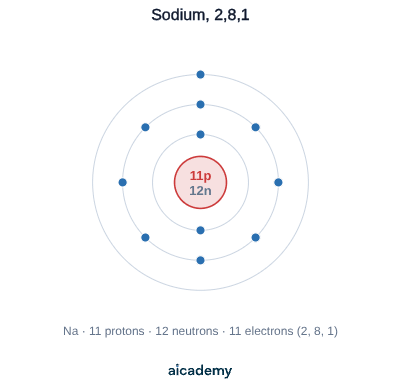
The two inner electrons sit on the first shell, eight fill the second, and a single electron sits alone on the outer shell. That lone outer electron is why sodium is a very reactive Group 1 metal.
Chlorine, structure 2,8,7, has seven electrons on its outer shell:
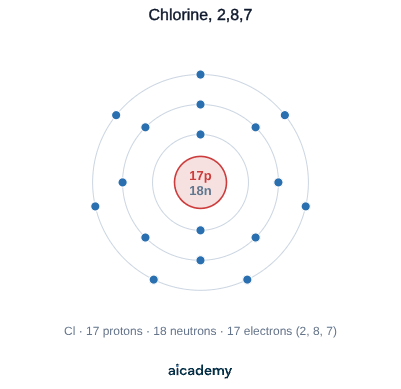
When you draw these by hand, keep the electron counts exact: an examiner counts the electrons on each shell, so 2,8,7 must show exactly seven on the outer circle.
Key terms
- Energy level (shell)
- A region around the nucleus at a fixed distance where electrons are found.
- Electronic structure
- The arrangement of electrons in the shells of an atom, written as numbers such as 2,8,1.
- Outer shell
- The highest occupied energy level of an atom, which controls its chemical reactions.
Frequently asked questions
Sodium has 11 electrons arranged as 2,8,1. Two electrons fill the first shell, eight fill the second shell, and the last electron goes into the third shell, which is why sodium is in Group 1 and Period 3.
For the first 20 elements, the first shell holds up to 2 electrons and the second and third shells each hold up to 8. Electrons always fill the lowest shell first before the next one begins.
Draw the nucleus in the centre, then draw circles around it for the shells. Add electrons as crosses or dots on each circle, filling the inner shells first: 2 on the first, then up to 8 on each of the next shells for the first 20 elements.
Generate revision on any topic you study
Type any topic you're studying and Aicademy generates a complete lesson, quiz, and flashcard set, personalised to your level.
Lessons on anything
Structured, level-matched lessons on any topic you study
Practice quizzes
Find out what you actually know before the exam does
Flashcard sets
Lock in key concepts with instant revision cards
Ask Aica
Stuck on something? Get a clear explanation, any time
Atomic Structure, Isotopes and Relative Atomic Mass
The Periodic Table and Its Development
Related lessons
6 min
8 min
8 min
8 min