Track progress, take quizzes and save notes on this lesson.

Free forever · no card needed

Start free
Intermediate

Group 0: The Noble Gases

4.1.2.4 Group 0

Aligned to the AQA 8462 specification

Level
Intermediate
Reading time
5 min
Published
2 July 2026
On this page
  1. 1.Meet the Noble Gases
  2. 2.Why They Are Unreactive
  3. 3.Single Atoms, Not Molecules
  4. 4.The Boiling Point Trend
  5. 5.Predicting Missing Values From the Trend
  6. 6.Common Exam Mistakes

Key takeaways

  • The noble gases in Group 0 are very unreactive because their atoms have a stable arrangement of electrons: a full outer shell (eight outer electrons, except helium which has two).
  • Because their outer shells are already full, noble gas atoms have no tendency to lose, gain or share electrons, so they do not easily form molecules or compounds.
  • Boiling points of the noble gases increase down the group as the relative atomic mass increases, from helium at the top to radon at the bottom.
  • The noble gases exist as single atoms (they are monatomic), unlike most non-metal elements which exist as molecules.

Meet the Noble Gases

Group 0 sits at the far right of the periodic table and contains the noble gases: helium, neon, argon, krypton, xenon and radon. They are colourless gases at room temperature, and they share one striking feature that sets them apart from every other group.

The noble gases are very unreactive. Unlike the reactive metals of Group 1 or the reactive non-metals of Group 7, they take part in almost no chemical reactions. This lack of reactivity is the single most important fact about the group, and every other property flows from it.

Noble gasSymbolElectronic structure
HeliumHe2
NeonNe2, 8
ArgonAr2, 8, 8

Their unreactivity makes them useful precisely because they do not react: argon fills light bulbs to stop the filament burning, and helium fills balloons because it is light and will not catch fire.

Why They Are Unreactive

The reason for the group's unreactivity lies in the arrangement of its electrons. Noble gas atoms have a stable electron arrangement: a full outer shell.

For every noble gas except helium, the outer shell holds eight electrons. Helium is the exception; its single shell fills at just two electrons, so helium's outer shell is also full, just with two rather than eight. A full outer shell is an especially stable, low-energy arrangement.

Chemical reactions happen when atoms lose, gain or share outer electrons to reach a full outer shell. A noble gas atom is already there. It has no tendency to give away, take in or share electrons, so it does not readily form molecules or compounds.
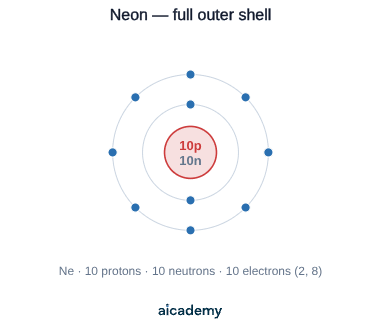
Noble gases are unreactive because their atoms have a full, stable outer shell (eight outer electrons, or two for helium), leaving no electrons to lose, gain or share.

Single Atoms, Not Molecules

Most non-metal elements exist as molecules: hydrogen, oxygen and chlorine all go around as pairs of atoms bonded together. The noble gases do not.

Because a noble gas atom already has a full outer shell, it has no reason to bond even to another atom of the same element. Noble gases therefore exist as single, separate atoms — they are described as monatomic. This is a direct consequence of the full outer shell and is a common short-answer question.

ElementExisting asReason
Oxygen (Group 6)Molecules (O₂)Atoms share electrons to fill their outer shells
Chlorine (Group 7)Molecules (Cl₂)Atoms share electrons to fill their outer shells
Neon (Group 0)Single atomsOuter shell already full; no need to bond

Do not write "molecules of noble gas" in an answer. The correct description is single atoms.

The Boiling Point Trend

The noble gases show a clear trend in their physical properties as you move down the group. Boiling point increases down Group 0.

Going down the group, the relative atomic mass of the atoms increases. Heavier atoms are held together more strongly by the weak forces between them, so more energy is needed to separate them into a gas. Helium, at the top, has the lowest boiling point of any element; radon, at the bottom, has the highest boiling point in the group.

Noble gasApproximate boiling point (°C)
Helium−269
Neon−246
Argon−186
Krypton−153
Xenon−108

Each step down the group raises the boiling point, so all these gases boil far below room temperature and are gases in normal conditions.

Something not quite clicking?

Ask Aica to explain any part of this differently. Free, takes 30 seconds.

Ask Aica

Predicting Missing Values From the Trend

A favourite exam question gives you data for some noble gases and asks you to predict a missing value using the trend. The examiner is testing whether you can extend a pattern, so you must justify the prediction with the trend, not just quote a number.

Worked example. Neon boils at about −246 °C and argon at about −186 °C. Estimate the boiling point of krypton, the next element down.

Boiling point increases down the group, so krypton must boil at a higher temperature than argon (−186 °C). The gaps are widening as you go down (about 23 °C from helium to neon, about 60 °C from neon to argon), so a sensible estimate is somewhere above −186 °C, in the region of −150 °C. The measured value is −153 °C, which fits.

When predicting a value, state the trend first ("boiling point increases down the group"), then give a number consistent with it. A bare number without the trend rarely gets full marks.

The same logic works upwards: an element above another in Group 0 must have a lower boiling point.

Common Exam Mistakes

1. Saying noble gases have zero outer electrons

Group 0 refers to the group name, not the number of outer electrons. Noble gas atoms have a full outer shell: eight outer electrons, or two for helium. Never write that they have no outer electrons.

2. Forgetting helium is the exception

Helium has two outer electrons, not eight, because its single shell fills at two. It is still a full, stable shell. Do not force helium to have eight.

3. Describing noble gases as molecules

Noble gases exist as single atoms (monatomic). Writing He₂ or "neon molecules" is wrong, because a full outer shell gives no reason to bond.

4. Getting the boiling point trend backwards

Boiling point increases down the group as relative atomic mass increases. Helium (top) has the lowest, radon (bottom) the highest.

5. Predicting a value without justifying it

For a prediction question, state the trend that supports your value. A number alone, with no reference to "increases down the group", usually misses the explanation mark.

Key terms

Noble gas
An unreactive element in Group 0 of the periodic table whose atoms have a full, stable outer shell of electrons.
Full outer shell
An outer electron shell holding its maximum number of electrons (eight, or two for helium), giving a stable arrangement.
Monatomic
Existing as single, separate atoms rather than as molecules; the noble gases are monatomic.

Frequently asked questions

Noble gases are unreactive because their atoms already have a stable, full outer shell of electrons: eight outer electrons, except helium which has two. With a full outer shell they have no tendency to gain, lose or share electrons, so they rarely react.

Boiling point increases down Group 0 as the relative atomic mass increases. Helium at the top has the lowest boiling point and radon at the bottom the highest, so you can predict a missing value by continuing the trend.

Helium has two outer electrons, not eight. Its only shell holds a maximum of two, so it is full with two. Every other noble gas has eight outer electrons, and all of them count as a stable, full outer shell.

Generate revision on any topic you study

Type any topic you're studying and Aicademy generates a complete lesson, quiz, and flashcard set, personalised to your level.

Lessons on anything

Structured, level-matched lessons on any topic you study

Practice quizzes

Find out what you actually know before the exam does

Flashcard sets

Lock in key concepts with instant revision cards

Ask Aica

Stuck on something? Get a clear explanation, any time

Prev

The Periodic Table and Its Development

Next

Group 1: The Alkali Metals

Related lessons

5 min

7 min

Lesson

Group 7: The Halogens

AQA GCSE Chemistry · AQA 8462

19 days ago

6 min

Lesson

Electronic Structure

AQA GCSE Chemistry · AQA 8462

19 days ago

Top students don’t revise more. They revise what counts.

Start revising free

Free to start. No card needed.