Track progress, take quizzes and save notes on this lesson.

Free forever · no card needed

Start free
Intermediate

Variation and Evolution by Natural Selection

4.6.2.1 Variation·4.6.2.2 Evolution

Aligned to the AQA 8461 specification

Level
Intermediate
Reading time
10 min
Published
16 June 2026
Updated
1 July 2026
On this page
  1. 1.What Variation Means
  2. 2.Classifying the Causes of Variation
  3. 3.Mutation: The Source of All Genetic Variation
  4. 4.Evolution and Natural Selection
  5. 5.Worked Example: Natural Selection in Action
  6. 6.Speciation: Forming New Species
  7. 7.Common Exam Mistakes

Key takeaways

  • Variation is the differences in characteristics between individuals of the same species, caused by genes, by the environment, or by a combination of both.
  • All genetic variants arise from mutations, random changes in the DNA base sequence; most mutations have no effect on the phenotype, some influence it, and very few determine it.
  • Evolution is a change in the inherited characteristics of a population over time through natural selection, which acts on variation that already exists rather than creating it.
  • In natural selection, individuals best suited to the environment survive, reproduce and pass on their advantageous alleles, so those alleles become more common over many generations.
  • Two populations form new species when they have become so different that they can no longer interbreed to produce fertile offspring.

What Variation Means

Variation is the differences in the characteristics of individuals within a population of the same species. No two field mice, oak trees, or humans are identical, and these differences have measurable causes.

A characteristic (or trait) is any feature of an organism — height, eye colour, blood group, leaf size, running speed. The phenotype is the full set of observable characteristics an organism actually shows. Variation describes how phenotypes differ from one individual to the next.

There are three possible causes of variation:

  • Genetic — differences caused by the genes (alleles) an individual inherited.
  • Environmental — differences caused by the conditions in which the individual developed.
  • A combination of genetic and environmental factors together.

The genome is the entire genetic material of an organism. The phenotype develops through the interaction of the genome with the environment — genes set what is possible, the environment shapes what actually appears.

Within a population of a species there is usually extensive genetic variation — a large pool of inherited differences spread across many individuals. This stored variation is the raw material that natural selection later acts on, so it matters that you can identify where variation comes from.

Classifying the Causes of Variation

To decide whether a characteristic is genetic, environmental, or both, ask: would this difference still exist if every individual had developed in identical conditions? If yes, the cause is at least partly genetic.

CharacteristicMain causeWhy
Human blood group (A, B, AB, O)GeneticFixed by inherited alleles; environment has no effect
Natural eye colourGeneticDetermined by inherited alleles
A scar on the skinEnvironmentalCaused by an injury, not inherited
Language a person speaksEnvironmentalLearned from surroundings, not coded in genes
Plant leaf colour when grown in shadeEnvironmentalLight level affects chlorophyll, not the genes
Human heightCombinationGenes set a potential range; diet and health determine where in that range a person ends up
Body mass in animalsCombinationInherited build plus available food

Worked classification — two genetically identical tomato plants (clones) are grown, one indoors in dim light and one outdoors in full sun. The outdoor plant grows taller and bears more fruit.

  • The plants share identical genes, so the genetic contribution to the difference is zero.
  • The only thing that differs is the growing conditions (light, temperature).
  • The cause of this difference is therefore purely environmental.

Run the same test on human height across an ordinary population and the answer changes: people with different inherited alleles, eating different diets, vary for both reasons — a combination.

Mutation: The Source of All Genetic Variation

Every inherited difference in a population traces back to one event: mutation. A mutation is a random change in the DNA base sequence (the genetic code).

All genetic variants arise from mutations. New alleles cannot appear any other way — sexual reproduction reshuffles existing alleles into new combinations, but it does not create new ones. Only mutation does that.

Mutations are not all equally important. Their effect on the phenotype falls into three tiers:

Effect of the mutationHow commonResult
No effect on phenotypeMost mutationsDNA change does not alter the protein, or sits in non-coding DNA
Influences the phenotypeSome mutationsSlightly alters a protein, nudging a characteristic
Determines the phenotypeVery few mutationsProduces a clearly new characteristic on its own

So the correct picture is: most mutations have no effect, some influence the phenotype, and very few determine it.

Mutations occur continuously — there is a steady trickle of new DNA changes in every generation. Very rarely a mutation produces a genuinely new phenotype. If that new phenotype happens to suit a change in the environment, it can spread and cause a relatively rapid change in the species. Most of the time, though, a new mutation has no advantage and makes little difference.

Evolution and Natural Selection

Evolution is a change in the inherited characteristics of a population over time, brought about by the process of natural selection. Over very long timescales it may result in the formation of new species.

The theory of evolution by natural selection states that all species of living things have evolved from simple life forms that first developed more than three billion years ago.

Natural selection acts on the variation that already exists in a population — it does not create variation, it filters it. The mechanism runs in four stages:

  1. Variation — individuals in a population vary, and some of that variation is genetic (caused by mutations and inherited).
  2. Competition and selection pressure — organisms produce more offspring than the environment can support, so they compete for limited resources (food, mates, space) or face predators and disease.
  3. Survival of the fittest — individuals whose phenotypes are best suited to the environment are more likely to survive and reproduce.
  4. Inheritance — survivors pass on the alleles for their advantageous characteristics, so those alleles become more common in the next generation.

Repeat this over many generations and the frequency of the advantageous alleles rises while less useful ones decline. The inherited characteristics of the population shift — that shift is evolution.

"Fittest" means best suited to the current environment — not strongest or fastest. A well-camouflaged moth can be fitter than a faster one.

Want more lessons like this one?

Generate lessons on anything you study. Free account, no card needed.

Start generating

Worked Example: Natural Selection in Action

Two standard cases let you step through the mechanism with named characteristics.

Case 1 — Antibiotic resistance in bacteria. A patient takes antibiotics to clear a bacterial infection.

  1. Variation — a random mutation has, by chance, made a few bacteria in the population resistant to the antibiotic. The rest are not resistant.
  2. Selection pressure — the antibiotic is the changed environment. It kills the non-resistant bacteria.
  3. Survival — the resistant bacteria survive the treatment because their phenotype suits the new conditions.
  4. Reproduction and allele frequency — the survivors reproduce (bacteria divide rapidly), passing on the resistance allele. The next generation is largely resistant.

The population has evolved: the resistance allele rose from rare to common. Because bacteria reproduce so fast, this is an example of a relatively rapid change in a species.

Case 2 — The peppered moth. Peppered moths rest on tree bark; predatory birds eat the ones they can see.

Clean woodland (light bark)Sooty woodland (dark bark)
Pale mothcamouflagedstands out, eaten
Dark mothstands out, eatencamouflaged
  1. Variation — the population contains both pale and dark moths; the dark form arose by mutation.
  2. Selection pressure — when soot from industry darkened the bark, the environment changed.
  3. Survival — on dark bark the dark moths were camouflaged and survived; the pale moths were eaten by birds.
  4. Reproduction and allele frequency — surviving dark moths passed on the allele for dark colour, so dark moths became the majority.

In both cases the same four steps run — variation, competition/selection, survival of the suited, and passing on of genes — and the allele frequency in the population changes over time.

Speciation: Forming New Species

Sometimes natural selection runs far enough to produce an entirely new species.

If two populations of one species become so different in phenotype that they can no longer interbreed to produce fertile offspring, they have formed two new species.

This typically happens when populations are separated and exposed to different environments:
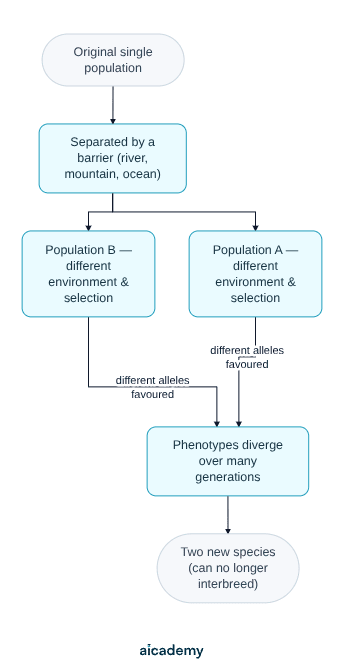
Each separated population accumulates its own mutations and faces its own selection pressures, so the favoured alleles differ. Over many generations the two populations diverge in phenotype. The test for a new species is the fertile-offspring test: once the two groups can no longer interbreed to produce fertile offspring, they count as separate species.

(Extra context — the term speciation and the detailed mechanism of geographic isolation are Biology-only content in AQA 8461; the core idea that you must know is the fertile-offspring definition of a new species above.)

The chain from a single mutation up to a new species is therefore one continuous process: mutation creates variation → natural selection changes allele frequencies → enough divergence produces a new species.

Common Exam Mistakes

1. Saying natural selection "creates" variation

Natural selection does not create new alleles — mutation does. Selection only acts on variation that already exists, making useful alleles more common and others rarer. Write that mutation is the source of variation, then that selection filters it.

2. Claiming individuals "adapt" or "want to" change

Individual organisms do not change their genes to suit the environment, and they do not choose to adapt. The mutations arise randomly before the selection pressure; the environment then selects which existing variants survive. Avoid wording that suggests the moth or bacterium "decided" to become resistant or dark.

3. Mixing up genetic, environmental and combined causes

A scar or a learned language is environmental — not inherited. Blood group is purely genetic. Height and body mass are a combination. Ask whether the difference would remain if conditions were identical before deciding the cause.

4. Getting the proportions of mutation effects wrong

The order is: most mutations have no effect on the phenotype, some influence it, and very few determine it. A common error is to imply most mutations are harmful or change the phenotype — they do not.

5. Forgetting the fertile-offspring part of the species definition

Two populations form new species only when they can no longer interbreed to produce fertile offspring. Stating they "look different" or "cannot mate" without the fertile-offspring point loses the precision the definition requires.

6. Leaving out "passing on the genes"

A full natural-selection answer must end with inheritance: survivors reproduce and pass on the advantageous alleles, so those alleles become more frequent in the next generation. An answer that stops at "the fittest survive" is incomplete.

Key terms

Variation
The differences in the characteristics of individuals within a population of the same species.
Phenotype
The full set of observable characteristics an organism actually shows, developing through the interaction of the genome with the environment.
Genome
The entire genetic material of an organism.
Mutation
A random change in the DNA base sequence; the source of all new genetic variants.
Evolution
A change in the inherited characteristics of a population over time, brought about by natural selection.
Natural selection
The process by which individuals best suited to the environment survive, reproduce and pass on their advantageous alleles, which become more common over generations.
Speciation
The formation of new species, occurring when two populations can no longer interbreed to produce fertile offspring.

Frequently asked questions

All genetic variants arise from mutations, which are random changes in the DNA base sequence. Sexual reproduction reshuffles existing alleles into new combinations but does not create new ones; only mutation makes new alleles.

Individuals in a population vary; they compete for limited resources and face predators and disease. Those whose phenotypes best suit the environment are more likely to survive and reproduce, passing on their advantageous alleles, so those alleles become more common over generations.

Two populations form two new species when they have become so different in phenotype that they can no longer interbreed to produce fertile offspring. Saying they merely look different or cannot mate is not precise enough for the definition.

Generate revision on any topic you study

Type any topic you're studying and Aicademy generates a complete lesson, quiz, and flashcard set, personalised to your level.

Lessons on anything

Structured, level-matched lessons on any topic you study

Practice quizzes

Find out what you actually know before the exam does

Flashcard sets

Lock in key concepts with instant revision cards

Ask Aica

Stuck on something? Get a clear explanation, any time

Prev

Inherited Disorders and Sex Determination

Next

Selective Breeding

Related lessons

Top students don’t revise more. They revise what counts.

Start revising free

Free to start. No card needed.