Track progress, take quizzes and save notes on this lesson.

Free forever · no card needed

Start free
Intermediate

Darwin, Wallace and the Development of Evolution

4.6.3.1 Theory of evolution·4.6.3.2 Speciation·4.6.3.3 The understanding of genetics (Biology only)

Aligned to the AQA 8461 specification

Level
Intermediate
Reading time
11 min
Published
16 June 2026
Updated
1 July 2026
On this page
  1. 1.Darwin's Theory of Evolution by Natural Selection
  2. 2.Why Darwin's Theory Was Only Gradually Accepted
  3. 3.Lamarck's Rival Theory
  4. 4.Wallace: The Independent Co-Discoverer
  5. 5.Speciation: How New Species Arise
  6. 6.Mendel and the Units of Inheritance
  7. 7.How Genetics Developed: A Timeline
  8. 8.Common Exam Mistakes

Key takeaways

  • Darwin's theory of natural selection states that individuals best suited to their environment are more likely to survive and breed, passing on their characteristics, which become more common over generations.
  • Darwin's theory was only gradually accepted for three reasons: it challenged religious belief, there was insufficient evidence at the time, and the mechanism of inheritance was not known until about 50 years later.
  • Lamarck proposed that changes acquired during an organism's lifetime can be inherited, but we now know this cannot occur in the vast majority of cases.
  • Alfred Russel Wallace independently proposed natural selection, published joint writings with Darwin in 1858, and did pioneering work on warning colouration and speciation.
  • Mendel's pea-plant experiments showed inheritance is determined by separate units passed on unchanged; these units, now called genes, were only recognised after his death.

Darwin's Theory of Evolution by Natural Selection

Evolution is the slow change in the inherited characteristics of a species over many generations. Charles Darwin proposed that this change happens through a process he called natural selection.

Darwin developed his ideas over decades. They came from observations made during a round-the-world voyage on HMS Beagle, backed by years of experimentation and discussion, and linked to the developing knowledge of geology and fossils at the time.

His theory of evolution by natural selection works in four steps:

  1. Individual organisms within a species show a wide range of variation for a characteristic.
  2. Individuals with characteristics most suited to the environment are more likely to survive to breed successfully.
  3. The characteristics that helped them survive are passed on to the next generation.
  4. Over many generations, the helpful characteristics become more common in the population.

Natural selection: the process by which organisms better adapted to their environment tend to survive, breed, and pass on their characteristics to their offspring.

Darwin published these ideas in his book On the Origin of Species in 1859. The theory states that all species of living things have evolved from simple life forms that first developed more than three billion years ago.

Why Darwin's Theory Was Only Gradually Accepted

Darwin's ideas were revolutionary, and there was much controversy surrounding them. The theory of evolution by natural selection was only gradually accepted, for three reasons set out in the AQA specification. Each is worth understanding in full.

Reason 1 — It challenged religious belief. The theory challenged the idea that God made all the animals and plants that live on Earth. Many people at the time believed that every species had been created in its present form, so the idea that species change and share common ancestors was deeply unsettling.

Reason 2 — There was not enough evidence. At the time the theory was published, there was insufficient evidence to convince many scientists. The fossil record was incomplete, and Darwin could not point to enough examples to prove that one species had gradually changed into another.

Reason 3 — Inheritance was not understood. The mechanism of inheritance and variation was not known until about 50 years after the theory was published. Darwin could describe that characteristics are passed on, but he could not explain how. Without an understanding of genes, a key part of his argument was missing.

Exam tip: if a question asks why Darwin's theory was only gradually accepted, give all three reasons — religion, lack of evidence, and the unknown mechanism of inheritance. One reason on its own is unlikely to gain full marks.

A study of creationism is not required for this specification.

Lamarck's Rival Theory

Darwin's was not the only theory of how organisms change over time. The French scientist Jean-Baptiste Lamarck had proposed an earlier theory, based mainly on the idea that changes which occur in an organism during its lifetime can be inherited. This is often called the inheritance of acquired characteristics.

The clearest way to learn both theories is to contrast how each explains the same example: how giraffes came to have long necks.

FeatureLamarck's explanationDarwin's explanation
Starting pointGiraffes stretched their necks to reach high leavesGiraffes already varied — some had longer necks than others
What changedThe neck got longer during the animal's life through useNo change within a lifetime; variation was already present
What is inheritedThe longer neck gained by stretching is passed to offspringLonger-necked giraffes survive better and pass on the genes for a long neck
Over generationsEach generation stretches further and inherits a longer neckThe proportion of long-necked giraffes increases by selection

Lamarck's idea sounds reasonable, but we now know that in the vast majority of cases this type of inheritance cannot occur. A characteristic gained during an organism's life, such as a muscle built up through exercise, is not coded in the sex cells and so is not passed to its offspring. Darwin's mechanism — selection acting on inherited variation — is the one supported by modern evidence.

Common confusion: do not say Darwin believed animals change to suit their environment within their lifetime. That is Lamarck's idea. Darwin's variation is already present before selection acts.

Wallace: The Independent Co-Discoverer

Darwin is the most famous name attached to natural selection, but he was not working alone. Alfred Russel Wallace independently proposed the theory of evolution by natural selection at the same time.

Wallace published joint writings with Darwin in 1858. It was this joint publication that prompted Darwin to finally publish On the Origin of Species the following year, in 1859.

Wallace travelled and worked worldwide, gathering evidence for evolutionary theory. He is best known for two contributions:

  • His work on warning colouration in animals — bright colours that signal to predators that an animal is poisonous or distasteful, which natural selection favours because predators learn to avoid them.
  • His theory of speciation — how entirely new species arise.

The development of evolutionary theory shows a key idea about how science works: it is built up over time from information gathered by many scientists, not produced by one person in isolation. Darwin and Wallace reached the same idea independently from different evidence.

Wallace did much pioneering work on speciation, but more evidence gathered over time has led to our current understanding of the theory of speciation, which is more detailed than what either Darwin or Wallace could describe.

Want more lessons like this one?

Generate lessons on anything you study. Free account, no card needed.

Start generating

Speciation: How New Species Arise

A species is a group of organisms that can breed together to produce fertile offspring. Speciation is the formation of a new species.

New species arise when populations of the same species become so different that they can no longer interbreed to produce fertile offspring. The steps that give rise to a new species are:

  1. A population of one species becomes separated, for example by a river, a mountain range, or the sea (this is called isolation).
  2. Conditions on each side are slightly different, so the two groups experience different selection pressures.
  3. There is natural variation within each group. Natural selection favours different characteristics in each environment.
  4. Over many generations, the two populations become more and more different in their genes and characteristics.
  5. Eventually the two populations are so different that even if they meet again they can no longer interbreed to produce fertile offspring. They are now two separate species.
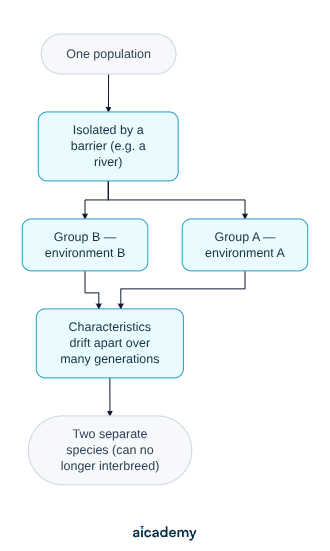
Memorise the chain: isolation → different selection → genetic difference builds up → can no longer interbreed → new species.

Mendel and the Units of Inheritance

The missing piece in Darwin's theory — how characteristics are passed on — was actually being uncovered at almost the same time, by a monk named Gregor Mendel.

In the mid-19th century, Mendel carried out careful breeding experiments on pea plants. From his results he made a crucial observation: the inheritance of each characteristic is determined by separate "units" that are passed on to descendants unchanged. These units did not blend together; they stayed distinct from one generation to the next.

Mendel's work was decades ahead of its time, and its importance was not recognised until after his death. There are clear reasons for this:

  • The scientific community of the time did not understand or value his mathematical, experimental approach to inheritance.
  • Chromosomes and the cell machinery that carry the units had not yet been seen, so there was no physical structure to connect his "units" to.

The "units" Mendel described are what we now call genes.

(Extra context — not required by AQA 8461.) Mendel published his pea-plant results in 1866, but they were largely ignored until around 1900, about 16 years after his death in 1884, when other scientists independently rediscovered the same patterns.

How Genetics Developed: A Timeline

Mendel's units were only fully understood once many other scientists, over nearly a century, added the missing pieces. Modern gene theory is the result of this combined work — exactly the kind of gradual, collaborative progress the specification highlights.

Scientist / developmentContributionWhen
LamarckProposed inheritance of acquired characteristics (later rejected)Early 19th century
Darwin and WallaceJoint writings on natural selection (1858); Darwin's On the Origin of Species1858–1859
Gregor MendelBreeding experiments showing inheritance by separate "units"Mid-19th century
Observation of chromosomesBehaviour of chromosomes during cell division observedLate 19th century
Linking units to chromosomesChromosomes and Mendel's "units" seen to behave alike; units (genes) located on chromosomesEarly 20th century
Structure of DNAStructure of DNA determined and the mechanism of gene function worked outMid-20th century

The order of events worth remembering:

  1. Mendel describes inherited "units" (mid-1800s).
  2. Chromosomes are seen moving during cell division (late 1800s).
  3. Chromosomes and Mendel's units are found to behave in the same way, so the units — now called genes — must sit on chromosomes (early 1900s).
  4. The structure of DNA is worked out and gene function explained (mid-1900s).

Common Exam Mistakes

1. Mixing up Darwin and Lamarck

Lamarck said characteristics gained during an organism's life are inherited. Darwin said variation is already present and selection acts on it. Stretching a neck is Lamarck; surviving because you were born with a longer neck is Darwin.

2. Giving only one reason the theory was slow to be accepted

The specification expects three: it challenged the belief that God made all living things, there was insufficient evidence at the time, and the mechanism of inheritance was not known until about 50 years later. Give all three for full marks.

3. Forgetting Wallace

Many students name only Darwin. Wallace independently proposed natural selection, published joint writings with Darwin in 1858, and did pioneering work on warning colouration and speciation.

4. A vague definition of a new species

Saying two groups "look different" is not enough. A new species has formed only when the populations can no longer interbreed to produce fertile offspring.

5. Saying Mendel was ignored "for no reason"

His work was not valued because the science of the time could not connect his abstract "units" to anything physical — chromosomes had not yet been observed. His importance was recognised only after his death.

6. Calling Mendel's "units" genes in his own time

Mendel called them units. The word gene came later, once units were linked to chromosomes in the early 20th century. Use the right term for the right date in a history-of-science question.

Key terms

Evolution
The slow change in the inherited characteristics of a species over many generations.
Natural selection
The process by which organisms better adapted to their environment tend to survive, breed, and pass on their characteristics to their offspring.
Variation
The range of differences in a characteristic shown by individual organisms within a species.
Species
A group of organisms that can breed together to produce fertile offspring.
Speciation
The formation of a new species, which happens when populations become so different that they can no longer interbreed to produce fertile offspring.
Inheritance of acquired characteristics
Lamarck's idea that changes which occur in an organism during its lifetime can be inherited by its offspring.
Warning colouration
Bright colours that signal to predators that an animal is poisonous or distasteful, favoured by natural selection.
Gene
The modern name for the separate units of inheritance that Mendel described, located on chromosomes.

Frequently asked questions

For three reasons: it challenged the belief that God made all the animals and plants, there was insufficient evidence at the time to convince many scientists, and the mechanism of inheritance was not known until about 50 years after the theory was published.

Lamarck said characteristics gained during an organism's life, such as a stretched neck, are inherited. Darwin said variation is already present before selection acts, and individuals born better suited to the environment survive and pass on their characteristics.

Mendel carried out breeding experiments on pea plants and found that the inheritance of each characteristic is determined by separate units passed on to descendants unchanged. These units are what we now call genes, though that term came later.

Generate revision on any topic you study

Type any topic you're studying and Aicademy generates a complete lesson, quiz, and flashcard set, personalised to your level.

Lessons on anything

Structured, level-matched lessons on any topic you study

Practice quizzes

Find out what you actually know before the exam does

Flashcard sets

Lock in key concepts with instant revision cards

Ask Aica

Stuck on something? Get a clear explanation, any time

Prev

Cloning: Plants and Animals

Next

Evidence for Evolution: Fossils and Extinction

Related lessons

Top students don’t revise more. They revise what counts.

Start revising free

Free to start. No card needed.