Track progress, take quizzes and save notes on this lesson.

Free forever · no card needed

Start free
Intermediate

Inherited Disorders and Sex Determination

4.6.1.7 Inherited disorders·4.6.1.8 Sex determination

Aligned to the AQA 8461 specification

Level
Intermediate
Reading time
9 min
Published
16 June 2026
Updated
1 July 2026
On this page
  1. 1.What Makes a Disorder Inherited
  2. 2.Polydactyly: A Dominant Disorder
  3. 3.Cystic Fibrosis: A Recessive Disorder
  4. 4.Worked Example: A Cystic Fibrosis Cross
  5. 5.Embryo Screening and Gene Therapy
  6. 6.Sex Determination: 23 Pairs of Chromosomes
  7. 7.Worked Example: Why the Ratio Is 50:50
  8. 8.Common Exam Mistakes

Key takeaways

  • Polydactyly (extra fingers or toes) is caused by a dominant allele, so only one copy is needed and it tends to appear in every generation of an affected family.
  • Cystic fibrosis is a disorder of cell membranes caused by a recessive allele, so a person must inherit two copies, one from each parent, to have the condition.
  • A cystic fibrosis carrier (Ff) is unaffected but carries the faulty allele; two carriers have a 1 in 4 chance of a child with the disorder, a 3:1 ratio of unaffected to affected.
  • Human body cells have 46 chromosomes in 23 pairs: 22 pairs control general characteristics and 1 pair is the sex chromosomes, XX in females and XY in males.
  • The egg always carries an X, so it is the sperm carrying an X or a Y that decides a baby's sex, giving a roughly 50:50 ratio of female to male.

What Makes a Disorder Inherited

Some disorders are passed from parents to children through their genes. These inherited disorders are caused by inheriting particular alleles — versions of a gene — rather than by infection, diet, or lifestyle.

The allele behind a disorder behaves like any other allele. A dominant allele shows its effect even when only one copy is present. A recessive allele shows its effect only when two copies are present, so a person needs to inherit the recessive allele from both parents.

An allele is a version of a gene. A dominant allele is expressed with one copy; a recessive allele is expressed only with two copies.

This single distinction — dominant or recessive — controls how a disorder moves through a family and how likely a child is to inherit it. The AQA specification names two disorders you must know: polydactyly, caused by a dominant allele, and cystic fibrosis, caused by a recessive allele. The rest of this lesson works through both, then shows how the same allele rules decide a baby's sex.

Polydactyly: A Dominant Disorder

Polydactyly means having extra fingers or toes. It is caused by a dominant allele.

Because the allele is dominant, a person needs only one copy to have the condition. Using D for the dominant polydactyly allele and d for the normal recessive allele, anyone with at least one D allele has polydactyly:

GenotypeAllelesPhenotype
DDTwo dominantPolydactyly
DdOne of eachPolydactyly
ddTwo recessiveNormal number of digits

The practical consequence: a person with polydactyly almost always has a parent with it, because a single dominant allele is enough to pass it on. An affected parent who is Dd has a 1 in 2 (50%) chance of passing the D allele to each child.

Dominant disorder = only one faulty allele needed. It tends to appear in every generation of an affected family.

Polydactyly is usually not life-threatening, and the extra digit is often removed surgically after birth.

Cystic Fibrosis: A Recessive Disorder

Cystic fibrosis is a disorder of cell membranes. It is caused by a recessive allele, so a person must inherit two copies — one from each parent — to have the condition.

The faulty allele disrupts the proteins that move salt and water across cell membranes. This produces thick, sticky mucus in the lungs and digestive system, causing breathing problems and difficulty absorbing food.

Using F for the normal dominant allele and f for the recessive cystic fibrosis allele:

GenotypeAllelesPhenotype
FFTwo dominantUnaffected
FfOne of eachUnaffected carrier
ffTwo recessiveHas cystic fibrosis

A person who is Ff is a carrier: they do not have the disorder, but they carry the faulty allele and can pass it on. Two healthy carriers can have a child with cystic fibrosis — which is exactly what the next slide works through.

A carrier has one recessive allele (Ff). They are unaffected themselves but can pass the allele to their children. Carriers explain how a recessive disorder can "skip" generations.

Worked Example: A Cystic Fibrosis Cross

Two parents are both unaffected carriers of cystic fibrosis, so both have the genotype Ff. What is the chance their child has cystic fibrosis?

(Higher Tier only — constructing a genetic cross is Higher Tier. Foundation students must be able to complete and interpret a Punnett square that is partly given, and read off the ratios.)

Each parent passes one allele to the child. Cross Ff × Ff:
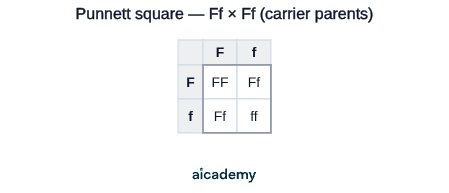
The four equally likely outcomes are:

Offspring genotypeCountPhenotype
FF1Unaffected
Ff2Unaffected carrier
ff1Has cystic fibrosis

Reading off the square:

  • 1 in 4 (25%) chance the child has cystic fibrosis (ff).
  • 3 in 4 (75%) chance the child is unaffected (FF or Ff).
  • The ratio of unaffected to affected is 3 : 1.

Check: 1 + 2 + 1 = 4 outcomes; the affected fraction is . These are probabilities for each child, not guarantees — every child independently faces the same 1 in 4 chance.

Want more lessons like this one?

Generate lessons on anything you study. Free account, no card needed.

Start generating

Embryo Screening and Gene Therapy

Two technologies can address inherited disorders, and AQA asks you to weigh the issues they raise.

Embryo screening checks the genes of an embryo for faulty alleles. During IVF (fertilisation outside the body), cells are taken from each early embryo and tested; embryos free of the disorder can then be chosen for implantation. Doctors can also test cells during pregnancy.

Gene therapy aims to treat a disorder by inserting working alleles into a patient's cells — for example, delivering a healthy allele to lung cells in cystic fibrosis.

(Extra context — not required by AQA 8461.) Embryo screening before IVF implantation is formally called pre-implantation genetic diagnosis (PGD).

The specification asks you to make informed judgements about the economic, social and ethical issues of embryo screening. Present both sides:

Arguments for embryo screeningArguments against embryo screening
Reduces suffering by avoiding serious inherited disordersThere are concerns it could lead to selecting other traits ("designer babies")
May lower the long-term cost of treating the disorderThe screening process itself is expensive
Lets parents make an informed choiceSome people feel it is wrong to destroy embryos
The disorder allele could become rarer over generationsImplies people with the disorder are less valuable, which many find offensive

There is no single "correct" answer — a good exam response gives points on both sides and reaches a reasoned judgement.

Sex Determination: 23 Pairs of Chromosomes

Ordinary human body cells contain 23 pairs of chromosomes — 46 in total.

22 of these pairs control general characteristics only. The remaining pair is the sex chromosomes, which carry the genes that determine whether a person is male or female:

SexSex chromosomesDescription
FemaleXXThe two are the same
MaleXYThe two are different

A useful memory hook: females are XX (same), males are XY (different).

Body cells have 23 pairs of chromosomes. 22 pairs control characteristics; 1 pair is the sex chromosomes — XX in females, XY in males.

When gametes (egg and sperm) form, the pair separates so each gamete carries just one sex chromosome. Every egg carries an X. A sperm carries either an X or a Y — and that is what decides the baby's sex, as the next slide shows.

Worked Example: Why the Ratio Is 50:50

Cross a mother (XX) with a father (XY) to predict the sex of their children.

(Higher Tier only — constructing the cross is Higher Tier. Foundation students complete and read off a Punnett square that is partly provided.)

The mother can only pass an X. The father passes either an X or a Y:
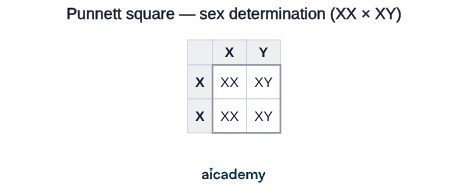
The four equally likely outcomes:

OffspringCountSex
XX2Female
XY2Male

Reading off the square:

  • 2 out of 4 offspring are XX (female) = 50%.
  • 2 out of 4 offspring are XY (male) = 50%.
  • The ratio of female to male is 1 : 1, or roughly 50 : 50.

The father's sperm decides the sex, because the egg always supplies an X — it is whether the fertilising sperm carries an X or a Y that sets the outcome. The 50:50 split is a probability: in any real family the actual numbers vary by chance, just as flipping a coin many times gives roughly, but not exactly, half heads.

Common Exam Mistakes

1. Swapping which disorder is dominant and which is recessive

Polydactyly is dominant (one allele is enough); cystic fibrosis is recessive (two alleles needed). Mixing these up is the single most common error on this topic. Anchor it: extra fingers stand out, like a dominant allele showing with one copy.

2. Forgetting that carriers are unaffected

A cystic fibrosis carrier (Ff) has no symptoms. They are not "slightly affected" — the recessive allele needs two copies to show, so a single copy produces a healthy carrier who can still pass it on.

3. Treating probabilities as guarantees

A 1 in 4 chance of cystic fibrosis does not mean exactly one in every four children is affected. Each child independently faces the same 1 in 4 chance; a family of four could have none affected or more than one.

4. Saying the mother determines the baby's sex

The egg always carries an X. It is the sperm (X or Y) that decides the sex of the child.

5. Confusing the number of chromosomes and pairs

Human body cells have 46 chromosomes, arranged as 23 pairs. Of these, 22 pairs are non-sex chromosomes and 1 pair is the sex chromosomes.

6. Giving a one-sided answer on embryo screening

Judgement questions reward balance. A response that lists only benefits, or only objections, is unlikely to gain full marks — give economic, social and ethical points on both sides, then state a reasoned conclusion.

Key terms

Inherited disorder
A disorder passed from parents to children through their genes, caused by inheriting particular alleles rather than by infection or lifestyle.
Allele
A version of a gene; a dominant allele is expressed with one copy and a recessive allele only with two copies.
Polydactyly
A condition of having extra fingers or toes, caused by a dominant allele.
Cystic fibrosis
A disorder of cell membranes caused by a recessive allele, producing thick sticky mucus in the lungs and digestive system.
Carrier
A person with one recessive allele (Ff) who is unaffected themselves but can pass the allele to their children.
Embryo screening
Checking the genes of an embryo for faulty alleles, often during IVF, so embryos free of the disorder can be chosen for implantation.
Gene therapy
A technique that aims to treat a disorder by inserting working alleles into a patient's cells.
Sex chromosomes
The one pair of chromosomes that determine sex, XX in females and XY in males.

Frequently asked questions

Cystic fibrosis is caused by a recessive allele, so a person must inherit two copies, one from each parent, to have the condition. By contrast polydactyly is caused by a dominant allele and only needs one copy.

No, a cystic fibrosis carrier (Ff) is completely unaffected and has no symptoms. The recessive allele needs two copies to show its effect, so a single copy produces a healthy carrier who can still pass the allele on.

The father's sperm determines a baby's sex. The mother's egg always carries an X chromosome, so it is whether the fertilising sperm carries an X (giving a girl, XX) or a Y (giving a boy, XY) that sets the outcome.

Generate revision on any topic you study

Type any topic you're studying and Aicademy generates a complete lesson, quiz, and flashcard set, personalised to your level.

Lessons on anything

Structured, level-matched lessons on any topic you study

Practice quizzes

Find out what you actually know before the exam does

Flashcard sets

Lock in key concepts with instant revision cards

Ask Aica

Stuck on something? Get a clear explanation, any time

Prev

Genetic Inheritance and Punnett Squares

Next

Variation and Evolution by Natural Selection

Related lessons

Top students don’t revise more. They revise what counts.

Start revising free

Free to start. No card needed.