Human Defence Systems and the Immune System

Aligned to the AQA 8461 specification
- Level
- Intermediate
- Reading time
- 12 min
- Published
- 16 June 2026
- Updated
- 25 August 2026
On this page
Key takeaways
- Non-specific defences (skin, nose, trachea, bronchi and stomach acid) act against every pathogen the same way, while the immune system can mount a specific response against a particular pathogen.
- In the airways the mucus traps pathogens and the cilia waft the mucus up to the throat where it is swallowed and destroyed by acidic stomach acid.
- In phagocytosis a white blood cell engulfs and then digests a pathogen, and this acts against many different pathogens rather than one specific type.
- Antibodies are specific proteins made by lymphocytes that lock onto the antigens on a pathogen's surface; one antibody type matches one antigen type.
- Antitoxins neutralise the toxins released by pathogens so they cannot harm tissues; they do not destroy the pathogen itself.
Physical Barriers: Skin, Nose, Trachea and Bronchi
The body's first job is to stop pathogens entering. Several non-specific defences act as physical barriers, and they work against any pathogen that arrives.
- Skin covers the body as a tough physical barrier, keeping pathogens out. If skin is cut, it scabs over quickly — the scab seals the break before pathogens can get into the blood.
- The nose is lined with hairs and mucus. These trap pathogens and particles in the air before they travel deeper into the airways.
- The trachea and bronchi (the tubes carrying air to the lungs) are lined with cilia and mucus. The sticky mucus traps pathogens; the cilia are tiny hair-like structures that waft the mucus up and away from the lungs, towards the throat where it is swallowed.
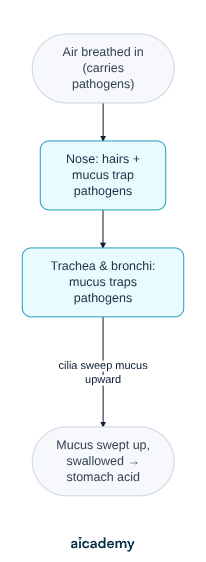
Remember: the cilia do not trap the pathogens — the mucus traps them, and the cilia move the mucus. Mixing these two up is a common slip.
These defences are all non-specific: they block bacteria, viruses, protists and fungi alike, without "recognising" any of them.
White Blood Cells and Phagocytosis
If a pathogen breaks through the barriers and enters the body, the immune system tries to destroy it. The work is done by white blood cells, and the first method is phagocytosis.
In phagocytosis, a white blood cell engulfs (surrounds and takes in) the pathogen, then digests it using enzymes. This destroys the pathogen completely.
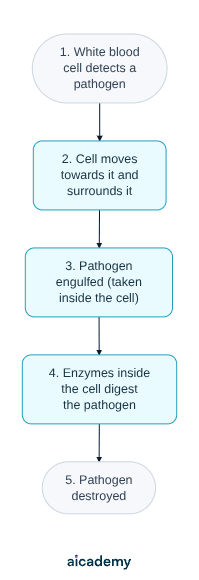
Worked walk-through 1 — from a cut to a destroyed pathogen. You cut your finger and a bacterium enters the blood:
- The bacterium has slipped past the skin barrier through the cut.
- A white blood cell detects the bacterium in the blood.
- The white blood cell moves to it and engulfs it, surrounding it entirely.
- Enzymes inside the white blood cell digest the bacterium.
- The bacterium is destroyed before it can reproduce and cause illness.
Key idea: phagocytosis is non-specific within the immune system — a phagocyte will engulf many different pathogens. The cell engulfs the pathogen and then digests it.
Studying this for an exam?
Generate a personalised learning path for this subject. Free to get started.
Antibody Production
The second white-blood-cell method is antibody production, and this part of the response is specific — it is aimed at one particular pathogen.
Every pathogen carries antigens on its surface — unique marker molecules. A type of white blood cell (a lymphocyte) recognises a pathogen's antigens as foreign and produces antibodies: proteins that lock onto those specific antigens.
Because an antibody's shape matches one specific antigen, antibodies are specific: an antibody made against one pathogen will not lock onto a different pathogen with different antigens.
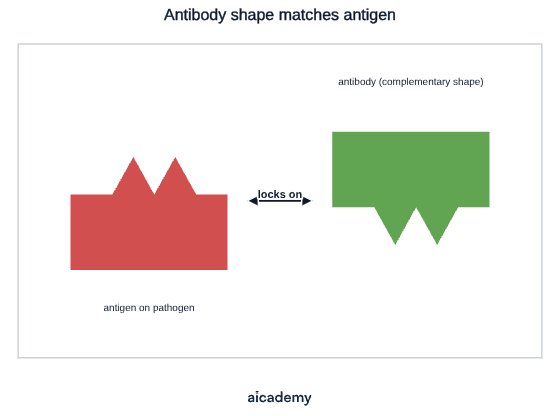
Once antibodies lock onto the antigens, they cause the pathogens to clump together and mark them out, so they are destroyed more easily.
Worked walk-through 2 — why antibodies are specific. Suppose a virus enters the body:
- The virus carries antigens on its surface with a particular shape.
- A lymphocyte recognises these antigens as foreign and makes antibodies with a complementary shape.
- The antibodies lock onto the virus's antigens — like a key fitting one lock.
- A different pathogen has differently shaped antigens, so these antibodies will not fit it. A new, specific antibody is needed for each new pathogen.
Antibody: a protein made by white blood cells that locks onto the specific antigens of a particular pathogen. One antibody type matches one antigen type.
Key terms
- Pathogen
- A microorganism such as a bacterium, virus, protist or fungus that causes disease.
- Non-specific defences
- Defences that act against every pathogen in the same way, such as skin, nose, trachea, bronchi and stomach acid.
- Cilia
- Tiny hair-like structures lining the trachea and bronchi that waft mucus and trapped pathogens up away from the lungs.
- Phagocytosis
- The process in which a white blood cell engulfs a pathogen and then digests it using enzymes.
- Lymphocyte
- A type of white blood cell that recognises foreign antigens and produces antibodies against them.
- Antigen
- A unique marker molecule on the surface of a pathogen that the immune system recognises as foreign.
- Antibody
- A protein made by white blood cells that locks onto the specific antigens of a particular pathogen.
- Antitoxin
- A molecule made by white blood cells that neutralises the toxins produced by pathogens.
Frequently asked questions
An antigen is a marker molecule on the surface of a pathogen, while an antibody is a protein made by a white blood cell that locks onto that antigen. Put simply, the antigen is on the pathogen and the antibody is made by you.
White blood cells use three distinct methods: phagocytosis, where the cell engulfs and digests a pathogen; antibody production, where antibodies lock onto a pathogen's specific antigens; and antitoxin production, which neutralises toxins released by pathogens.
No. In the trachea and bronchi it is the sticky mucus that traps pathogens. The cilia are tiny hair-like structures that waft the mucus, with the trapped pathogens, up and out of the airways towards the throat.
Generate revision on any topic you study
Type any topic you're studying and Aicademy generates a complete lesson, quiz, and flashcard set, personalised to your level.
Lessons on anything
Structured, level-matched lessons on any topic you study
Practice quizzes
Find out what you actually know before the exam does
Flashcard sets
Lock in key concepts with instant revision cards
Ask Aica
Stuck on something? Get a clear explanation, any time
Viral, Bacterial, Fungal and Protist Diseases
Vaccination and Herd Immunity
Related lessons
11 min
11 min
10 min