Track progress, take quizzes and save notes on this lesson.

Free forever · no card needed

Start free
Intermediate

Diffusion, Osmosis and Active Transport

4.1.3.1 Diffusion·4.1.3.2 Osmosis (Required practical 3)·4.1.3.3 Active transport

Aligned to the AQA 8461 specification

Level
Intermediate
Reading time
12 min
Published
16 June 2026
Updated
1 July 2026
On this page
  1. 1.Diffusion Moves Particles Down a Concentration Gradient
  2. 2.Three Factors Change the Rate of Diffusion
  3. 3.Surface Area : Volume Ratio Limits Cell Size
  4. 4.Big Organisms Need Exchange Surfaces
  5. 5.Osmosis: Water Across a Partially Permeable Membrane
  6. 6.Required Practical 3 and Percentage Change in Mass
  7. 7.Reading the Osmosis Graph
  8. 8.Active Transport: Moving Against the Gradient
  9. 9.Common Exam Mistakes

Key takeaways

  • Diffusion is the net movement of particles of a substance in solution, or of a gas, from an area of higher concentration to an area of lower concentration; it is passive and needs no energy.
  • The rate of diffusion increases with a steeper concentration gradient, a higher temperature and a larger surface area of the membrane.
  • As an organism gets bigger its surface area : volume ratio falls, so large organisms need specialised exchange surfaces and a transport system rather than relying on diffusion across the outer surface.
  • Osmosis is the diffusion of water from a dilute solution to a more concentrated solution through a partially permeable membrane; like diffusion it is passive.
  • Active transport moves substances from a more dilute to a more concentrated solution, against the concentration gradient, and requires energy from respiration; examples are root hairs absorbing mineral ions and the gut absorbing sugar.

Diffusion Moves Particles Down a Concentration Gradient

Diffusion is the spreading out of the particles of a substance in solution, or of a gas, producing a net movement from an area of higher concentration to an area of lower concentration. The particles move randomly; because there are more of them on the crowded side, more drift away from it than back toward it, so the net flow is down the concentration gradient.

Diffusion is passive — it needs no energy from the cell. The random motion of the particles does all the work. Movement continues until the concentration is even, though particles keep moving after that with no further net change.

Substances cells move by diffusion include:

SubstanceDirection across the membrane
OxygenInto cells for respiration
Carbon dioxideOut of respiring cells; in gas exchange
UreaOut of cells into the blood plasma, for excretion in the kidney

Net movement is the overall direction of travel once movement both ways is added up. Particles cross the membrane in both directions; diffusion describes which way the balance flows.

Three Factors Change the Rate of Diffusion

The rate of diffusion is how quickly the net movement happens. Three factors control it, and the exam expects you to explain the effect of each.

FactorEffect on rateWhy
Concentration gradientSteeper gradient → fasterA bigger difference in concentration means a larger net flow toward the low side
TemperatureHigher temperature → fasterParticles gain kinetic energy and move more quickly, so they spread out sooner
Surface area of the membraneLarger area → fasterMore space for particles to cross at the same time

A useful way to picture the gradient is two regions either side of a membrane:
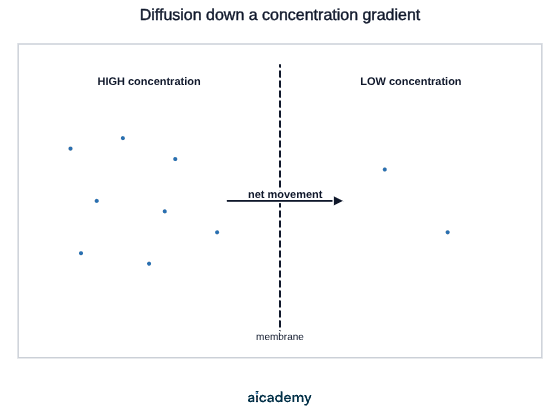
A steeper gradient and a larger surface area both speed diffusion up. A gradient that has evened out gives no net movement, even though particles still move.

Surface Area : Volume Ratio Limits Cell Size

A cell takes substances in across its surface, but uses and stores them throughout its volume. As an object gets bigger, its volume grows faster than its surface area, so the surface area : volume ratio falls.

A single-celled organism has a relatively large surface area to volume ratio. This lets enough oxygen and food diffuse in, and enough waste diffuse out, across its surface alone to meet the whole cell's needs.

Worked example — compare a 1 cm cube and a 2 cm cube.

For a cube of side : surface area (six faces) and volume .

1 cm cube:

Ratio .

2 cm cube:

Ratio .

The smaller cube has the larger ratio ( against ). Doubling the side halved the ratio. A 3 cm cube falls further: .

To write a ratio as , divide both numbers by the volume. becomes . The smaller the object, the larger its surface area : volume ratio.

Big Organisms Need Exchange Surfaces

Because surface area : volume ratio falls as size rises, a large multicellular organism cannot rely on diffusion across its outer surface — the inside cells are too far from the outside and the ratio is too small. It needs specialised exchange surfaces and a transport system (such as blood) to carry substances the rest of the way.

The spec wants you to explain why these surfaces are effective. An exchange surface works better when it has:

  • a large surface area — more room for substances to cross;
  • a thin membrane — a short diffusion path, so particles cross quickly;
  • (in animals) an efficient blood supply — keeps the concentration gradient steep by removing what arrives;
  • (in animal gas exchange) ventilation — fresh air keeps the gradient steep.
Exchange surfaceKey adaptation
Small intestine (villi)Large surface area; thin walls; rich blood supply
Lungs (alveoli)Large surface area; thin walls; good blood supply; ventilated
Fish gillsLarge surface area of filaments; thin; good blood flow
Plant roots (root hairs)Large surface area to absorb water and ions
Plant leavesLarge, flat surface; internal air spaces for gas exchange

Each adaptation maps onto one factor that raises diffusion rate: surface area, diffusion path length, or keeping the gradient steep.

Something not quite clicking?

Ask Aica to explain any part of this differently. Free, takes 30 seconds.

Ask Aica

Osmosis: Water Across a Partially Permeable Membrane

Osmosis is the diffusion of water from a dilute solution (lots of water, little dissolved solute) to a more concentrated solution (less water, more solute), through a partially permeable membrane — a membrane that lets water molecules through but not the larger solute particles.

The net movement of water is toward the more concentrated solution because that side has the lower water concentration. Like diffusion, osmosis is passive and needs no energy.
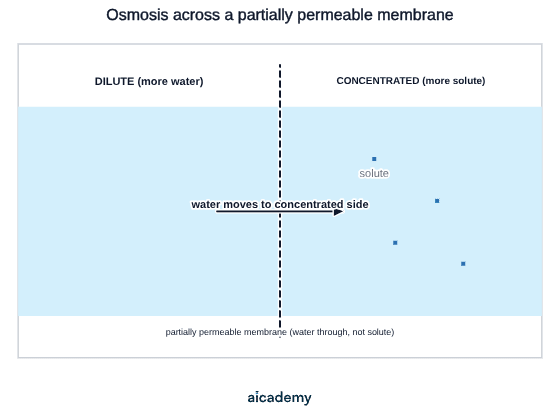
A plant cell placed in pure water gains water by osmosis and becomes firm (turgid); in a concentrated solution it loses water and becomes flaccid. This water movement is what Required practical 3 measures.

Osmosis moves only water, and only across a partially permeable membrane, from a dilute to a more concentrated solution. Naming all three parts is what earns the marks.

Required Practical 3 and Percentage Change in Mass

Required practical 3 investigates the effect of a range of salt or sugar solution concentrations on the mass of plant tissue.

Method (in brief): cut equal-sized cylinders of plant tissue (such as potato) with a cork borer, blot and weigh each one, then leave each in a different concentration of sugar solution for a set time. Blot and reweigh. In a dilute solution the tissue gains water by osmosis and gains mass; in a concentrated solution it loses water and loses mass.

Because the cylinders are not all identical, you compare percentage change in mass, not raw grams:

Worked example — a mass gain. A potato cylinder starts at g and ends at g.

The tissue gained water by osmosis, so the solution was more dilute than the cell contents.

Worked example — a mass loss. A cylinder starts at g and ends at g.

The negative sign means the tissue lost water, so the solution was more concentrated than the cell contents.

Always divide by the initial mass, and keep the sign. A negative answer is a loss, a positive answer is a gain — the sign carries the meaning.

Reading the Osmosis Graph

Plotting percentage change in mass (y-axis) against solution concentration (x-axis) gives a line that slopes down: high positive change in dilute solutions, negative change in concentrated ones.

The key point is where the line crosses zero — there is no net change in mass, so no net osmosis. At that concentration the external solution and the cell contents have the same concentration of water, so water moves in and out at equal rates.

Worked example — find the no-change concentration. Suppose the line passes through these points:

Concentration (mol/dm³)Percentage change in mass
0.20+8%
0.40−6%

The line crosses zero between and . From to is a fall of percentage points across mol/dm³. To fall the first points (from to ) takes:

So the no-change concentration is about mol/dm³. This estimates the concentration of the cell sap inside the tissue, because that is where external and internal concentrations match.

Read the no-change point straight off the graph where the curve cuts the x-axis (zero % change). It estimates the internal concentration of the tissue.

Active Transport: Moving Against the Gradient

Active transport moves substances from a more dilute solution to a more concentrated solution — that is, against the concentration gradient. Pushing particles the "wrong" way requires energy from respiration.

This is the opposite of diffusion and osmosis, which are passive and move down the gradient. The spec asks you to explain the differences between all three:

ProcessWhat movesDirection (relative to gradient)Energy needed?
DiffusionAny dissolved substance or gasDown the gradient (high → low)No
OsmosisWater only (partially permeable membrane)Toward the more concentrated solutionNo
Active transportDissolved substances (e.g. ions, sugar)Against the gradient (low → high)Yes — from respiration

Two examples the spec names:

  • Plant root hairs absorb mineral ions from very dilute solutions in the soil into the root, where ion concentration is already higher. Plants need these ions for healthy growth.
  • The gut absorbs sugar from lower concentrations in the gut into the blood, which has a higher sugar concentration, so it can be used in respiration.

If a substance moves from low to high concentration, it must be active transport, and it must be using energy from respiration. Diffusion and osmosis only ever move down the gradient.

Common Exam Mistakes

1. Calling osmosis "the movement of water" and stopping there

The marks need all three parts: water moving across a partially permeable membrane, from a dilute to a more concentrated solution. Leaving out the membrane or the direction loses the definition mark.

2. Saying osmosis moves "from high to low concentration"

For solute that is true, but osmosis is described by water: water moves from the dilute solution (high water concentration) to the concentrated solution (low water concentration). State it in terms of water to avoid the contradiction.

3. Dividing by the final mass in the percentage change

The denominator is always the initial mass: . Dividing by the final mass, or dropping the negative sign on a loss, gives the wrong answer.

4. Forgetting that a larger organism has a smaller surface area : volume ratio

Bigger objects have a smaller ratio, which is exactly why large organisms need exchange surfaces and transport systems. Stating it the wrong way round reverses the reasoning the question is testing.

5. Saying active transport does not need energy

Active transport moves substances against the concentration gradient, which requires energy from respiration. Only diffusion and osmosis are passive. Mixing these up is the most common transport error.

6. Confusing what each process moves

Osmosis moves water only; diffusion moves dissolved substances or gases; active transport moves dissolved substances against the gradient. If the question is about water crossing a membrane, the answer is osmosis, not diffusion.

Key terms

Diffusion
The net movement of particles of a substance in solution, or of a gas, from a higher to a lower concentration.
Concentration gradient
The difference in concentration between two areas; a steeper gradient gives a faster net movement of particles.
Surface area : volume ratio
A comparison of a body's surface area to its volume, which falls as an object gets bigger.
Exchange surface
A specialised surface, with a large area and thin membrane, where substances are transferred in a large organism.
Osmosis
The diffusion of water from a dilute to a more concentrated solution through a partially permeable membrane.
Partially permeable membrane
A membrane that lets water molecules through but not the larger dissolved solute particles.
Active transport
The movement of substances against the concentration gradient, from dilute to concentrated, using energy from respiration.
Passive
A process, such as diffusion or osmosis, that needs no energy from the cell.

Frequently asked questions

Diffusion is the passive net movement of any dissolved substance or gas down a concentration gradient. Osmosis is the passive movement of water only, across a partially permeable membrane, to the more concentrated solution. Active transport moves dissolved substances against the gradient and needs energy from respiration.

Percentage change in mass is the final mass minus the initial mass, divided by the initial mass, multiplied by 100. Always divide by the initial mass and keep the sign: a positive answer is a gain of water and a negative answer is a loss of water.

As an object gets bigger its volume grows faster than its surface area, so its surface area : volume ratio falls. The inside cells become too far from the outside for diffusion alone, so large multicellular organisms need specialised exchange surfaces and a transport system such as blood.

Generate revision on any topic you study

Type any topic you're studying and Aicademy generates a complete lesson, quiz, and flashcard set, personalised to your level.

Lessons on anything

Structured, level-matched lessons on any topic you study

Practice quizzes

Find out what you actually know before the exam does

Flashcard sets

Lock in key concepts with instant revision cards

Ask Aica

Stuck on something? Get a clear explanation, any time

Next

Enzymes and the Lock-and-Key Model

Related lessons

Top students don’t revise more. They revise what counts.

Start revising free

Free to start. No card needed.