Plant Hormones and Tropisms

Aligned to the AQA 8461 specification
- Level
- Intermediate
- Reading time
- 10 min
- Published
- 16 June 2026
- Updated
- 25 August 2026
On this page
Key takeaways
- A tropism is a directional growth response to a stimulus: phototropism is a response to light and gravitropism (geotropism) is a response to gravity.
- Shoots are positively phototropic and negatively gravitropic (growing up and towards light); roots are the reverse, negatively phototropic and positively gravitropic.
- Auxin is made in the tips of shoots and roots and causes unequal growth when it builds up on one side; it promotes growth in shoots but inhibits growth in roots.
- Required practical 8 investigates the effect of light or gravity on newly germinated seedlings, recording shoot length and growth direction while keeping control variables constant.
- Plant hormones are used commercially: auxins as weed killers, rooting powders and in tissue culture; ethene to control fruit ripening; gibberellins to end seed dormancy, promote flowering and increase fruit size.
Worked Walk-Through: Why a Shoot Bends Towards Light
Picture a young shoot lit from one side by a window. Follow the cause and effect step by step.
- Auxin is produced in the shoot tip.
- Light shining from one side causes auxin to move to the shaded side of the shoot. The shaded side now has more auxin than the lit side.
- In a shoot, more auxin means faster growth, so the cells on the shaded side grow longer than those on the lit side.
- Uneven growth makes the shoot bend towards the light — a positive phototropic response.
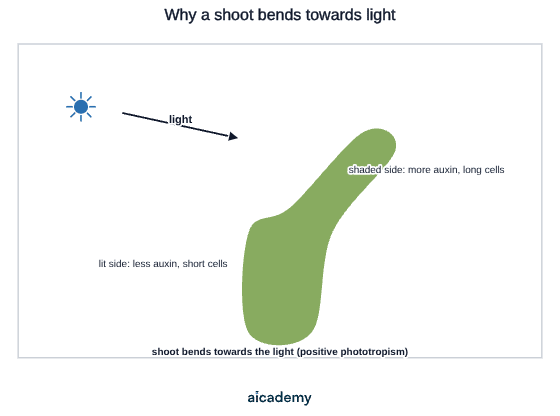
(Higher Tier only — the statement that auxin accumulates on the shaded side and redistributes in response to the stimulus is the Higher Tier explanation of phototropism.)
Now apply the same logic to gravity. Lay a shoot on its side in the dark. Auxin gathers on the lower side. In a shoot, the extra auxin on the lower side makes those cells grow faster, so the shoot curves upwards — a negative gravitropic response. In a root lying on its side, auxin also gathers on the lower side, but because auxin inhibits root growth, the lower side grows slower, the upper side grows faster, and the root curves downwards — a positive gravitropic response.
Something not quite clicking?
Ask Aica to explain any part of this differently. Free, takes 30 seconds.
Key terms
- Tropism
- A directional growth response of a plant to an external stimulus.
- Phototropism
- A growth response to light; shoots are positively phototropic and roots are negatively phototropic.
- Gravitropism
- A growth response to gravity (also called geotropism); shoots are negatively gravitropic and roots are positively gravitropic.
- Auxin
- A plant hormone made in the tips of shoots and roots that causes unequal growth; it promotes growth in shoots but inhibits growth in roots.
- Ethene
- A plant hormone used commercially to control the ripening of fruit during storage and transport.
- Gibberellins
- Plant hormones used to end seed dormancy, promote flowering, and increase fruit size.
- Positive response
- Growth towards a stimulus, such as a shoot growing towards light.
- Negative response
- Growth away from a stimulus, such as a root growing away from light.
Frequently asked questions
Light from one side causes auxin to move to the shaded side of the shoot, so that side has more auxin. In a shoot, more auxin means faster growth, so the cells on the shaded side grow longer than those on the lit side, making the shoot bend towards the light (a positive phototropic response).
No. It is the same hormone, but it has opposite effects: more auxin speeds up growth in shoots, while more auxin slows down growth in roots. That single difference is why a horizontal shoot bends up while a horizontal root bends down, even though auxin collects on the lower side of both.
Auxins are used as selective weed killers, in rooting powders, and to promote growth in tissue culture. Ethene controls the ripening of fruit during storage and transport. Gibberellins are used to end seed dormancy, promote flowering, and increase fruit size.
Generate revision on any topic you study
Type any topic you're studying and Aicademy generates a complete lesson, quiz, and flashcard set, personalised to your level.
Lessons on anything
Structured, level-matched lessons on any topic you study
Practice quizzes
Find out what you actually know before the exam does
Flashcard sets
Lock in key concepts with instant revision cards
Ask Aica
Stuck on something? Get a clear explanation, any time
Contraception and Fertility Treatments
Sexual and Asexual Reproduction and Meiosis
Related lessons
14 min
12 min