Plant Tissues and Transpiration

Aligned to the AQA 8461 specification
- Topic
- Organisation
- Level
- Intermediate
- Reading time
- 14 min
- Published
- 16 June 2026
- Updated
- 25 August 2026
On this page
- 1.The Leaf Is a Plant Organ Built From Specialised Tissues
- 2.Each Leaf Tissue Is Adapted to Its Job
- 3.Xylem and Phloem Are the Plant's Transport Tissues
- 4.Root Hair Cells Take In Water and Mineral Ions
- 5.Transpiration: Water Travels Up and Evaporates From the Leaves
- 6.Worked Example: Predicting How Conditions Change the Rate
- 7.Worked Example: Calculating the Rate of Transpiration
- 8.Stomata and Guard Cells Control the Trade-Off
- 9.Common Exam Mistakes
Key takeaways
- The leaf is a plant organ built from tissues: epidermis, palisade mesophyll, spongy mesophyll, xylem and phloem in the veins, and guard cells surrounding the stomata.
- Xylem is made of dead, hollow cells strengthened with lignin and carries water and mineral ions upward only, from roots to leaves, in the transpiration stream.
- Phloem is made of living cells and carries dissolved sugars in both directions, a process called translocation.
- Transpiration is the evaporation of water from leaf cells followed by diffusion of water vapour out through the stomata; it is sped up by higher temperature, more wind and more light, but slowed by higher humidity.
- Root hair cells take in water by osmosis (passive) and mineral ions by active transport (which needs energy from respiration); guard cells open and close the stomata to control gas exchange and water loss.
The Leaf Is a Plant Organ Built From Specialised Tissues
A tissue is a group of similar cells working together; an organ is several tissues working together to carry out a function. The leaf is a plant organ whose main job is photosynthesis, and it is built from a small set of named tissues.
For AQA, the leaf tissues you need are: the epidermis (upper and lower), the palisade mesophyll, the spongy mesophyll, the xylem and phloem (in the veins), and the guard cells surrounding the stomata.
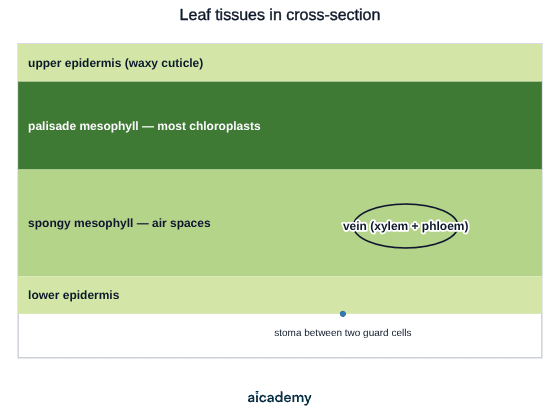
A tissue is similar cells with a shared function. An organ is several tissues grouped to perform a function. The leaf is an organ; xylem and phloem are tissues inside it.
How much of this have you taken in?
Quiz yourself on this section, free, no card needed.
Transpiration: Water Travels Up and Evaporates From the Leaves
Transpiration is the loss of water vapour from a plant. Water evaporates from the surfaces of the spongy mesophyll cells inside the leaf and then diffuses out through the open stomata as water vapour. As water leaves the top of the plant, more is pulled up the xylem to replace it. This continuous flow of water from roots to leaves is the transpiration stream.
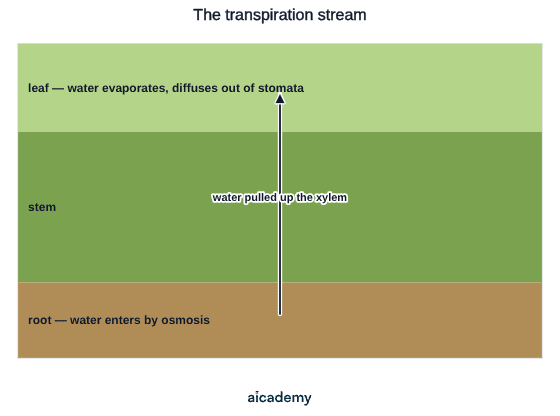
The transpiration stream also delivers the mineral ions the plant absorbed at the roots up to the leaves.
Transpiration = evaporation of water from the leaf cells followed by diffusion of water vapour out through the stomata. It pulls the whole transpiration stream up the xylem.
Do not confuse transpiration with translocation: transpiration moves water up the xylem; translocation moves sugars through the phloem.
Stomata and Guard Cells Control the Trade-Off
The plant faces a problem: stomata must open to let carbon dioxide in for photosynthesis, but every time they open they also let water vapour out. The guard cells manage this trade-off by opening and closing the stomata.
How it works:
- In the light, guard cells take in water and become turgid (swollen). Their uneven walls make them bend, opening the stoma for gas exchange.
- In the dark or when short of water, guard cells lose water and become flaccid, so the stoma closes, reducing water loss.
Most stomata are on the lower surface of the leaf, away from direct sun, which helps limit water loss.
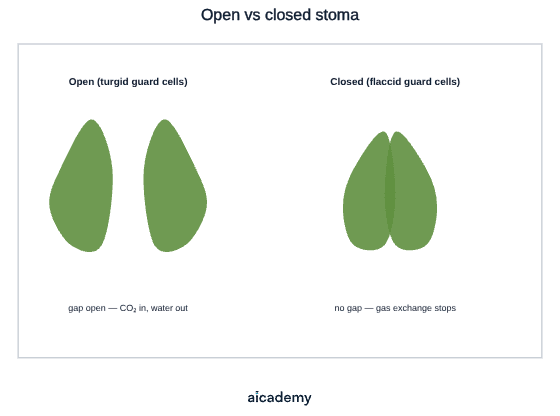
The role of stomata and guard cells is to control gas exchange and water loss. Open in light for photosynthesis; close in the dark or drought to conserve water.
Key terms
- Tissue
- A group of similar cells working together to carry out a function.
- Organ
- Several tissues working together to carry out a function; the leaf is a plant organ.
- Xylem
- A transport tissue of dead, hollow cells strengthened with lignin that carries water and mineral ions upward from roots to leaves.
- Phloem
- A transport tissue of living cells that carries dissolved sugars in both directions, a process called translocation.
- Transpiration
- The evaporation of water from leaf cells followed by diffusion of water vapour out through the stomata.
- Translocation
- The movement of dissolved sugars through the phloem, in either direction.
- Stomata
- Small openings, mostly on the lower leaf surface, through which gases are exchanged and water vapour is lost; controlled by guard cells.
- Guard cells
- Cells surrounding each stoma that become turgid to open it and flaccid to close it, controlling gas exchange and water loss.
- Meristem
- Tissue at the growing tips of shoots and roots containing cells that keep dividing to make new cells so the plant can grow.
- Root hair cell
- A root cell with a long thin projection that gives a large surface area for absorbing water by osmosis and mineral ions by active transport.
Frequently asked questions
Xylem is made of dead, hollow cells strengthened with lignin and carries water and mineral ions upward only, from roots to leaves (the transpiration stream). Phloem is made of living cells and carries dissolved sugars in both directions, a process called translocation.
Increasing temperature, air movement (wind) and light intensity all speed up transpiration, because they increase evaporation or steepen the diffusion gradient of water vapour leaving the leaf. Increasing humidity slows transpiration, because moist air outside reduces that gradient.
Water enters root hair cells by osmosis, moving down the concentration gradient using no energy. Mineral ions such as nitrate are usually in low concentration in the soil, so they are taken in against their gradient by active transport, which requires energy from respiration.
Generate revision on any topic you study
Type any topic you're studying and Aicademy generates a complete lesson, quiz, and flashcard set, personalised to your level.
Lessons on anything
Structured, level-matched lessons on any topic you study
Practice quizzes
Find out what you actually know before the exam does
Flashcard sets
Lock in key concepts with instant revision cards
Ask Aica
Stuck on something? Get a clear explanation, any time
Cancer: Tumours and Risk Factors
Communicable Diseases and Pathogens
Related lessons
14 min
9 min
10 min