Track progress, take quizzes and save notes on this lesson.

Free forever · no card needed

Start free
Intermediate

Cancer: Tumours and Risk Factors

4.2.2.7 Cancer

Aligned to the AQA 8461 specification

Level
Intermediate
Reading time
9 min
Published
16 June 2026
Updated
1 July 2026
On this page
  1. 1.Cancer Is Uncontrolled Cell Division
  2. 2.Benign Tumours Stay in One Place
  3. 3.Malignant Tumours Invade and Spread
  4. 4.Benign vs Malignant: The Key Comparison
  5. 5.Worked Examples: Classifying Tumours
  6. 6.Risk Factors: Genetic and Lifestyle
  7. 7.Common Exam Mistakes

Key takeaways

  • Cancer is the result of changes in cells that lead to uncontrolled growth and division, producing a mass of extra cells called a tumour.
  • A benign tumour is contained in one area, usually within a membrane, and does not invade other tissues or spread; it is not a cancer, though a large one can press on nearby organs.
  • Malignant tumour cells are cancers: they invade neighbouring tissues and spread to other parts of the body in the blood, where they form secondary tumours.
  • Both benign and malignant tumours are caused by uncontrolled cell division; the difference is behaviour, namely whether the cells stay put or invade and spread.
  • Cancer has both genetic risk factors and lifestyle or environmental risk factors, including carcinogens such as ionising radiation and the chemicals in tobacco smoke; a risk factor increases the chance of cancer but does not guarantee it.

Cancer Is Uncontrolled Cell Division

Cancer is the result of changes in cells that lead to uncontrolled growth and division.

In a healthy body, mitosis — the cell division that produces new identical cells for growth and repair — is tightly controlled. Cells only divide when more cells are needed, and they stop when they are not. Cancer begins when that control breaks down: a cell starts to divide again and again without stopping, even when no new cells are required.

Normal cellsCancer cells
Divide by mitosis only when new cells neededDivide continuously, even when not needed
Stop dividing once a tissue is the right sizeKeep dividing without stopping
Growth is controlledGrowth is uncontrolled

This uncontrolled division produces a mass of extra cells. That mass is called a tumour.

Cancer is caused by changes in cells that lead to uncontrolled growth and division, producing a tumour.

The single most important idea to carry through this lesson is that the root problem is mitosis happening out of control. Everything else — tumours, spreading, risk factors — follows from that one change inside the cell.

Benign Tumours Stay in One Place

There are two types of tumour, and the difference between them is the whole basis of this topic. The first type is benign.

A benign tumour is a growth of abnormal cells that is contained in one area, usually within a membrane. The membrane holds the mass together so the abnormal cells stay where they formed. A benign tumour does not invade other parts of the body.

Because the cells stay put, a benign tumour grows by pushing against the tissue around it rather than spreading through it. Examples include many warts and some types of mole. These growths are usually not dangerous — although a benign tumour can still cause problems if it grows large and presses on a nearby organ, such as a brain tumour pressing on surrounding tissue inside the skull.

A benign tumour: abnormal cells contained in one area, usually within a membrane, that do not invade other tissues or spread around the body.

Key features to remember for the exam:

  • Grows in one place
  • Usually enclosed within a membrane
  • Does not invade neighbouring tissues
  • Does not spread to other parts of the body

Malignant Tumours Invade and Spread

The second type of tumour is malignant — and malignant tumour cells are cancers. This is the type that makes cancer dangerous.

A malignant tumour does two things a benign tumour does not. First, its cells invade neighbouring tissues, growing into and damaging the healthy tissue around them rather than staying contained. Second, cells can break away and spread to different parts of the body in the blood.

When malignant cells travel in the blood, they can settle in a new part of the body and start dividing there, forming a new tumour. These new growths are called secondary tumours.
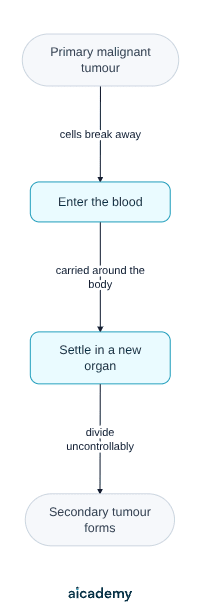
Malignant tumour cells are cancers. They invade neighbouring tissues and spread to different parts of the body in the blood, where they form secondary tumours.

(Extra context — the spread of cancer cells from a primary tumour to form secondary tumours elsewhere is called metastasis. The term is beyond AQA 8461, but it names the process the spec describes.)

It is the ability to invade and to spread in the blood that makes malignant tumours life-threatening, because secondary tumours can damage several organs at once.

Benign vs Malignant: The Key Comparison

The comparison between the two tumour types is the most heavily tested part of this topic. Learn this table in both directions — you should be able to state a feature and give the type, or be given the type and state the feature.

FeatureBenign tumourMalignant tumour
CauseUncontrolled cell divisionUncontrolled cell division
LocationStays in one areaInvades neighbouring tissues
MembraneUsually contained within a membraneNot contained — grows into surrounding tissue
Spreads in the blood?NoYes
Forms secondary tumours?NoYes
Is it a cancer?NoYes — malignant cells are cancers
Usual danger levelOften not dangerousDangerous / life-threatening

Notice the one thing both share: both are caused by uncontrolled cell division. The difference is entirely about behaviour — whether the cells stay put or invade and spread.

Exam shortcut: if a tumour invades, spreads in the blood, or forms secondary tumours, it is malignant (a cancer). If it is contained in one place within a membrane, it is benign.

Worth saving these ideas?

Turn what you've read into instant revision cards. Free to get started.

Make flashcards

Worked Examples: Classifying Tumours

These walk-throughs show how to apply the two definitions to the kind of description an exam question gives you. Match each feature to the correct type and justify your answer.

Example 1 — Classify from a description.

A patient has a mass of abnormal cells that is enclosed in a membrane, has stayed in the same place since it was found, and shows no sign of spreading to other organs.

This tumour is benign. Justification: it is contained within a membrane and stays in one area with no spread to other parts of the body — these are exactly the features of a benign tumour. Because the cells are not invading or spreading, it is not a cancer.

Example 2 — Classify and explain the danger.

A patient has a tumour whose cells have grown into the surrounding tissue, and identical abnormal cells have since been found in the liver and the lungs.

This tumour is malignant — a cancer. Justification: the cells have invaded neighbouring tissues, and identical cells appearing in distant organs (liver and lungs) show the cells have spread in the blood and formed secondary tumours. A benign tumour cannot do either of these things.

When a question gives you tumour features, do not just label it — quote the feature that proves your choice. "Malignant, because the cells have spread in the blood to form secondary tumours" earns the reasoning marks; "malignant" alone does not.

The same logic works in reverse. If told a tumour is malignant, you are expected to state that its cells invade neighbouring tissues and can spread in the blood to form secondary tumours elsewhere in the body.

Risk Factors: Genetic and Lifestyle

Scientists have identified risk factors for various types of cancer. A risk factor is something that increases the chance of developing a cancer — it does not guarantee it. The factors fall into two groups, and you should know both.

Genetic risk factors. There are genetic risk factors for some cancers. Some people inherit faulty versions of genes that make their cells more likely to begin dividing uncontrollably, raising their risk of certain cancers compared with the general population.

Lifestyle and environmental risk factors. Scientists have identified lifestyle risk factors for various types of cancer. Many of these involve carcinogens — substances or types of radiation that can cause cancer by damaging the genetic material inside cells.

Carcinogen / risk factorLinked cancer (example)
Ionising radiation (e.g. X-rays, radon, nuclear radiation)Various cancers
Chemicals in tobacco smokeLung cancer
UV radiation from the Sun / sunbedsSkin cancer

A carcinogen is an agent that can cause cancer. Ionising radiation and the chemicals in tobacco smoke are carcinogens named in the AQA specification.

How a carcinogen leads to a tumour, step by step:

  1. A carcinogen (such as UV light or chemicals in tobacco smoke) damages the genetic material inside a cell.
  2. The damage changes the cell so its division is no longer controlled.
  3. The cell begins to divide uncontrollably by mitosis.
  4. This uncontrolled division builds a tumour, which may be malignant.

This is the through-line of the whole topic: a risk factor causes a change in a cell, that change makes division uncontrolled, and uncontrolled division forms a tumour.

(Extra context — carcinogens and ionising radiation, along with diet, alcohol and obesity, are listed by AQA 8461 under non-communicable disease risk factors (section 4.2.2.6). Section 4.2.2.7 itself only requires that lifestyle and genetic risk factors for cancer exist; the named carcinogens above come from the related section.)

Common Exam Mistakes

1. Saying benign tumours never cause any harm

Benign tumours do not invade or spread, but a large one can still press on nearby organs and cause problems. "Benign" means it stays in one place, not that it is always harmless.

2. Forgetting that malignant cells spread in the blood

The spec is specific: malignant cells spread to other parts of the body in the blood, where they form secondary tumours. State the blood as the route — do not just say they "move around".

3. Mixing up which type is the cancer

Malignant tumour cells are the cancers. Benign tumours are not cancers. A common error is to call any tumour "cancer" — only malignant ones qualify.

4. Confusing primary and secondary tumours

The original tumour is the primary tumour. A secondary tumour forms when cells spread in the blood and start dividing in a new location. Secondary tumours are a feature of malignant cancers only.

5. Treating a risk factor as a guaranteed cause

A risk factor increases the chance of cancer; it does not guarantee it. Not everyone exposed to a carcinogen develops cancer, and some people with no obvious risk factors still do.

6. Forgetting genetic risk factors

Cancer risk is not only about lifestyle. Some cancers have genetic risk factors — inherited faulty genes — and a full answer on risk factors should mention both genetic and lifestyle/environmental causes.

Key terms

Cancer
The result of changes in cells that lead to uncontrolled growth and division.
Tumour
A mass of extra cells produced by uncontrolled cell division.
Benign tumour
A growth of abnormal cells contained in one area, usually within a membrane, that does not invade other tissues.
Malignant tumour
A tumour whose cells are cancers, invading neighbouring tissues and spreading in the blood to form secondary tumours.
Secondary tumour
A new tumour that forms when malignant cells spread in the blood and start dividing in a new part of the body.
Risk factor
Something that increases the chance of developing a cancer, though it does not guarantee it.
Carcinogen
An agent, such as ionising radiation or chemicals in tobacco smoke, that can cause cancer by damaging genetic material.
Mitosis
The cell division that produces new identical cells for growth and repair, which becomes uncontrolled in cancer.

Frequently asked questions

A benign tumour stays contained in one area, usually within a membrane, and does not invade other tissues or spread, so it is not a cancer. A malignant tumour invades neighbouring tissues and spreads in the blood to form secondary tumours, and its cells are cancers.

Cells break away from the primary malignant tumour and spread to different parts of the body in the blood. They can settle in a new organ and start dividing there, forming a new growth called a secondary tumour.

Cancer is caused by changes in cells that lead to uncontrolled growth and division. There are genetic risk factors from inherited faulty genes, and lifestyle and environmental risk factors, many involving carcinogens such as ionising radiation and chemicals in tobacco smoke that damage the genetic material in cells.

Generate revision on any topic you study

Type any topic you're studying and Aicademy generates a complete lesson, quiz, and flashcard set, personalised to your level.

Lessons on anything

Structured, level-matched lessons on any topic you study

Practice quizzes

Find out what you actually know before the exam does

Flashcard sets

Lock in key concepts with instant revision cards

Ask Aica

Stuck on something? Get a clear explanation, any time

Prev

Non-Communicable Diseases and Risk Factors

Next

Plant Tissues and Transpiration

Related lessons

8 min

Lesson

Mitosis and the Cell Cycle

AQA GCSE Biology · AQA 8461

1 month ago

10 min

Lesson

Stem Cells

AQA GCSE Biology · AQA 8461

1 month ago

Top students don’t revise more. They revise what counts.

Start revising free

Free to start. No card needed.