The Nervous System and Reflexes

Aligned to the AQA 8461 specification
- Level
- Intermediate
- Reading time
- 11 min
- Published
- 16 June 2026
- Updated
- 16 August 2026
On this page
Key takeaways
- Homeostasis is the regulation of internal conditions to maintain optimum conditions for function, which matters because enzymes only work efficiently within narrow ranges of temperature and pH.
- Every automatic control system has three parts: a receptor that detects a stimulus, a coordination centre (brain, spinal cord or pancreas) that processes it, and an effector (a muscle or gland) that responds.
- The central nervous system is only the brain and spinal cord; impulses travel from receptors along a sensory neurone to the CNS and out along a motor neurone to an effector.
- At a synapse the electrical impulse stops and a chemical neurotransmitter diffuses across the gap to start a new impulse; the impulse itself does not jump the gap.
- A reflex action is automatic and rapid and does not involve the conscious brain; the reflex arc runs receptor → sensory neurone → relay neurone → motor neurone → effector.
The Three Parts of Every Control System
Every automatic control system in the body — whether it controls glucose, temperature or water — is built from the same three components. Learn these three words and what each does, because the same structure appears in every homeostasis question.
| Component | What it is | What it does |
|---|---|---|
| Receptor | Cells that detect stimuli | Detect a stimulus — a change in the environment |
| Coordination centre | Brain, spinal cord or pancreas | Receive and process information from receptors |
| Effector | A muscle or a gland | Bring about a response that restores the optimum level |
A stimulus is any change the body can detect — a rise in temperature, a bright light, a touch. The receptor detects it, the coordination centre decides what to do, and the effector carries out the response. Muscles respond by contracting; glands respond by secreting a substance such as a hormone.
The general pathway for any nervous response is:
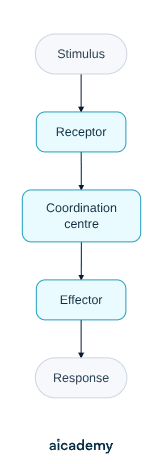
Three named coordination centres are on the AQA spec: the brain, the spinal cord and the pancreas. The pancreas is the coordination centre for controlling blood glucose.
Worth saving these ideas?
Turn what you've read into instant revision cards. Free to get started.
Reflex Actions and the Reflex Arc
A reflex action is an automatic and rapid response to a stimulus. Reflexes are protective — they happen before you have time to think, which is what makes them so fast.
The critical point for the exam: reflex actions are automatic and rapid, and they do not involve the conscious part of the brain. The signal travels through the spinal cord (or unconscious parts of the brain) and back out, so a response happens without you having to decide on it.
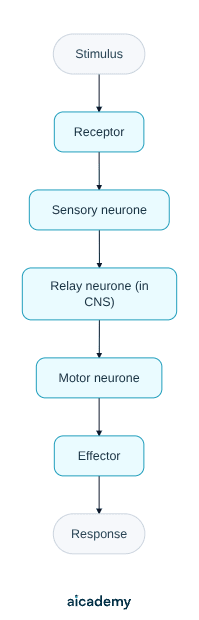
The pathway a reflex takes is called a reflex arc:
| Structure | Role in the reflex arc |
|---|---|
| Receptor | Detects the stimulus |
| Sensory neurone | Carries impulse to the CNS |
| Synapse | Passes the signal chemically between neurones |
| Relay neurone | Connects sensory to motor neurone inside the CNS |
| Motor neurone | Carries impulse from the CNS to the effector |
| Effector | Muscle or gland that produces the response |
The relay neurone sits inside the CNS (the spinal cord or unconscious brain). Because the impulse is processed there rather than in the conscious brain, the response is faster and you cannot choose to stop it.
Key terms
- Homeostasis
- The regulation of the internal conditions of a cell or organism to maintain optimum conditions for function in response to internal and external changes.
- Receptor
- Cells that detect a stimulus, a change in the environment.
- Coordination centre
- A structure such as the brain, spinal cord or pancreas that receives and processes information from receptors.
- Effector
- A muscle or gland that brings about a response, by contracting or by secreting a substance.
- Stimulus
- Any change in the environment that the body can detect, such as a rise in temperature, a bright light or a touch.
- Central nervous system (CNS)
- The brain and the spinal cord, which process information and coordinate responses.
- Sensory neurone
- A neurone that carries electrical impulses from a receptor to the CNS.
- Relay neurone
- A neurone found inside the CNS that links a sensory neurone to a motor neurone.
- Motor neurone
- A neurone that carries electrical impulses from the CNS to an effector.
- Synapse
- The tiny gap between two neurones, across which a chemical neurotransmitter diffuses to pass the signal.
- Reflex action
- An automatic and rapid response to a stimulus that does not involve the conscious part of the brain.
- Reflex arc
- The pathway a reflex takes: receptor, sensory neurone, relay neurone, motor neurone and effector.
Frequently asked questions
Reflex actions are automatic and rapid because they do not involve the conscious part of the brain. The signal is processed in the spinal cord (or unconscious brain) via the relay neurone, so a protective response happens before you have time to think about it.
Neurones do not touch, so at a synapse the electrical impulse stops and triggers the release of a chemical neurotransmitter. The chemical diffuses across the gap and binds to the next neurone's membrane, starting a new electrical impulse. The impulse itself does not jump the gap.
Sensory neurones carry impulses from a receptor to the CNS, relay neurones lie inside the CNS and link sensory to motor neurones, and motor neurones carry impulses from the CNS to an effector.
Generate revision on any topic you study
Type any topic you're studying and Aicademy generates a complete lesson, quiz, and flashcard set, personalised to your level.
Lessons on anything
Structured, level-matched lessons on any topic you study
Practice quizzes
Find out what you actually know before the exam does
Flashcard sets
Lock in key concepts with instant revision cards
Ask Aica
Stuck on something? Get a clear explanation, any time
Response to Exercise and Metabolism
The Endocrine System and Negative Feedback
Related lessons
10 min
12 min
11 min