The Endocrine System and Negative Feedback

Aligned to the AQA 8461 specification
- Level
- Intermediate
- Reading time
- 11 min
- Published
- 16 June 2026
- Updated
- 16 August 2026
On this page
Key takeaways
- The endocrine system is made of glands that secrete hormones directly into the bloodstream, and the blood carries them to a target organ where only cells with the right receptors respond.
- Compared with the nervous system, the endocrine system is slower to act but its effects are longer-lasting and more general.
- The pituitary is the master gland because it secretes hormones in response to body conditions that act on other glands, making them release their own hormones.
- Thyroxine from the thyroid stimulates the basal metabolic rate and is kept steady by negative feedback, where the response always opposes the change.
- Adrenaline from the adrenal glands prepares the body for fight or flight by increasing heart rate and boosting oxygen and glucose delivery, and it is a response to a stimulus, not controlled by negative feedback.
The Glands and Where They Are
For AQA 8461 you must be able to identify the position of six glands on a diagram of the human body. Learn their positions and what each releases.
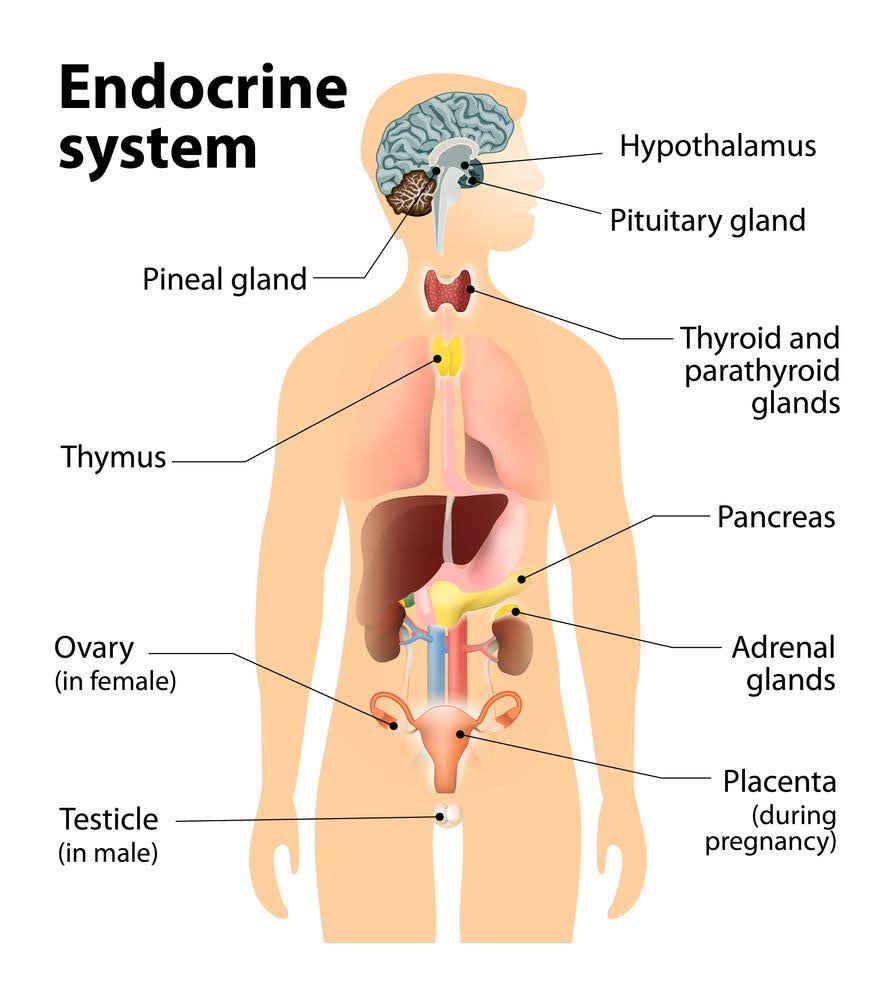
| Gland | Position in the body |
|---|---|
| Pituitary gland | At the base of the brain |
| Thyroid | In the neck |
| Pancreas | Behind the stomach |
| Adrenal glands | One on top of each kidney |
| Ovaries (female) | Lower abdomen |
| Testes (male) | In the scrotum |
AQA asks you to point to these six glands on a body diagram. A frequent slip is placing the adrenal glands in the neck — they sit on top of the kidneys.
The Pituitary Gland: the Master Gland
The pituitary gland sits at the base of the brain and is described as the 'master gland'.
It earns that name because it secretes several hormones into the blood in response to body conditions, and many of those hormones act on other glands, stimulating them to release their own hormones to bring about effects. So the pituitary does not just act directly — it controls a chain of other glands.
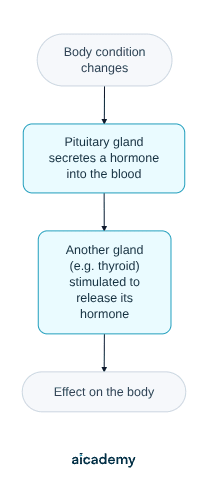
A worked example of this chain — controlling the thyroid:
- The pituitary detects that the body needs more activity from the thyroid.
- The pituitary secretes a hormone (TSH) into the blood.
- The blood carries it to the thyroid gland.
- The thyroid responds by releasing thyroxine.
- Thyroxine then acts on body cells to raise the metabolic rate.
The pituitary is the master gland because the hormones it releases control other glands. It responds to body conditions and triggers a cascade — one gland switching on another.
How much of this have you taken in?
Quiz yourself on this section, free, no card needed.
Thyroxine and Negative Feedback
(Higher Tier only — the role of thyroxine, and its control by negative feedback, is HT content in AQA 8461.)
Thyroxine is a hormone released by the thyroid gland. It stimulates the basal metabolic rate — the rate at which your body uses energy at rest — and plays an important role in growth and development.
The level of thyroxine in the blood is kept steady by negative feedback: when a level rises too high, the body acts to bring it back down; when it falls too low, the body acts to raise it. The response always opposes the change.
Worked example — trace the negative-feedback loop:
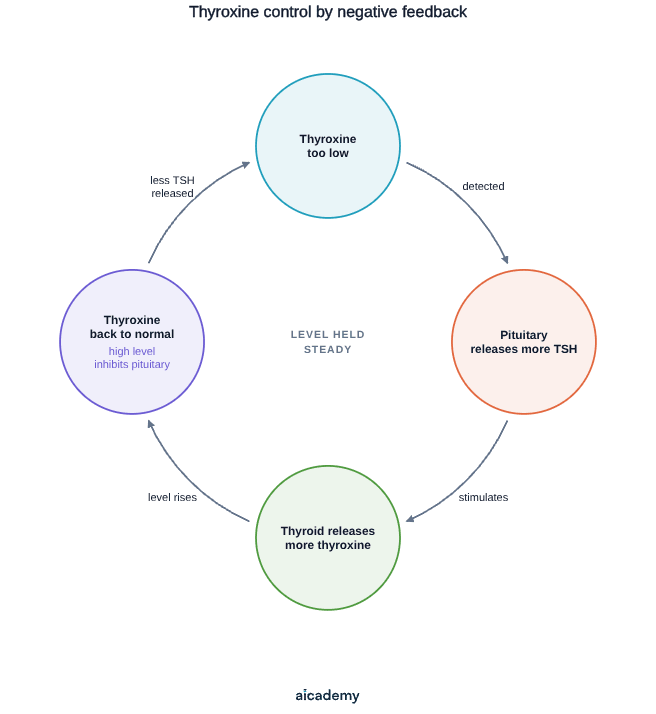
So a fall in thyroxine triggers a response that raises it, and a rise triggers a response that lowers it. The two opposing actions hold the level around a steady set point.
In negative feedback the response always opposes the change that triggered it. Low thyroxine → more is made; high thyroxine → less is made. That is what keeps the level stable.
Key terms
- Endocrine system
- The body's system of chemical control, made of glands that secrete hormones into the bloodstream.
- Gland
- An organ that secretes (releases) a hormone.
- Hormone
- A chemical messenger that travels in the blood to act on a target organ.
- Target organ
- The organ a particular hormone acts on, because its cells have the right receptors.
- Pituitary gland
- The master gland at the base of the brain that secretes hormones controlling other glands.
- Thyroxine
- A hormone released by the thyroid that stimulates the basal metabolic rate and plays a role in growth and development.
- Adrenaline
- A hormone produced by the adrenal glands in times of fear or stress that prepares the body for fight or flight.
- Negative feedback
- A control mechanism where the response always opposes the change, keeping a level such as thyroxine around a steady set point.
- Basal metabolic rate
- The rate at which the body uses energy at rest, which thyroxine stimulates.
Frequently asked questions
Glands secrete hormones directly into the bloodstream, and the blood carries them to their target organ. Only the target organ responds, because only its cells have the right receptors. Hormones travel in the blood, not along nerves.
The pituitary is the master gland because it secretes several hormones into the blood in response to body conditions, and many of these act on other glands, stimulating them to release their own hormones. It controls a chain of glands rather than only acting directly.
No. Adrenaline is a response to a stimulus, fear or stress, and the level drops once the threat passes. Only thyroxine is held at a steady set point by negative feedback, where the response always opposes the change. Mixing these up is a classic Higher Tier error.
Generate revision on any topic you study
Type any topic you're studying and Aicademy generates a complete lesson, quiz, and flashcard set, personalised to your level.
Lessons on anything
Structured, level-matched lessons on any topic you study
Practice quizzes
Find out what you actually know before the exam does
Flashcard sets
Lock in key concepts with instant revision cards
Ask Aica
Stuck on something? Get a clear explanation, any time
The Nervous System and Reflexes
Control of Blood Glucose and Diabetes
Related lessons
11 min
10 min
8 min