Communicable Diseases and Pathogens

Aligned to the AQA 8461 specification
- Level
- Foundational
- Reading time
- 10 min
- Published
- 16 June 2026
- Updated
- 16 August 2026
On this page
Key takeaways
- A pathogen is a microorganism (bacterium, virus, protist or fungus) that causes communicable disease; the pathogen spreads between hosts and the disease is the harm it then causes.
- Bacteria reproduce rapidly inside the body and produce toxins that damage tissues, while viruses live and reproduce inside cells, damaging or destroying them.
- Antibiotics kill bacteria because bacteria are cells with targetable structures; viruses are not cells and reproduce inside our own cells, so antibiotics have no effect on them.
- Pathogens spread by direct contact, water and air, and some are carried by a vector such as an insect; most prevention methods work by blocking a specific route.
- All four pathogen types can infect plants as well as animals, and a full prevention answer names the method and explains which route it blocks.
How Bacteria Make Us Ill
Bacteria are single-celled living organisms. Once inside the body, they can reproduce rapidly — dividing again and again as long as conditions suit them. A small number of bacteria can therefore become a very large population within hours.
The damage comes mainly from what bacteria release. Many bacteria produce toxins — poisons that damage the body's tissues and make us feel ill.
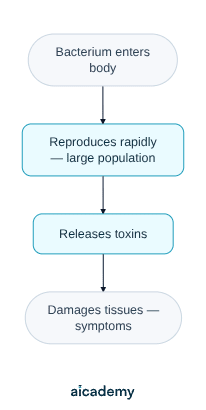
So with a bacterial infection there are two linked problems: the rising number of bacteria, and the toxins they release as they grow.
Key idea: bacteria reproduce rapidly inside the body and produce toxins (poisons) that damage tissues and make us feel ill.
Because bacteria are living cells with their own structures, they can be killed by antibiotics — a point that becomes important when comparing them with viruses on the next slide.
How Viruses Make Us Ill
A virus is not a cell. It is a tiny particle that cannot reproduce on its own — it must get inside a host cell to multiply. This single fact explains why viruses damage the body the way they do.
Once inside a cell, a virus takes over the cell's machinery and uses it to make many copies of itself. The cell becomes packed with new virus particles and is damaged or destroyed in the process — often bursting open to release the new viruses, which then invade more cells.
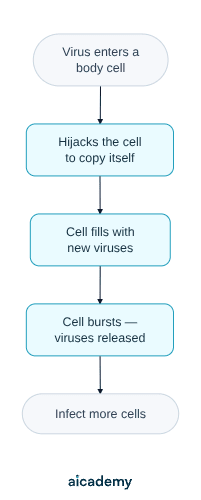
Key idea: viruses live and reproduce inside cells, causing cell damage. The harm to the body comes from this cell damage, not from toxins.
This is the crucial contrast with bacteria. Bacteria mostly harm us with toxins released outside their own cells; viruses harm us by reproducing inside our cells and destroying them.
(Extra context — not required by AQA 8461.) Viruses are sometimes described as "on the boundary of living and non-living" because they cannot reproduce without a host. AQA does not ask you to classify viruses as alive or not.
How much of this have you taken in?
Quiz yourself on this section, free, no card needed.
Key terms
- Pathogen
- A microorganism (a bacterium, virus, protist or fungus) that causes a communicable disease in a plant or animal.
- Communicable disease
- A disease that can be passed from one organism to another; also called an infectious disease.
- Toxin
- A poison released by many bacteria that damages the body's tissues and makes us feel ill.
- Host cell
- A body cell that a virus must get inside to reproduce, using the cell's machinery to make copies of itself.
- Antibiotic
- A medicine that kills bacteria by attacking structures and processes that bacterial cells have, but has no effect on viruses.
- Vector
- An organism, such as an insect, that transfers a pathogen between hosts without getting the disease itself.
Frequently asked questions
A pathogen is the microorganism that spreads between hosts, while the disease is the harm the pathogen causes once it is inside the body. You catch a pathogen, and the illness is what that pathogen then causes.
Antibiotics target structures found in bacterial cells, such as cell walls. Viruses are not cells and reproduce inside the body's own cells, so antibiotics cannot reach or kill them.
Bacteria reproduce rapidly and release toxins (poisons) that damage tissues and make us feel ill. Viruses get inside body cells and use them to make copies of themselves, damaging or destroying the cells in the process.
Generate revision on any topic you study
Type any topic you're studying and Aicademy generates a complete lesson, quiz, and flashcard set, personalised to your level.
Lessons on anything
Structured, level-matched lessons on any topic you study
Practice quizzes
Find out what you actually know before the exam does
Flashcard sets
Lock in key concepts with instant revision cards
Ask Aica
Stuck on something? Get a clear explanation, any time
Plant Tissues and Transpiration
Viral, Bacterial, Fungal and Protist Diseases
Related lessons
11 min
12 min
8 min