Track progress, take quizzes and save notes on this lesson.

Free forever · no card needed

Start free
Foundational

Blood: Components and Functions

4.2.2.3 Blood

Aligned to the AQA 8461 specification

Level
Foundational
Reading time
10 min
Published
16 June 2026
Updated
1 July 2026
On this page
  1. 1.Blood Is a Tissue, Not Just a Liquid
  2. 2.Plasma: The Transport Liquid
  3. 3.Red Blood Cells: Structure Built for Oxygen
  4. 4.Haemoglobin and Oxyhaemoglobin
  5. 5.White Blood Cells and Platelets
  6. 6.Reading a Blood Sample: Predicting Consequences
  7. 7.Common Exam Mistakes

Key takeaways

  • Blood is a tissue consisting of plasma, in which red blood cells, white blood cells and platelets are suspended.
  • Plasma is the liquid part of blood and transports carbon dioxide, soluble products of digestion (glucose and amino acids), urea, hormones and heat; oxygen is carried by red blood cells, not plasma.
  • Red blood cells are adapted to carry oxygen by their biconcave disc shape, having no nucleus to make room for more haemoglobin, and being packed with haemoglobin, the iron-containing protein that binds oxygen.
  • Haemoglobin binds oxygen to form oxyhaemoglobin in the lungs (high oxygen) and releases it again in the respiring tissues (low oxygen).
  • White blood cells defend against pathogens by phagocytosis and producing antibodies and antitoxins, while platelets are cell fragments that help the blood clot to seal wounds.

Blood Is a Tissue, Not Just a Liquid

Blood is a tissue — a group of different cell types working together for a shared role: transport and defence around the body. It only looks like a simple red liquid.

A tissue is defined as a group of cells with a similar structure and function. Blood qualifies because it contains several cell types suspended in a straw-coloured liquid called plasma. The cells are carried along by the plasma but are not dissolved in it.

There are four components to learn:

ComponentWhat it isHeadline job
PlasmaStraw-coloured liquidTransports almost everything dissolved
Red blood cellsBiconcave cells with no nucleusCarry oxygen
White blood cellsLarger cells with a nucleusDefend against pathogens
PlateletsTiny cell fragmentsHelp blood clot

Key definition: Blood is a tissue consisting of plasma, in which red blood cells, white blood cells and platelets are suspended.

If you spun a blood sample in a centrifuge, it would separate into layers: red blood cells sink to the bottom (they are the densest and most numerous), a thin pale layer of white blood cells and platelets sits in the middle, and the plasma floats on top as roughly 55% of the volume.

Plasma: The Transport Liquid

Plasma is the liquid part of blood — about 55% of its volume — and it is mostly water. Because nearly everything the body moves around is dissolved or suspended in plasma, it is the main transport medium of the circulatory system.

Plasma transports:

  • Carbon dioxide — the waste gas from respiration, carried from the respiring tissues to the lungs to be breathed out.
  • Soluble products of digestion — such as glucose and amino acids, carried from the small intestine to the cells that need them.
  • Urea — a waste product made in the liver from the breakdown of excess amino acids, carried to the kidneys to be removed in urine.
  • Hormones — chemical messengers carried from glands to their target organs.
  • Heat — energy transferred from warmer organs (like the liver and muscles) around the body, helping keep body temperature even.

A useful way to remember the load plasma carries is to group it by direction:

SubstanceFromTo
Carbon dioxideRespiring tissuesLungs
Glucose, amino acidsSmall intestineBody cells
UreaLiverKidneys
HormonesGlandsTarget organs

Oxygen is not mainly carried by plasma — it is carried by red blood cells. This is a frequent mix-up, so keep oxygen out of your plasma list.

Red Blood Cells: Structure Built for Oxygen

Red blood cells (also called erythrocytes) have one job: carry oxygen from the lungs to every respiring cell in the body. Almost every structural feature is an adaptation that increases how much oxygen they can carry and how fast they can load and unload it.

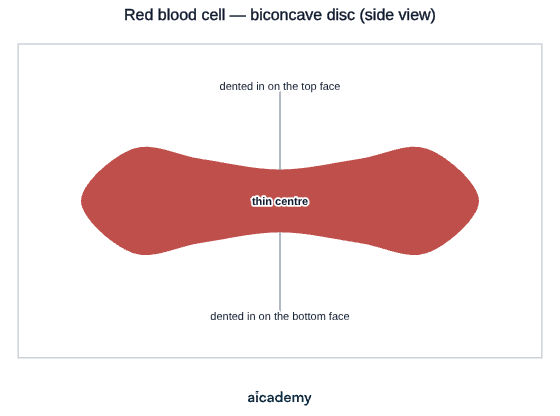
A simplified side-on view of the biconcave shape, dented on both flat faces:
Three key adaptations, and the reasoning behind each:

AdaptationWhat it meansWhy it helps carry oxygen
Biconcave disc shapeFlattened disc, dented on both flat facesLarger surface area to volume ratio, so oxygen diffuses in and out faster
No nucleusThe nucleus is lost as the cell maturesMore internal room for haemoglobin, so each cell carries more oxygen
Packed with haemoglobinA red, iron-containing protein fills the cellHaemoglobin is the molecule that actually binds and releases oxygen

Remember: mature red blood cells have no nucleus. This is unusual for an animal cell, and it exists to make room for more haemoglobin — not for any other reason.

The biconcave shape also makes the cells flexible, so they can squeeze single-file through narrow capillaries where gas exchange happens.

Haemoglobin and Oxyhaemoglobin

Haemoglobin is the red, iron-containing protein inside red blood cells. It is what lets the cell pick up oxygen in one place and drop it off in another. The same chemistry runs forwards in the lungs and backwards in the tissues.

In the lungs, oxygen concentration is high, so haemoglobin binds oxygen to form oxyhaemoglobin:

In the respiring tissues, oxygen concentration is low because cells are using it up, so the reaction reverses. Oxyhaemoglobin breaks down, releasing oxygen where it is needed:

Walk-through — how the three adaptations combine for one cell:

  1. The cell enters a capillary in the lung. Its large surface area (biconcave shape) lets oxygen diffuse in quickly.
  2. With no nucleus, the inside is packed with haemoglobin, so a lot of oxygen can be loaded into a single small cell.
  3. The haemoglobin binds that oxygen, forming oxyhaemoglobin, and the cell carries it away in the bloodstream.
  4. Reaching a respiring muscle, the low oxygen level triggers the reverse reaction. Haemoglobin releases the oxygen, the large surface area speeds its diffusion out, and the cell heads back to the lungs to repeat the cycle.

Each adaptation removes a different bottleneck: shape speeds diffusion, the missing nucleus increases capacity, and haemoglobin provides the chemistry. Together they make red blood cells far more efficient than a plain spherical cell would be.

(Extra context — not required by AQA 8461.) Each red blood cell holds roughly 250 million haemoglobin molecules, and one haemoglobin molecule can carry up to four oxygen molecules.

Worth saving these ideas?

Turn what you've read into instant revision cards. Free to get started.

Make flashcards

White Blood Cells and Platelets

White blood cells are part of the body's defence against pathogens (microorganisms that cause disease, such as bacteria and viruses). Unlike red blood cells, they keep their nucleus and are larger but far less numerous. They defend the body in two main ways:

  • Phagocytosis — some white blood cells surround and engulf pathogens, then digest and destroy them.
  • Producing antibodies — some white blood cells make antibodies, proteins that lock onto and help destroy specific pathogens.
  • Producing antitoxins — some white blood cells make antitoxins, which neutralise the harmful toxins released by certain pathogens.

White blood cells defend the body against pathogens. The full detail of how this defence works is covered separately under "human defence systems" — here you only need their role in blood.

Platelets are small fragments of cells — not whole cells, and they have no nucleus. When a blood vessel is cut, platelets help the blood clot. The clot forms a seal that:

  • stops further blood loss, and
  • blocks the entry of pathogens through the wound.
ComponentHas a nucleus?Whole cell?Main function
Red blood cellNoYesCarry oxygen
White blood cellYesYesDefend against pathogens
PlateletNoNo (cell fragment)Help blood clot to seal wounds

Remember: platelets are cell fragments, not complete cells. Calling them "cells" can lose the mark in a description question.

Reading a Blood Sample: Predicting Consequences

Exam questions often describe a blood sample with an abnormal count and ask you to predict and justify the consequence. Use the same method each time: name the component's job, then reason from "less of it" or "more of it" to the effect on the body.

Walk-through — a sample with a very low platelet count:

  1. State the normal job: platelets help the blood clot to seal wounds.
  2. Reason from the shortage: with too few platelets, clots form slowly or not at all.
  3. Predict the consequence: even a small cut would bleed for much longer, and the person bruises easily, because there is no effective seal forming.

Walk-through — a sample with a low red blood cell count:

  1. State the normal job: red blood cells carry oxygen using haemoglobin.
  2. Reason from the shortage: fewer red blood cells means less haemoglobin, so less oxygen is delivered to the tissues.
  3. Predict the consequence: the person tires quickly and feels breathless, because their cells cannot get enough oxygen for respiration.
Sample shows…Component affectedLikely consequence
Low plateletsPlateletsSlow clotting; prolonged bleeding, bruising
Low red blood cell countRed blood cellsLess oxygen delivered; tiredness, breathlessness
Very high white blood cellsWhite blood cellsOften a sign the body is fighting an infection

Exam tip: when a question says "explain" or "justify", link the component's function to the observed consequence. A consequence stated without the reason rarely gains full marks.

Common Exam Mistakes

1. Saying red blood cells have a nucleus

Mature red blood cells have no nucleus. The space is used for extra haemoglobin so the cell can carry more oxygen. Writing that they keep a nucleus contradicts their main adaptation.

2. Claiming plasma carries oxygen

Plasma transports carbon dioxide, dissolved food (glucose and amino acids), urea, hormones and heat. Oxygen is carried by red blood cells bound to haemoglobin, not by the plasma.

3. Calling platelets "cells"

Platelets are fragments of cells, not whole cells. A description that calls them complete cells is inaccurate and can cost the mark.

4. Confusing the haemoglobin reaction direction

Oxygen joins haemoglobin to form oxyhaemoglobin in the lungs (high oxygen); the reaction reverses in the respiring tissues (low oxygen) to release oxygen. Getting the two locations the wrong way round describes the opposite of what happens.

5. Listing a job for the wrong component

Match each function to its owner: plasma transports dissolved substances and heat, red blood cells carry oxygen, white blood cells defend against pathogens, and platelets clot the blood. Mixing these up is the most common way to lose easy marks on this topic.

Key terms

Plasma
The straw-coloured liquid part of blood, about 55% of its volume, that transports dissolved substances and heat.
Red blood cell
A biconcave cell with no nucleus, packed with haemoglobin, whose job is to carry oxygen.
Haemoglobin
The red, iron-containing protein inside red blood cells that binds and releases oxygen.
Oxyhaemoglobin
The substance formed when haemoglobin binds oxygen in the lungs; it breaks down again in the respiring tissues.
White blood cell
A larger cell with a nucleus that defends the body against pathogens.
Platelet
A tiny fragment of a cell, with no nucleus, that helps the blood clot to seal wounds.
Pathogen
A microorganism that causes disease, such as a bacterium or virus.
Urea
A waste product made in the liver from the breakdown of excess amino acids, carried in plasma to the kidneys.

Frequently asked questions

Blood has four components: plasma, the straw-coloured liquid that transports dissolved substances and heat; red blood cells, which carry oxygen; white blood cells, which defend against pathogens; and platelets, which help the blood clot to seal wounds.

Mature red blood cells lose their nucleus to make more internal room for haemoglobin, so each cell can carry more oxygen. This is unusual for an animal cell and exists for that one reason. Their biconcave disc shape also gives a large surface area to load and unload oxygen quickly.

No. Plasma transports carbon dioxide, the soluble products of digestion such as glucose and amino acids, urea, hormones and heat. Oxygen is carried by red blood cells, bound to haemoglobin, not by the plasma.

Generate revision on any topic you study

Type any topic you're studying and Aicademy generates a complete lesson, quiz, and flashcard set, personalised to your level.

Lessons on anything

Structured, level-matched lessons on any topic you study

Practice quizzes

Find out what you actually know before the exam does

Flashcard sets

Lock in key concepts with instant revision cards

Ask Aica

Stuck on something? Get a clear explanation, any time

Prev

The Heart and Blood Vessels

Next

Coronary Heart Disease

Related lessons

9 min

Lesson

The Heart and Blood Vessels

AQA GCSE Biology · AQA 8461

1 month ago

13 min

Lesson

Coronary Heart Disease

AQA GCSE Biology · AQA 8461

1 month ago

Top students don’t revise more. They revise what counts.

Start revising free

Free to start. No card needed.