Hormones in Human Reproduction

Aligned to the AQA 8461 specification
- Level
- Intermediate
- Reading time
- 8 min
- Published
- 16 June 2026
- Updated
- 16 August 2026
On this page
Key takeaways
- Oestrogen is the main female reproductive hormone, produced in the ovaries; testosterone is the main male hormone, produced by the testes and stimulating sperm production.
- Four hormones control the menstrual cycle: FSH and LH come from the pituitary gland, while oestrogen and progesterone come from the ovaries.
- FSH matures an egg in the ovary, oestrogen builds the uterus lining, an LH surge triggers ovulation around day 14, and progesterone maintains the lining.
- Ovulation is directly caused by the LH surge, not by oestrogen; oestrogen builds the lining and on Higher Tier stimulates LH.
- On Higher Tier, oestrogen stimulates LH but inhibits FSH, and progesterone inhibits both FSH and LH, which is why no new egg matures while progesterone is high.
Walking Through the 28-Day Cycle
The cycle is usually described in four stages. Day 1 is the first day of the period. The timeline below tracks which hormone is responsible at each point.
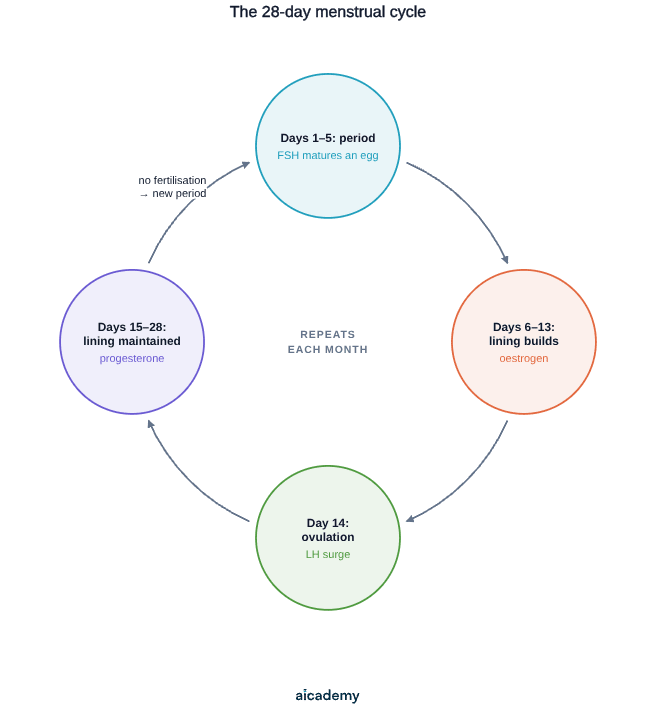
Stage by stage:
- Days 1–5 (period) — the uterus lining is shed. FSH is released and begins to mature an egg.
- Days 6–13 — the maturing egg's follicle produces oestrogen, which thickens and builds the uterus lining ready to receive a fertilised egg.
- Day 14 (ovulation) — a surge of LH stimulates the release of the mature egg from the ovary.
- Days 15–28 — progesterone maintains the thick uterus lining. If the egg is not fertilised, progesterone levels fall, the lining breaks down, and the cycle restarts at day 1.
The egg is released around day 14 of a 28-day cycle — roughly the midpoint. Cycle lengths vary between individuals, so 28 days is an average, not a fixed rule.
Studying this for an exam?
Generate a personalised learning path for this subject. Free to get started.
Key terms
- Hormone
- A chemical messenger made by a gland and carried in the blood to a target organ where it produces an effect.
- Secondary sex characteristics
- The physical features that distinguish adult males and females but are not the reproductive organs themselves.
- Oestrogen
- The main female reproductive hormone, produced in the ovaries, controlling puberty and the menstrual cycle and helping build the uterus lining.
- Testosterone
- The main male reproductive hormone, produced by the testes, which stimulates sperm production.
- FSH
- Follicle stimulating hormone, made by the pituitary gland, which causes an egg to mature in the ovary.
- LH
- Luteinising hormone, made by the pituitary gland, which stimulates the release of the egg at ovulation.
- Progesterone
- A hormone produced by the ovaries that maintains the thickened uterus lining.
- Ovulation
- The release of a mature egg from the ovary, occurring around day 14 of a 28-day cycle.
- Menstrual cycle
- The roughly 28-day cycle that prepares the body for a possible pregnancy each month.
Frequently asked questions
FSH and LH are made by the pituitary gland in the brain, while oestrogen and progesterone are made by the ovaries. Sorting them by gland is a quick way to keep the four hormones straight.
Ovulation is triggered by a surge of LH around day 14 of the cycle, which stimulates the release of the mature egg from the ovary. Oestrogen builds the uterus lining but it is the LH surge that directly causes the egg to be released.
FSH (follicle stimulating hormone) causes an egg to mature in the ovary and comes first; LH (luteinising hormone) then stimulates the release of that egg at ovulation. A memory hook is FSH matures the egg, then LH lets it go.
Generate revision on any topic you study
Type any topic you're studying and Aicademy generates a complete lesson, quiz, and flashcard set, personalised to your level.
Lessons on anything
Structured, level-matched lessons on any topic you study
Practice quizzes
Find out what you actually know before the exam does
Flashcard sets
Lock in key concepts with instant revision cards
Ask Aica
Stuck on something? Get a clear explanation, any time
The Kidneys: Water and Nitrogen Balance
Contraception and Fertility Treatments
Related lessons
10 min
11 min
11 min