Track progress, take quizzes and save notes on this lesson.

Free forever · no card needed

Start free
Advanced

The Kidneys: Water and Nitrogen Balance

4.5.3.3 Maintaining water and nitrogen balance in the body (Biology only)

Aligned to the AQA 8461 specification

Level
Advanced
Reading time
10 min
Published
16 June 2026
Updated
1 July 2026
On this page
  1. 1.Why Your Body Must Balance Water and Waste
  2. 2.What Happens When Cells Gain or Lose Water
  3. 3.Dealing With Excess Protein: Deamination and Urea
  4. 4.How the Kidneys Make Urine: Filtration and Selective Reabsorption
  5. 5.ADH: Controlling Water by Negative Feedback
  6. 6.Treating Kidney Failure: Dialysis
  7. 7.Dialysis vs Transplant: An Evaluation
  8. 8.Common Exam Mistakes

Key takeaways

  • Water, ions and urea are lost in uncontrolled amounts through the lungs and skin, so the kidneys do the precise work of keeping the blood at the right concentration by adjusting the urine.
  • If body cells lose or gain too much water by osmosis they do not function efficiently, so the blood must be kept at a steady concentration.
  • Excess amino acids are deaminated in the liver to produce toxic ammonia, which the liver converts to the less toxic urea that the kidneys then remove in urine (HT).
  • The kidneys filter the blood under pressure, then selectively reabsorb all the glucose plus the water and ions the body needs, leaving excess water, ions and urea to form urine.
  • ADH from the pituitary gland controls water balance by negative feedback: more ADH makes the tubules reabsorb more water, producing a smaller volume of more concentrated urine (HT).

Why Your Body Must Balance Water and Waste

Your body constantly takes in water and produces waste, yet the concentration of your blood and cells must stay roughly constant. Three substances need careful management:

  • Water — too much or too little disrupts every cell.
  • Ions — such as sodium ions, taken in with food.
  • Urea — a waste product made when the body deals with excess protein.

These leave the body by three routes:

RouteWhat is lostControlled?
Lungs (breathing out)Water (as vapour)No
Skin (sweating)Water, ions and ureaNo (cooling, not balance)
Kidneys (urine)Excess water, ions and ureaYes

Sweating cools you down — it is not a way of controlling water balance. The body cannot choose how much water and ions it loses through the lungs or skin.

Because losses from the lungs and skin are uncontrolled, the kidneys do the precise work of keeping the blood at the right concentration by adjusting what ends up in the urine.

What Happens When Cells Gain or Lose Water

Body cells are surrounded by tissue fluid. Water moves between the cell and this fluid by osmosis — the diffusion of water across a partially permeable membrane, from a more dilute solution (high water concentration) to a more concentrated one (low water concentration).

If the blood and tissue fluid become too concentrated (too little water), water leaves the cells by osmosis. The cells shrink and cannot work efficiently.

If the blood becomes too dilute (too much water), water enters the cells by osmosis. The cells swell, and in extreme cases can burst.

If body cells lose or gain too much water by osmosis, they do not function efficiently. Keeping the blood at a steady concentration protects every cell in the body.

This is the core reason water balance matters. The chemical reactions inside cells — including those controlled by enzymes — depend on the right amount of water. The kidneys exist to hold that balance steady whatever you eat or drink.

Dealing With Excess Protein: Deamination and Urea

(Higher Tier only — the deamination of amino acids and the formation of urea in the liver.)

You cannot store excess protein or the amino acids it is broken down into. When the diet contains more protein than the body needs, the surplus amino acids must be broken down and removed safely.

This happens in the liver in two steps:

  1. Deamination — the amino group is removed from each excess amino acid, producing ammonia.
  2. Ammonia is very toxic, so the liver immediately converts it into urea.
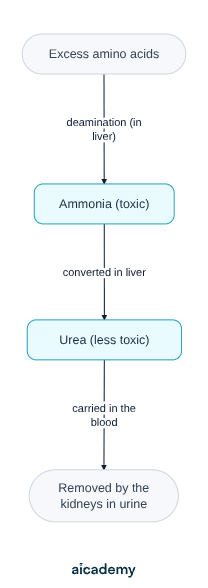
Urea is far less toxic than ammonia, so it can be carried safely in the blood to the kidneys, where it is removed in the urine.

Key chain to memorise (HT): excess amino acids → deaminated → ammonia → converted to urea (in the liver) → excreted by the kidneys. The liver makes urea; the kidneys remove it.

How the Kidneys Make Urine: Filtration and Selective Reabsorption

The kidneys clean the blood in two stages.

Stage 1 — Filtration. Blood is filtered under pressure. Small molecules are forced out of the blood: water, glucose, ions and urea all pass into the kidney tubules. Large items such as blood cells and proteins are too big to be filtered and stay in the blood.

Stage 2 — Selective reabsorption. The filtered liquid still contains useful substances the body needs to keep. As it flows through the tubules, these are taken back into the blood:

SubstanceFiltered out of blood?Reabsorbed back into blood?
GlucoseYesAll of it (none should be lost)
IonsYesOnly as much as the body needs
WaterYesAs much as the body needs
UreaYesNo — it stays in the urine as waste

Whatever is left after reabsorption — excess water, excess ions and the urea — leaves the body as urine.

"Selective" reabsorption means the body chooses what to take back. All glucose is reabsorbed; the amount of water and ions reabsorbed is adjusted to keep the blood balanced. Urea is left behind to be excreted.

(The spec does not require the structure of the kidney or the parts of a tubule, only that filtration and selective reabsorption take place.)

How much of this have you taken in?

Quiz yourself on this section, free, no card needed.

Test myself

ADH: Controlling Water by Negative Feedback

(Higher Tier only — the role of ADH and negative feedback control of water balance.)

The amount of water reabsorbed in the kidney tubules is controlled by a hormone called ADH (anti-diuretic hormone), released by the pituitary gland.

ADH changes how permeable the kidney tubules are to water. More ADH → tubules let more water back into the blood → less water in the urine, so the urine is smaller in volume and more concentrated. Less ADH has the opposite effect.

This is controlled by negative feedback — a change in one direction triggers a response that reverses it:
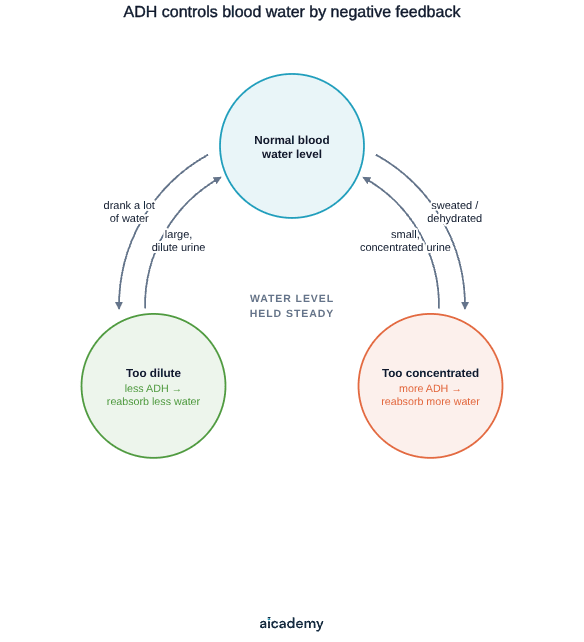
The detail for each arm:

  • Blood too concentrated (e.g. dehydrated, sweated a lot) → pituitary releases more ADH → kidney tubules become more permeable and reabsorb more water → less water lost, urine small and concentrated → blood water level rises back to normal.
  • Blood too dilute (e.g. drank a lot of water) → pituitary releases less ADH → tubules reabsorb less water → more water lost, urine large and dilute → blood water level falls back to normal.

Worked walk-through (HT) — you go for a long run on a hot day and sweat heavily. You lose water in sweat, so your blood becomes too concentrated. The pituitary detects this and releases more ADH. The kidney tubules become more permeable and reabsorb more water back into the blood. You produce a small volume of dark, concentrated urine, and your blood water level returns to normal. This is why dehydration makes urine darker.

Treating Kidney Failure: Dialysis

If the kidneys fail, urea and excess ions build up in the blood and the water balance is lost — this is life-threatening. One treatment is kidney dialysis, which does the kidneys' job using a machine.

How dialysis works:

  • The patient's blood flows out of the body and through a dialysis machine.
  • Inside, the blood flows on one side of a partially permeable membrane; dialysis fluid flows on the other side.
  • The dialysis fluid contains a normal concentration of glucose and ions, and no urea.
  • Because of these concentration differences, substances move by diffusion across the membrane:
    • Urea diffuses out of the blood into the dialysis fluid (the fluid has no urea, so urea moves out down its concentration gradient).
    • Excess ions diffuse out of the blood, while ions at normal levels do not (the fluid matches normal blood, so there is no net movement of those).
    • Glucose does not leave the blood, because the fluid has the same glucose concentration as healthy blood — no concentration gradient, so no net loss.
  • The cleaned blood is returned to the patient.

The dialysis fluid is carefully chosen: same glucose and ion levels as healthy blood (so useful substances are not lost), but no urea (so waste diffuses out). This mimics the selective work the kidneys normally do.

Dialysis must be repeated regularly — typically several sessions a week — because waste keeps building up between treatments.

Dialysis vs Transplant: An Evaluation

The other treatment for kidney failure is a kidney transplant — a healthy kidney from a donor is placed into the patient. Each option has trade-offs, and the right choice depends on the patient.

FactorKidney dialysisKidney transplant
LifestyleTied to a machine for regular sessions each weekFree to live normally once recovered
DietMust control diet (especially protein and salt)Fewer dietary restrictions
Cost over timeExpensive long-term (ongoing treatment)One-off operation is costly, but cheaper in the long run
AvailabilityAvailable when neededLimited by a shortage of donor organs (long waits)
RejectionNo rejection riskBody may reject the kidney; needs immunosuppressant drugs
Drugs / side effectsNo anti-rejection drugsImmunosuppressants for life, raising infection risk
PermanenceOngoing, does not cureCan last many years, but not forever

Worked walk-through — choosing for a young patient. A young, otherwise healthy patient is likely to benefit most from a transplant: it frees them from regular machine sessions, lets them eat more normally, and is cheaper over a lifetime. The downsides are the wait for a matching donor organ and a lifetime of immunosuppressant drugs with the risk of rejection. Dialysis is the option that keeps them alive while they wait for a suitable donor kidney.

There is no single "best" treatment — a good evaluation weighs cost, lifestyle, organ availability and rejection risk for the specific patient.

Common Exam Mistakes

1. Saying the kidney removes urea by "filtering it out and keeping it"

Urea is filtered out of the blood and left in the tubule — it is not reabsorbed. It is glucose (all of it), some ions and water that are selectively reabsorbed. Urea leaves in the urine.

2. Confusing where ammonia and urea are made and removed

Deamination and the conversion to urea both happen in the liver, not the kidney. The kidney's job is to remove the urea that the liver has already made. (HT)

3. Getting the ADH effect backwards

More ADH means more water reabsorbed, so less urine that is more concentrated. A common error is to write that more ADH produces more urine — it is the opposite. (HT)

4. Forgetting that lung and skin losses are uncontrolled

Water leaves via the lungs and skin, but the body does not regulate these to balance water — only the kidneys do that. Sweating is for cooling, not water control.

5. Thinking dialysis fluid should contain no glucose or ions

Dialysis fluid contains glucose and ions at normal blood concentrations so these useful substances are not lost by diffusion. Only urea is absent from the fluid, so only waste diffuses out.

6. Treating "best treatment" as a fact rather than an evaluation

Dialysis vs transplant has no fixed answer. Marks come from weighing trade-offs — cost, lifestyle, donor availability and rejection — for the patient described.

Key terms

Urea
A waste product made in the liver when the body deals with excess protein, carried in the blood and removed by the kidneys in urine.
Osmosis
The diffusion of water across a partially permeable membrane, from a more dilute solution to a more concentrated one.
Deamination
The removal of the amino group from excess amino acids in the liver, producing ammonia.
Selective reabsorption
The taking back into the blood of useful substances from the kidney tubules: all the glucose, plus the water and ions the body needs.
ADH (anti-diuretic hormone)
A hormone released by the pituitary gland that controls how much water the kidney tubules reabsorb.
Kidney dialysis
A treatment for kidney failure in which a machine cleans the blood using a partially permeable membrane and dialysis fluid.
Dialysis fluid
Fluid used in dialysis containing a normal blood concentration of glucose and ions and no urea, so only waste diffuses out of the blood.

Frequently asked questions

After the blood is filtered, useful substances are taken back into the blood as the liquid flows through the tubules. All the glucose is reabsorbed, plus as much water and as many ions as the body needs. Urea is left behind to be excreted as urine.

ADH, released by the pituitary gland, changes how permeable the kidney tubules are to water. More ADH makes the tubules reabsorb more water, so less water is lost and the urine is smaller and more concentrated. Less ADH has the opposite effect.

Dialysis uses a machine to clean the blood regularly and carries no rejection risk, but ties the patient to sessions each week. A transplant places a donor kidney in the patient, freeing them to live normally, but donor organs are scarce and the body may reject the kidney.

Generate revision on any topic you study

Type any topic you're studying and Aicademy generates a complete lesson, quiz, and flashcard set, personalised to your level.

Lessons on anything

Structured, level-matched lessons on any topic you study

Practice quizzes

Find out what you actually know before the exam does

Flashcard sets

Lock in key concepts with instant revision cards

Ask Aica

Stuck on something? Get a clear explanation, any time

Prev

Control of Blood Glucose and Diabetes

Next

Hormones in Human Reproduction

Related lessons

Top students don’t revise more. They revise what counts.

Start revising free

Free to start. No card needed.