Contraception and Fertility Treatments

Aligned to the AQA 8461 specification
- Level
- Intermediate
- Reading time
- 10 min
- Published
- 16 June 2026
- Updated
- 16 August 2026
On this page
Key takeaways
- Hormonal contraceptives inhibit FSH so no egg matures: oral contraceptives are taken daily, while injections, implants and patches deliver slow-release progesterone lasting months or years.
- Non-hormonal methods stop sperm and egg meeting physically, chemically or surgically; condoms are the only common method that also reduces the spread of STIs.
- A fertility drug contains FSH and LH and stimulates ovulation so a woman may become pregnant naturally, but stimulating several eggs at once raises the chance of multiple births.
- In IVF the mother is given FSH and LH, eggs are collected and fertilised by sperm in the lab, the fertilised eggs develop into embryos, and one or two embryos are inserted into the uterus.
- Contraception and fertility treatment are mirror images: oral contraceptives inhibit FSH so no egg matures, while a fertility drug supplies FSH and LH so eggs mature and are released.
Worth saving these ideas?
Turn what you've read into instant revision cards. Free to get started.
IVF: In Vitro Fertilisation
(Higher Tier only.)
If a fertility drug alone does not work, In Vitro Fertilisation (IVF) can be used. "In vitro" means "in glass" — fertilisation happens in the laboratory, not in the body.
The spec gives a precise sequence. Learn it in order:
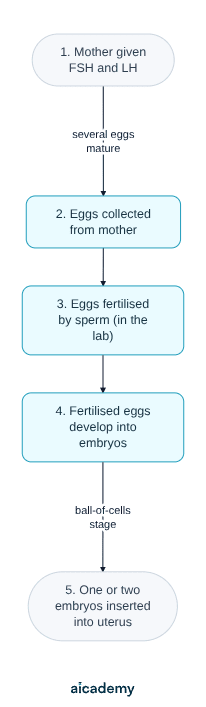
The precise sequence, in order:
- The mother is given FSH and LH, which stimulates the maturation of several eggs.
- The eggs are collected from the mother.
- The eggs are fertilised by sperm from the father — this happens in the laboratory.
- The fertilised eggs develop into embryos.
- At the tiny ball-of-cells stage, one or two embryos are inserted into the mother's uterus (womb).
Walk-through — put these jumbled steps in order:
"Embryos inserted into uterus / FSH and LH given / eggs fertilised in the lab / eggs collected / embryos develop."
- Start with the hormone stimulus: FSH and LH given to mature several eggs.
- You cannot fertilise eggs you have not got, so next: eggs collected.
- Then eggs fertilised in the lab by the father's sperm.
- The fertilised eggs then develop into embryos.
- Finally, at the ball-of-cells stage, one or two embryos inserted into the uterus.
Be precise on two marks examiners watch for: FSH and LH mature several eggs (not one), and only one or two embryos are transferred — to limit the risk of multiple births.
Key terms
- Contraception
- The deliberate prevention of pregnancy, by either hormonal or non-hormonal methods.
- FSH (follicle stimulating hormone)
- A hormone that causes an egg to mature in the ovary.
- LH (luteinising hormone)
- A hormone that triggers the release of a mature egg at ovulation.
- Hormonal method
- A contraceptive that works by altering FSH, LH or progesterone levels so that no egg matures or is released.
- Barrier method
- A non-hormonal contraceptive, such as a condom or diaphragm, that prevents sperm reaching an egg.
- Spermicide
- A chemical agent that kills or disables sperm, often used alongside a barrier method.
- Intrauterine device (IUD)
- A device placed inside the uterus that prevents the implantation of an embryo, with some types releasing a hormone.
- Fertility drug
- A drug containing FSH and LH that stimulates ovulation so a woman may become pregnant in the normal way.
- In vitro fertilisation (IVF)
- A treatment in which eggs are collected and fertilised by sperm in the laboratory, then embryos are inserted into the uterus.
Frequently asked questions
Oral contraceptives contain hormones that inhibit FSH production, so no eggs mature. With no mature egg, there is nothing to release or fertilise. The pill must be taken every day to stay reliable.
Among common methods, only the condom reduces the spread of STIs, because it forms a physical barrier to body fluids. No hormonal method (pill, implant, injection or patch) offers this protection.
The mother is given FSH and LH to mature several eggs, the eggs are collected, they are fertilised by sperm in the laboratory, the fertilised eggs develop into embryos, and one or two embryos are inserted into the uterus.
Generate revision on any topic you study
Type any topic you're studying and Aicademy generates a complete lesson, quiz, and flashcard set, personalised to your level.
Lessons on anything
Structured, level-matched lessons on any topic you study
Practice quizzes
Find out what you actually know before the exam does
Flashcard sets
Lock in key concepts with instant revision cards
Ask Aica
Stuck on something? Get a clear explanation, any time
Hormones in Human Reproduction
Plant Hormones and Tropisms
Related lessons
8 min
11 min