Genetic Inheritance and Punnett Squares

Aligned to the AQA 8461 specification
- Level
- Advanced
- Reading time
- 8 min
- Published
- 16 June 2026
- Updated
- 16 August 2026
On this page
Key takeaways
- Body cells carry two copies of every gene, one from each parent, and a gene's different versions are called alleles.
- A dominant allele is expressed even with one copy, so BB and Bb both give the dominant phenotype; a recessive phenotype like bb needs a recessive allele from both parents.
- Crossing two heterozygotes (Bb x Bb) gives a 3:1 phenotype ratio; crossing a heterozygote with a homozygous recessive (Bb x bb) gives a 1:1 ratio.
- Cross outcomes can be written as a ratio, percentage or probability, but they are expected proportions over many offspring, not guarantees for one small litter.
- Most characteristics are controlled by several genes interacting; only specific cases like mouse fur colour and red-green colour blindness are treated as single-gene.
Building a Punnett Square
(Higher Tier only — constructing a genetic cross by Punnett square is HT content. Foundation students must understand the key terms and the dominant/recessive idea, and may be asked to interpret a completed cross.)
A Punnett square is a grid that predicts the genotypes of offspring from two parents. To build one:
- Write each parent's genotype.
- Split each parent into its two possible gametes (one allele each).
- Put one parent's gametes along the top, the other's down the side.
- Fill each inner cell by combining the allele from its row and column.
Worked example — heterozygous cross (Bb × Bb):
Each Bb parent produces gametes B and b.
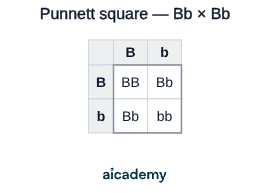
The four offspring genotypes are: BB, Bb, Bb, bb.
- Genotype ratio — 1 BB : 2 Bb : 1 bb
- Phenotype ratio — BB, Bb, Bb are all brown; bb is white, giving 3 brown : 1 white
This classic 3 : 1 phenotype ratio is the signature of crossing two heterozygotes.
Studying this for an exam?
Generate a personalised learning path for this subject. Free to get started.
A Second Cross: `Bb × bb`
When a heterozygous parent is crossed with a homozygous recessive parent, the ratio changes.
(Higher Tier only — constructing the cross is HT; the idea that
bbcan only pass on aballele follows from the rules above.)
Worked example — Bb × bb:
The Bb parent produces gametes B and b. The bb parent can only produce b gametes.
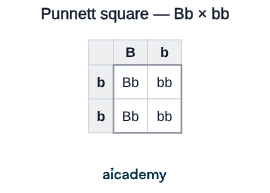
The four offspring genotypes are: Bb, bb, Bb, bb.
- Genotype ratio — 2 Bb : 2 bb, which simplifies to 1 Bb : 1 bb
- Phenotype ratio — Bb is brown, bb is white, giving 1 brown : 1 white
A
1 : 1phenotype ratio is the hallmark of crossing a heterozygote with a homozygous recessive. This kind of cross (called a test cross) can reveal a hidden allele.
Always check: each parent contributes exactly one allele to every offspring, and the genotypes in the grid must use only the alleles that parent actually carries.
Key terms
- Gamete
- A sex cell (sperm or egg) carrying one copy of each chromosome.
- Gene
- A short section of DNA that codes for a particular protein and so controls a feature.
- Allele
- A different version or form of the same gene.
- Dominant
- An allele that is expressed even when only one copy is present.
- Recessive
- An allele that is only expressed when two copies are present.
- Homozygous
- When both alleles for a gene are the same, such as BB or bb.
- Heterozygous
- When the two alleles for a gene are different, such as Bb.
- Genotype
- The combination of alleles an organism has, such as Bb.
- Phenotype
- The physical characteristic that results from the alleles, such as brown fur.
- Punnett square
- A grid that predicts the genotypes of offspring from two parents.
Frequently asked questions
The genotype is the combination of alleles an organism carries, such as Bb, while the phenotype is the physical characteristic those alleles produce, such as brown fur. A question asking for the genotype wants letters, not a description.
Both BB and Bb show the dominant phenotype because a single dominant allele is enough to mask the recessive one. The heterozygote Bb looks identical to the homozygous dominant BB.
A recessive phenotype such as white fur (bb) only appears when an organism inherits a recessive allele from both parents. A single recessive allele alongside a dominant one gives the dominant phenotype.
Generate revision on any topic you study
Type any topic you're studying and Aicademy generates a complete lesson, quiz, and flashcard set, personalised to your level.
Lessons on anything
Structured, level-matched lessons on any topic you study
Practice quizzes
Find out what you actually know before the exam does
Flashcard sets
Lock in key concepts with instant revision cards
Ask Aica
Stuck on something? Get a clear explanation, any time
DNA, the Genome and Protein Synthesis
Inherited Disorders and Sex Determination
Related lessons
12 min
9 min
11 min