Control of Blood Glucose and Diabetes

Aligned to the AQA 8461 specification
- Level
- Intermediate
- Reading time
- 10 min
- Published
- 16 June 2026
- Updated
- 16 August 2026
On this page
Key takeaways
- Blood glucose concentration is monitored and controlled by the pancreas, which releases hormones to push the level back to normal.
- When blood glucose is too high the pancreas releases insulin, which moves glucose from the blood into cells; in the liver and muscles excess glucose is converted to glycogen for storage.
- When blood glucose is too low the pancreas releases glucagon, which causes glycogen in the liver to be converted back into glucose and released into the blood (Higher Tier).
- Type 1 diabetes is caused by the pancreas producing little or no insulin and is treated with insulin injections.
- Type 2 diabetes is caused by body cells no longer responding to insulin, has obesity as a risk factor, and is treated with a carbohydrate-controlled diet and exercise.
Worked Example: After a Sugary Meal
Trace what happens, step by step, when you eat a meal rich in carbohydrate.
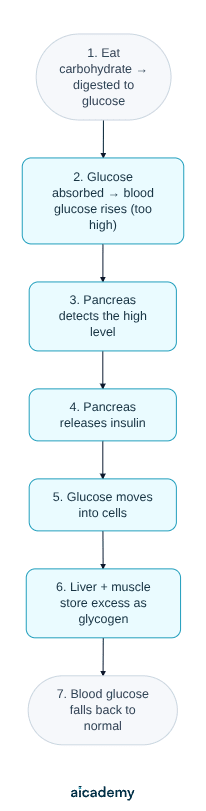
So the correcting hormone here is insulin, and the two things it does are: move glucose into cells, and store the excess as glycogen in the liver and muscles.
An exam question may give a graph of blood glucose over time after a meal. In a person without diabetes, the level rises after eating, then drops back to normal within a couple of hours as insulin acts. A sharp rise that stays high and does not come back down is a sign that insulin is missing or not working — the basis of diabetes, covered later in this lesson.
Studying this for an exam?
Generate a personalised learning path for this subject. Free to get started.
Worked Example: The Negative Feedback Loop (Higher Tier)
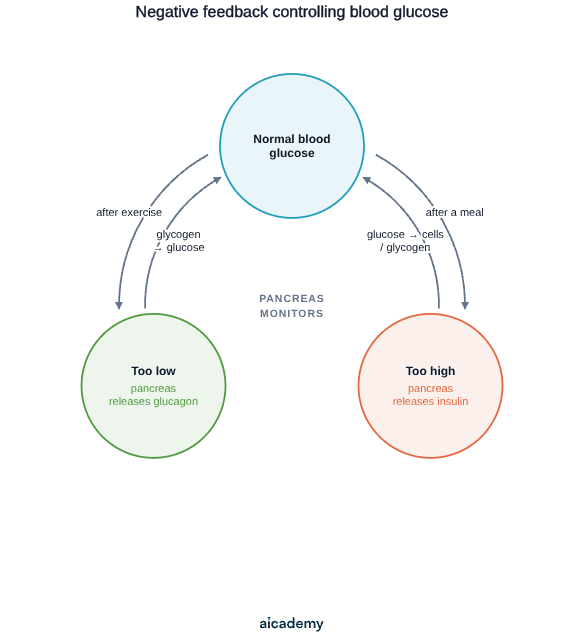
(Higher Tier only — this complete loop, showing how glucagon interacts with insulin, is a Higher Tier requirement.)
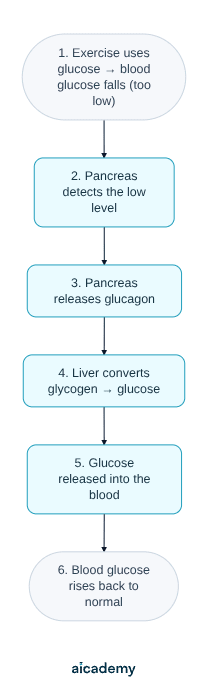
Insulin and glucagon work together in a negative feedback cycle: whenever the level moves away from normal, the body acts to reverse the change and bring it back. Trace the response to low blood glucose — for example, after exercise has used up glucose:
Step by step for the low-glucose case:
Because each hormone reverses the change that triggered it, the level is held steady around the norm. That is what "negative" means in negative feedback: the response opposes the original change.
Key terms
- Pancreas
- The organ that monitors and controls blood glucose concentration by releasing the hormones insulin and glucagon.
- Glucose
- A soluble sugar carried in the blood that cells use as fuel for respiration.
- Glycogen
- An insoluble storage molecule made from many glucose units, stored in the liver and muscles.
- Insulin
- A hormone released by the pancreas when blood glucose is too high; it moves glucose into cells and triggers storage as glycogen, lowering blood glucose.
- Glucagon
- A hormone released by the pancreas when blood glucose is too low; it converts glycogen back into glucose, raising blood glucose (Higher Tier).
- Negative feedback
- A control system in which a change away from normal triggers a response that reverses the change and brings the level back.
- Type 1 diabetes
- A condition in which the pancreas produces little or no insulin, treated with insulin injections.
- Type 2 diabetes
- A condition in which the body cells no longer respond to insulin; obesity is a risk factor and it is treated with a carbohydrate-controlled diet and exercise.
Frequently asked questions
When blood glucose is too high the pancreas releases insulin, which causes glucose to move out of the blood and into the body's cells. In the liver and muscles, excess glucose is then converted into glycogen for storage, so the level falls back to normal.
In Type 1 diabetes the pancreas produces little or no insulin, treated with insulin injections. In Type 2 diabetes the pancreas still makes insulin but the body cells no longer respond to it; obesity is a risk factor and it is usually managed with a carbohydrate-controlled diet and exercise.
Glucose is the soluble sugar carried in the blood and used by cells for respiration. Glycogen is the insoluble storage molecule made from many glucose units, kept in the liver and muscles.
Generate revision on any topic you study
Type any topic you're studying and Aicademy generates a complete lesson, quiz, and flashcard set, personalised to your level.
Lessons on anything
Structured, level-matched lessons on any topic you study
Practice quizzes
Find out what you actually know before the exam does
Flashcard sets
Lock in key concepts with instant revision cards
Ask Aica
Stuck on something? Get a clear explanation, any time
The Endocrine System and Negative Feedback
Hormones in Human Reproduction
Related lessons
11 min
11 min
9 min