Classification of Living Organisms

Aligned to the AQA 8461 specification
- Level
- Intermediate
- Reading time
- 10 min
- Published
- 16 June 2026
- Updated
- 16 August 2026
On this page
Key takeaways
- Classification is arranging living organisms into groups according to their structure and characteristics; the system used for centuries was developed by Carl Linnaeus in the 18th century.
- The Linnaean system arranges organisms into seven ranks from largest to smallest: kingdom, phylum, class, order, family, genus and species.
- The binomial system gives every species a two-part Latin name from its genus (capital letter) and species (lower case), written in italics, such as Homo sapiens.
- In 1990 Carl Woese used evidence from chemical analysis to propose the three-domain system: Archaea, Bacteria and Eukaryota; this was possible thanks to improved microscopes and understanding of biochemistry.
- An evolutionary tree shows how organisms are related; branches that join close together share a recent common ancestor, while a branch near the base split off earliest and is most distantly related.
Want more lessons like this one?
Generate lessons on anything you study. Free account, no card needed.
Evolutionary Trees
An evolutionary tree (or phylogenetic tree) is a diagram scientists use to show how they believe organisms are related through evolution. The closer two organisms branch on the tree, the more recently they shared a common ancestor, and the more closely related they are.
Scientists build these trees from two sources of evidence:
- Current classification data for living organisms — including structural and chemical comparisons.
- Fossil data for extinct organisms — fossils show what ancestors looked like and roughly when they lived.
A simple evolutionary tree sketch:
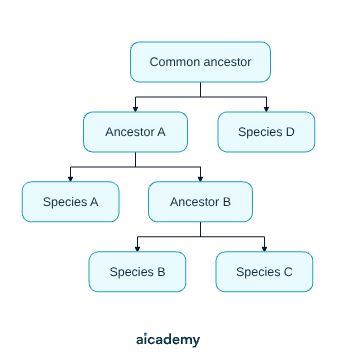
How to read it: species B and species C branch from the same point (ancestor B), so they share a recent common ancestor and are closely related. Species D branches off right at the bottom, so it split away earliest and is the most distantly related to the others. The points where lines split are the shared ancestors.
Branches that join close together = closely related (recent common ancestor). Branches that split near the base = distantly related (the split happened long ago).
Evolutionary trees are not fixed — when new fossil or chemical evidence is found, scientists may redraw them, just as the discovery of new evidence reshaped classification itself.
Key terms
- Classification
- Arranging living organisms into groups according to their structure and characteristics.
- Hierarchy
- A series of groups nested inside larger groups, used by the Linnaean system.
- Binomial system
- A two-part Latin naming system, from genus and species, giving every organism a unique scientific name worldwide.
- Genus
- The second-smallest Linnaean rank; the first part of a binomial name, written with a capital letter.
- Species
- The smallest Linnaean rank, containing organisms so similar they can breed together to produce fertile offspring.
- Three-domain system
- A classification proposed by Carl Woese in 1990 dividing all life into Archaea, Bacteria and Eukaryota.
- Archaea
- A domain of primitive bacteria that often live in extreme environments such as hot springs or very salty water.
- Evolutionary tree
- A diagram showing how organisms are believed to be related through evolution by their common ancestors.
- Common ancestor
- An ancestor shared by two organisms; the more recently it is shared, the more closely related they are.
Frequently asked questions
From largest to smallest the seven ranks are kingdom, phylum, class, order, family, genus and species. As you move down, the groups get smaller and the organisms inside share more characteristics. The mnemonic King Philip Came Over For Good Soup helps remember the order.
A binomial name has two parts from the genus and species. The genus comes first with a capital letter, the species comes second in lower case, and the whole name is in italics (or underlined when handwritten), for example Homo sapiens. Homo Sapiens and homo sapiens are wrong.
Carl Woese introduced the three-domain system in 1990 based on evidence from chemical analysis, comparing the molecules inside cells. This new evidence, from improved microscopes and biochemistry, showed that organisms once grouped as bacteria actually fell into two separate groups, Archaea and Bacteria.
Generate revision on any topic you study
Type any topic you're studying and Aicademy generates a complete lesson, quiz, and flashcard set, personalised to your level.
Lessons on anything
Structured, level-matched lessons on any topic you study
Practice quizzes
Find out what you actually know before the exam does
Flashcard sets
Lock in key concepts with instant revision cards
Ask Aica
Stuck on something? Get a clear explanation, any time
Antibiotic-Resistant Bacteria
Ecosystems and Interdependence
Related lessons
11 min
11 min