Deforestation and Global Warming

Aligned to the AQA 8461 specification
- Topic
- Ecology
- Level
- Intermediate
- Reading time
- 11 min
- Published
- 16 June 2026
- Updated
- 25 August 2026
On this page
- 1.Why Tropical Forests Are Being Cleared
- 2.How Deforestation Raises Atmospheric Carbon Dioxide
- 3.Worked Walk-Through: Explaining a CO₂ Rise
- 4.Deforestation and Biodiversity
- 5.Greenhouse Gases and Global Warming
- 6.Biological Consequences of Global Warming
- 7.Evaluating the Evidence for Human-Caused Warming
- 8.Common Exam Mistakes
Key takeaways
- Deforestation is the large-scale removal of trees, happening on a huge scale in tropical areas to provide land for agriculture (cattle and rice) and to grow crops for biofuels.
- Deforestation raises atmospheric carbon dioxide in two ways at once: it increases release (burning trees and decomposers respiring) and reduces removal (fewer trees photosynthesising).
- Deforestation destroys habitats so species lose food and shelter, reducing biodiversity, which is the variety of species rather than just the number of organisms.
- The greenhouse gases named by the spec, carbon dioxide and methane, are increasing; they absorb and trap heat radiated from Earth, raising the average global temperature, which is global warming.
- Biological consequences of global warming include loss of habitat from rising sea levels, changes in species distribution, and changes in migration patterns.
Studying this for an exam?
Generate a personalised learning path for this subject. Free to get started.
Greenhouse Gases and Global Warming
Carbon dioxide is one of several greenhouse gases. For AQA Biology the two you must name are carbon dioxide (CO₂) and methane (CH₄), and the specification states that their levels in the atmosphere are increasing.
Methane is added to the atmosphere by, for example, cattle (livestock farming) and decay in waterlogged conditions such as rice fields — the same agricultural changes that drive deforestation also raise methane.
How the greenhouse effect works:
- The Sun's energy reaches the Earth and warms the surface.
- The warmed Earth radiates energy back out as heat.
- Greenhouse gases in the atmosphere absorb and trap some of this heat instead of letting it escape into space.
- More greenhouse gas means more heat trapped, so the average global temperature rises. This rise is global warming.
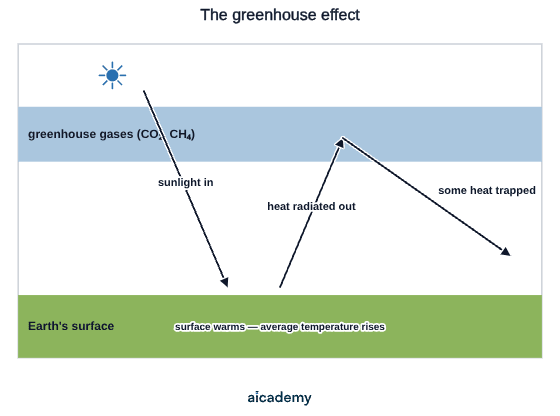
Don't confuse two things: the greenhouse effect is the natural trapping of heat that keeps Earth warm enough for life. Global warming is the extra warming caused by rising levels of greenhouse gases.
(Extra context — not required by AQA 8461.) Atmospheric CO₂ passed about 420 parts per million by the mid-2020s, up from roughly 280 ppm before industrialisation. You do not need figures for the exam; the spec only requires that you know the levels are increasing.
Key terms
- Deforestation
- The large-scale removal of trees, usually to use the land for agriculture or biofuel crops.
- Biofuel
- A fuel made from recently grown plant or animal material, rather than from fossil fuels.
- Biodiversity
- The variety of all the different species of organisms in an ecosystem, not just the number of organisms.
- Greenhouse gas
- A gas, such as carbon dioxide or methane, that absorbs and traps heat radiated from Earth's surface.
- Greenhouse effect
- The natural trapping of heat by greenhouse gases that keeps Earth warm enough for life.
- Global warming
- The extra warming of Earth's average temperature caused by rising levels of greenhouse gases.
- Peer review
- The process by which other independent scientists check a study's methods and conclusions before it is published, filtering out flawed work.
Frequently asked questions
It works in two ways. Burning felled trees releases carbon dioxide, and decomposers respiring on dead plant material release more. At the same time, fewer trees means less photosynthesis, so less carbon dioxide is removed from the air. Overall, atmospheric carbon dioxide rises.
The greenhouse effect is the natural trapping of heat by greenhouse gases that keeps Earth warm enough for life. Global warming is the extra warming caused by rising levels of greenhouse gases such as carbon dioxide and methane.
They include loss of habitat, for example when melting ice raises sea levels and floods low-lying land, changes in the distribution of species as temperature or rainfall changes, and changes in the timing or routes of animal migration patterns.
Generate revision on any topic you study
Type any topic you're studying and Aicademy generates a complete lesson, quiz, and flashcard set, personalised to your level.
Lessons on anything
Structured, level-matched lessons on any topic you study
Practice quizzes
Find out what you actually know before the exam does
Flashcard sets
Lock in key concepts with instant revision cards
Ask Aica
Stuck on something? Get a clear explanation, any time
Biodiversity and Human Impact on Ecosystems
Atoms, Elements and Compounds
Related lessons
12 min
9 min